Proper mirror adjustment is not just about comfort — it is the foundation of your safety. Correct viewing angles minimize «blind spots», allowing the driver to monitor what’s happening around the car without unnecessary head movement. To make your vehicle even more functional and convenient, we recommend using tuning accessories, a huge selection of which you can find in our assortment.
Set up your seating position
First, sit as comfortably as possible: adjust the seat, steering wheel, and backrest angle. Your back should be firmly against the backrest, hands on the wheel and slightly bent, and your legs should reach the pedals freely. Only then move on to the mirrors.
Adjusting the side mirrors
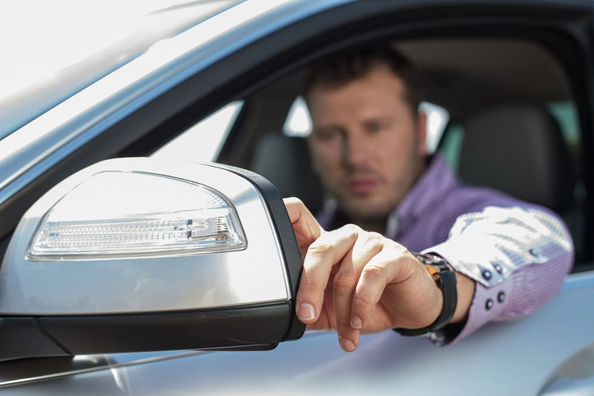
- Left mirror: Sit in the driver’s seat in your usual driving position. Lean your head to the left, almost touching the window. In this position, adjust the mirror so you see only a small edge (rear fender) of your car. When you return your head to the normal position, the car body should almost disappear from view. This widens the visibility of the adjacent lane.
- Right mirror: Lean your head toward the center of the cabin (roughly above the center console). Adjust the mirror until you can see the edge of the right rear fender. Back in a normal posture, you’ll see a small edge of the bumper and a wide panorama of the space to the right — which is critical when changing lanes. The horizon should be roughly in the middle of the mirror.
Adjusting the interior rear-view mirror
This mirror should become a «frame» for the rear window:
- The center of the mirror should align with the center of the rear window.
- You should not see your ears or the passengers’ headrests more than necessary.
- The horizon should run roughly through the middle of the mirror.
Additional tips
- Check the settings after every seat adjustment.
- In rain or fog — keep the mirrors clean.
- If the car has 360° cameras — mirrors are still important for quick checks.
- In the side mirror, the car body should take up a minimal part of the field of view — the road should take up the main space..
Remember that no adjustment eliminates «blind spots» completely. Before any maneuver, always take a quick look over your shoulder.
Properly adjusted mirrors significantly increase safety during lane changes and overtaking.