 Author: Radomskyi Maksym Vasyliovych
Trunk clutter doesn’t start with “extra stuff” — it starts when car chemicals, a tow strap, tools, and an emergency kit all sit in one space with no separation or securing. The result isn’t just noise: canisters leak, wrenches bang against trim, and during hard braking even a small item becomes dangerous.
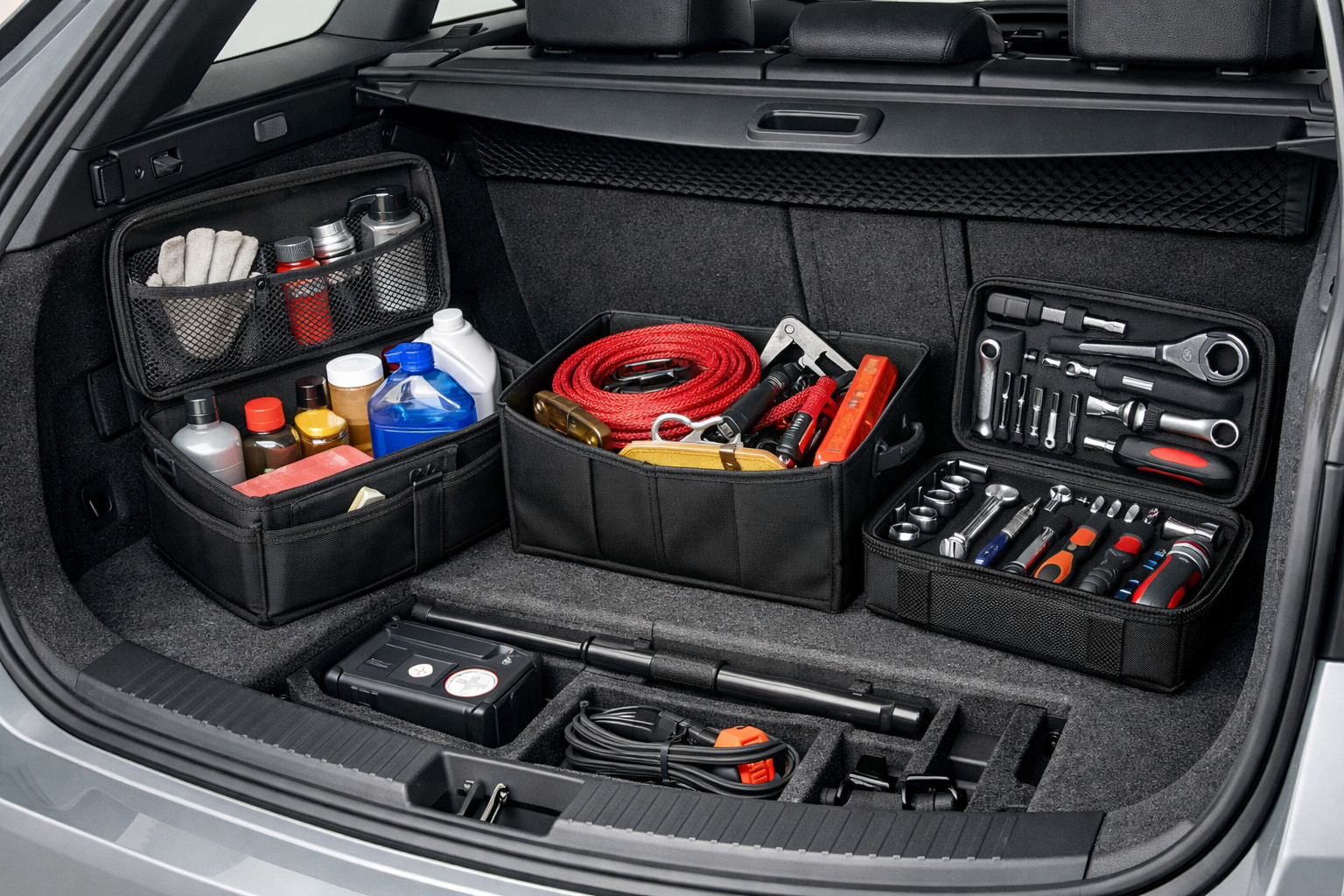
What works isn’t one big container, but a simple system: chemicals — separately, in sealed containers and preferably inside an additional box; tools and straps — in a rigid or semi-rigid organizer with dividers; bulky items — on factory tie-down points or under a cargo net. This is especially important for hatchbacks, wagons, and crossovers, where the cargo area is less separated from the cabin.
Why this problem happens
The problem appears when the trunk starts being used as a permanent storage space for everything at once: washer fluid, polish, lubricant, a pump, a wrench set, gloves, a strap. These items differ in weight, shape, and storage requirements, so they can’t safely sit in one bag or roll freely across the floor. For chemicals, it’s worth looking right away at car organizer bags and separate containers, and the overall placement logic can be built with trunk organization.
The second reason is driving dynamics. In a turn, over bumps, or during braking, cargo shifts — and at speeds around 48 km/h even an item weighing about 0.45 kg can already cause serious damage. If there’s no rigid partition between the cabin and the trunk, the risk is even higher.
Main causes
- Everything is packed into one shared space with no separation between chemicals, tools, and emergency items.
- No securing: factory tie-down points aren’t used, and nets or straps are missing or poorly chosen.
- Car chemicals are carried in soft bags, random bottles, or without an additional tray, which leads to leaks and odor.
- The organizer is too soft or too large, so it slides around the trunk and eats up usable space.
- Items that should be within reach are buried under seasonal clutter, and the trunk contents aren’t reviewed for months.
How to understand what’s causing it in your case
- After a normal drive, open the trunk and see what has shifted. If only the canisters tipped over, the problem is the container and tray. If everything moves, you’re missing basic securing.
- Press on the organizer or box with your hand. If it slides easily on the floor, the issue isn’t the amount of stuff — it’s how it’s installed.
- Check lids, the underfloor compartment, and the mat for odor, damp spots, and sticky residue. This is how hidden leaks from car chemicals are usually found.
- Try to grab the strap, gloves, or first-aid kit within 10 seconds without unloading the trunk. If it’s impossible, your access logic is broken — not just “too much stuff.”
- Also assess the body type and the presence of tie-down points. In a sedan, one rigid module is often enough; in a hatchback or wagon, a lower box, cover, or net is more often needed.
DD Tuning expert comment: the most common mistake is putting car chemicals, metal tools, and a tow strap into one large soft organizer. From the outside it looks neat, but inside items hit each other, and canisters get crushed. Before buying, measure the trunk width between the wheel arches and separate chemicals and heavy tools into two different modules right away.
Symptoms, causes, and what to do (table)
| Symptom | Likely cause | What to do |
|---|---|---|
| Rattling over potholes and in turns | Metal tools and small accessories are stored without dividers | Move them to a rigid or semi-rigid organizer with separate sections |
| Chemical smell in the trunk | Leaky container or improper packing of liquids | Keep only sealed compatible containers, store upright in a separate box or tray |
| The strap and gloves can’t be found quickly | Emergency items are buried under everyday cargo | Assign a separate, accessible section closer to the trunk edge |
| Items slide across the floor | Slippery base and no securing | Add a box or organizer with fastening; use the mat as protection, not as the only securing method |
| After braking, the canister is lying on its side | Soft bag or lack of secondary containment | Put chemicals in a separate plastic box, transport upright, and don’t mix with tools |
| There’s always not enough space in the trunk | Oversized organizer and seasonal items you no longer need | Do an audit at least once every two weeks and keep only what you actually use |
What really helps
- Divide the trunk into three groups: car chemicals, heavy tools and straps, plus a separate quick-access emergency kit.
- Store chemicals in original or compatible sealed containers, labeled, upright, and in an extra box or tray. Don’t combine incompatible liquids into one container or one bag.
- A rigid or semi-rigid organizer with dividers for wrenches, compressor, strap, gloves, and small tools. This prevents items from hitting each other and scattering around the trunk.
- Secure bulky items on factory tie-down points or under a cargo net. This is especially important where the cargo area is open to the cabin.
- A dedicated spot for what you may need immediately: first-aid kit, flashlight, cables, tow strap. Don’t hide them under suitcases, groceries, or seasonal gear.
- A quick trunk check every 14 days. It removes half the mess without buying anything.
What almost doesn’t work or only helps briefly
- One big soft organizer for everything at once. It looks tidy at first, but quickly turns into the same pile — just wrapped in fabric.
- Grocery bags, fabric totes without a rigid bottom, and random boxes. They don’t hold shape and don’t secure the contents.
- Rubber bands or elastic straps as the only securing method for heavy tools or chemicals. It’s not enough for these items.
- Pouring car chemicals into unlabeled bottles. This increases the risk of spills, confusion, and unwanted reactions.
- Trying to dampen rattles with rags or an old blanket without proper separation. The noise may decrease, but the cause remains.
When accessories or replacing elements makes sense
- Trunk organizer bags make sense when you need to separate straps, gloves, a compressor, wrenches, and a small emergency kit without constant reshuffling.
- Rubber trunk mats are useful if the main issue is dirt, water, and traces from leaks; they protect the trim but don’t replace cargo securing.
- Trunk organization is worth considering if you haven’t decided what you actually need: a box, a net, an organizer, or a combination of solutions.
Replacing elements is justified when the factory mat is slippery, the trim has already absorbed chemicals, and old compartments or mounts can’t hold the load. But if the only problem is that items aren’t sorted, buying expensive accessories without first auditing the contents delivers a weak result.
Solution: when it works and when it’s not worth spending money (table)
| Solution | When it works | When it’s not worth spending money |
|---|---|---|
| Semi-rigid organizer with dividers | For tools, a strap, gloves, a compressor, and small accessories with a stable set of items | If you often carry large boxes or want to store canisters with chemicals there too |
| Separate sealed box for car chemicals | When you carry washer fluid, cleaners, or lubricants in proper containers and want to eliminate leaks | If you pour liquids into random bottles or mix incompatible products |
| Cargo net or fastening to factory tie-down points | For large but relatively light items that need to be kept in place | If the car has no proper tie-down points or if it’s heavy metal tools |
| Rubber mat or tray | When you need to protect the trim from water, dirt, and small spills | If you expect the mat alone to hold a box or canister during braking |
| Large universal organizer for the entire trunk | In a large trunk with a consistent set of items and without frequent transport of bulky cargo | In a small trunk, or if the contents change often and you need free space |
From a customer’s experience: a person was looking for one big solution for a wagon’s trunk because they constantly carried washer fluid, a tow strap, a pump, and a wrench set. In the end, it wasn’t a “big box” that worked, but a combination of a separate box for chemicals and a semi-rigid organizer for tools, while the emergency items were moved closer to the trunk edge. After that, the rattling, smell, and the need to unload half the stuff just to reach one strap disappeared.
Conclusion
Trunk clutter almost always has a simple cause: items with different weight and purpose are stored as one pile. What works isn’t a “magic accessory,” but a basic layout — chemicals separately, tools separately, a quick-access emergency kit separately, plus securing bulky items.
If you start with an inventory check, remove seasonal clutter, and choose one or two correct modules instead of random bags, the trunk becomes quieter, safer, and genuinely convenient for everyday use.
How it works
- Sort the trunk contents Set aside car chemicals, tools, the tow rope, and the emergency kit separately. Do not mix everything into one bag or loose space without separation.
- Prepare separate containers for chemicals Keep car chemicals only in a sealed container, preferably in an additional box or tray. Place cans upright and do not combine them with metal tools.
- Use a rigid organizer for tools Put wrenches, the compressor, rope, gloves, and small accessories into a rigid or semi-rigid organizer with compartments. This reduces rattling and keeps items from flying around while driving.
- Secure large items Fasten large items to factory tie-down points or under a net if they are light. The mat protects the trim, but it does not replace proper cargo securing.
- Keep emergency items within easy reach Place the first aid kit, flashlight, cables, and rope closer to the edge of the trunk. That way, you can reach what you need in a few seconds without unloading the entire trunk.
- Do a quick inspection every 2 weeks Check what has shifted, what is leaking, and what you actually use. Remove seasonal clutter and leave only what you need all the time.
Pros and cons
Separate storage for car chemicals, tools, and a tow strap reduces clutter and eliminates the risk of items knocking against each other while driving.
A sealed container for car chemicals and an additional box or tray help prevent leaks, odors, and damage to the trunk trim.
A rigid or semi-rigid organizer with dividers is convenient for keys, a compressor, gloves, and small tools, since items do not spill around the trunk.
Securing large items to the factory tie-down points or under a cargo net increases safety, especially in hatchbacks, wagons, and crossovers, where the trunk is open to the cabin.
A quick trunk check every two weeks helps clear out unnecessary items and keep things tidy without extra purchases.
A single large soft organizer for everything often does not solve the problem: items inside still shift, and canisters can get crushed.
Bags, fabric totes without a rigid base, and random boxes hold their shape poorly, so they do not secure the contents and quickly turn into chaos.
Rubber bands or elastic straps on their own are not suitable for heavy tools or car chemicals, because they do not provide reliable fixation.
Pouring car chemicals into unlabeled bottles creates an additional risk of spills, confusion, and unwanted reactions between products.