
28.04.2026
365
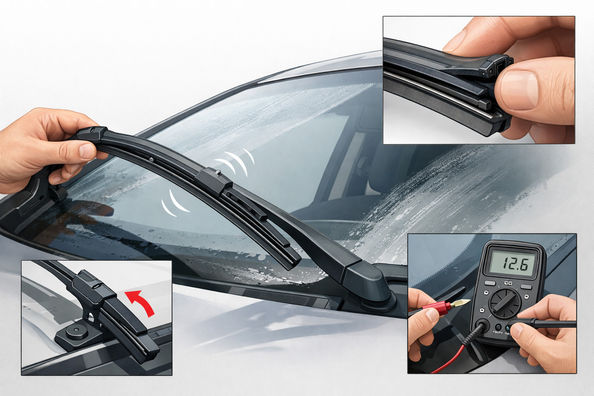
Wiper blade squeak doesn’t always mean the set is already “dead.” In most cases the problem starts earlier: a greasy road film builds up on the glass, wax residue remains after a wash, a rain repellent changes friction, the blade runs on almost dry glass, or the wiper arm applies uneven pressure.
So before replacing anything, the logic is simple: first rule out the glass, the washer fluid, installation, and pressure—only then spend money on new parts. If after cleaning and checking the blade still squeaks, chatters, or leaves streaks, then the cause is either the rubber itself or the wiper arm.
Squeaking appears when the blade edge doesn’t glide smoothly over the glass, but instead grabs, skips, or flips incorrectly during the sweep. For the driver it sounds like a squeal, creak, or short vibration, and on the windshield you’ll see streaks, missed areas, or water the blade pushes back.
Several things affect this at once: the condition of the glass, the condition of the rubber, whether there’s enough washer fluid, the arm angle, and the clamping force. In heat the rubber hardens faster; in winter it gets finished off by ice, salt, and dirt; and at speed a weak or misadjusted arm loses even contact even more noticeably.
DD Tuning expert comment: the most common mistake is replacing wipers right after the first squeak without washing the glass itself. The second typical story is installing a new set but not checking the adapter and arm play, so the new blade repeats the old problem. If the noise disappears on well-wetted glass, you should start not with a purchase, but with diagnosing friction and pressure.
| Symptom | Likely cause | What to do |
|---|---|---|
| Squeak appears only at the start of the sweep | Glass is slightly dry or there’s a greasy film | Fully clean the windshield and test only with enough fluid |
| Blade chatters and hops in one direction | Wrong arm angle or the blade doesn’t flip properly | Check arm geometry, adapter seating, and contact uniformity |
| Streaks remain even after washing the glass | Rubber edge is worn or hardened | Inspect the blade edge; if there are cracks and loss of elasticity, replace the set |
| Noise appeared after a car wash | Wax or other water-repellent coating on the glass | Remove the film by cleaning and don’t test wipers on waxed glass |
| New blade squeaks right after installation | Installation error or incomplete locking | Reinstall the blade, check the adapter, and make sure there’s no play |
| One area of the glass cleans worse than the others | Weak arm pressure or incorrect blade length | Check the arm, spring, and the correctly selected size |
The first thing that most often works is not replacement, but deep cleaning the windshield until it wets evenly with no obvious water-repellent zones. If after washing the water still beads up, the glass is still too dirty for a proper wiper check.
Second is testing only with normal washer fluid delivery. Many “squeaky” blades stop making noise when you don’t force them to run on dry dust. If the nozzles are clogged, the fluid level is low, or the fluid isn’t right for the season, the diagnosis will be misleading.
Third is checking the mounting and the arm. If the blade is new or relatively fresh but noisy, it’s important to inspect the adapter, pressure, and play. If the instructions for the specific blade type don’t forbid it, you can carefully clean the edge from dirt—but without aggressive chemicals and heavy rubbing.
And only after that does replacement make sense: when the rubber is cracked, has lost elasticity, there are persistent streaks, or the edge is deformed. In that condition, cleaning won’t restore normal operation.
If the edge is hardened, has cracks, or the blade consistently leaves streaks after cleaning the glass, then it’s logical to look at new wiper blades. If the noise appears due to weak wetting, first it’s worth sorting out a proper washer fluid, because plain water or a random mix quickly leads to semi-dry running.
Rain repellent only makes sense on clean glass and only when your wipers work normally with such a coating. If squeaking and chattering appeared specifically after a water-repellent layer, spending money on yet another product isn’t worth it—first you need to remove the film. A separate story is the arm: when new wipers don’t solve the problem on one side, it’s better to invest in checking or replacing the arm rather than buying yet another set of rubber.
| Solution | When it works | When it’s not worth spending money |
|---|---|---|
| Deep cleaning of the windshield | When there’s film, wax, sticky residue, water beads on the glass | When the rubber is already cracked, hard, or deformed |
| Proper washer fluid | When the noise appears on slightly dry glass or with weak wetting | When the blade streaks even on well-wet glass |
| Reinstalling the blade | When the problem started right after installing a new set | When the old blade is long worn and has obvious edge defects |
| Replacing the wiper set | When there are cracks, hardening, loss of elasticity, persistent streaks | When the cause is weak arm pressure or incorrect angle |
| Checking or replacing the arm | When the blade hops in one direction, there’s play, or contact is uneven along the length | When the noise shows up the same on both blades due to dirty glass |
| Rain repellent | When the glass is clean, the wipers are compatible with the coating, and you need better water shedding at speed | When the current coating already triggers squeak or the glass hasn’t been cleaned of film |
From a customer’s experience: the typical scenario is this—someone comes in for new wipers because the old ones “suddenly started creaking” after a wash. After checking, it turns out there’s a wax film on the glass and the wipers are running almost dry, while the rubber itself is still fine. After cleaning the glass the noise disappears, and replacement is only needed when the edge has already hardened or the streaks won’t go away even on wet glass.
Wiper squeak is not only a wiper problem, but an issue with the whole “glass, fluid, mounting, arm, rubber” chain. Before replacing, it’s worth checking in order: glass cleanliness, operation on a well-wetted surface, the edge condition, adapter seating, and arm pressure. If after that noise, chattering, and streaks remain, then replacement is truly justified.
The material is based on real selection experience, diagnostic practice, and real usage scenarios where the problem is often solved not by random buying, but by correctly identifying the cause.
Shipping to EU
Wholesale and retail
Own warehouse
Опис продукту
Подарунки не надаються при оформленні покупки у кредит під 0,01% або при покупці частинами.