24.05.2026
568
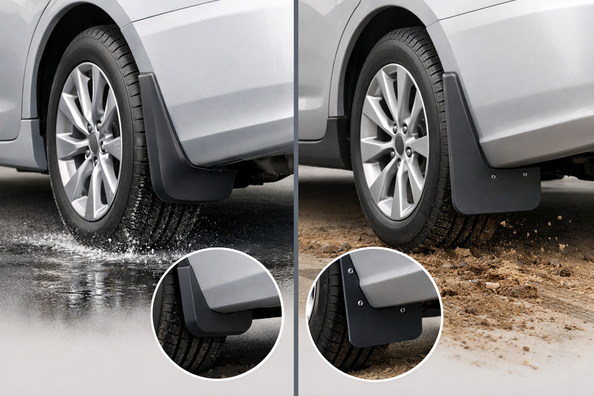
Overpaying for OEM mud flaps doesn’t always make sense. The money is justified when you need an exact fit for a specific trim level, minimal trimming, predictable installation, and a separate accessory warranty. But if your car doesn’t have complex body add-ons and you’re willing to make a template, check clearances, and adjust the mounting points, a universal kit often provides the same basic dirt protection for less.
The issue is that “OEM” doesn’t automatically mean easy installation, and “universal” doesn’t always mean a bad fit. On some cars, the factory kit also requires new holes and precise positioning, while among non-OEM options there are vehicle-specific solutions that install without drilling. That’s why paying extra only makes sense after checking arch geometry, ground clearance, the mounting method, and the condition of the wheel liner.
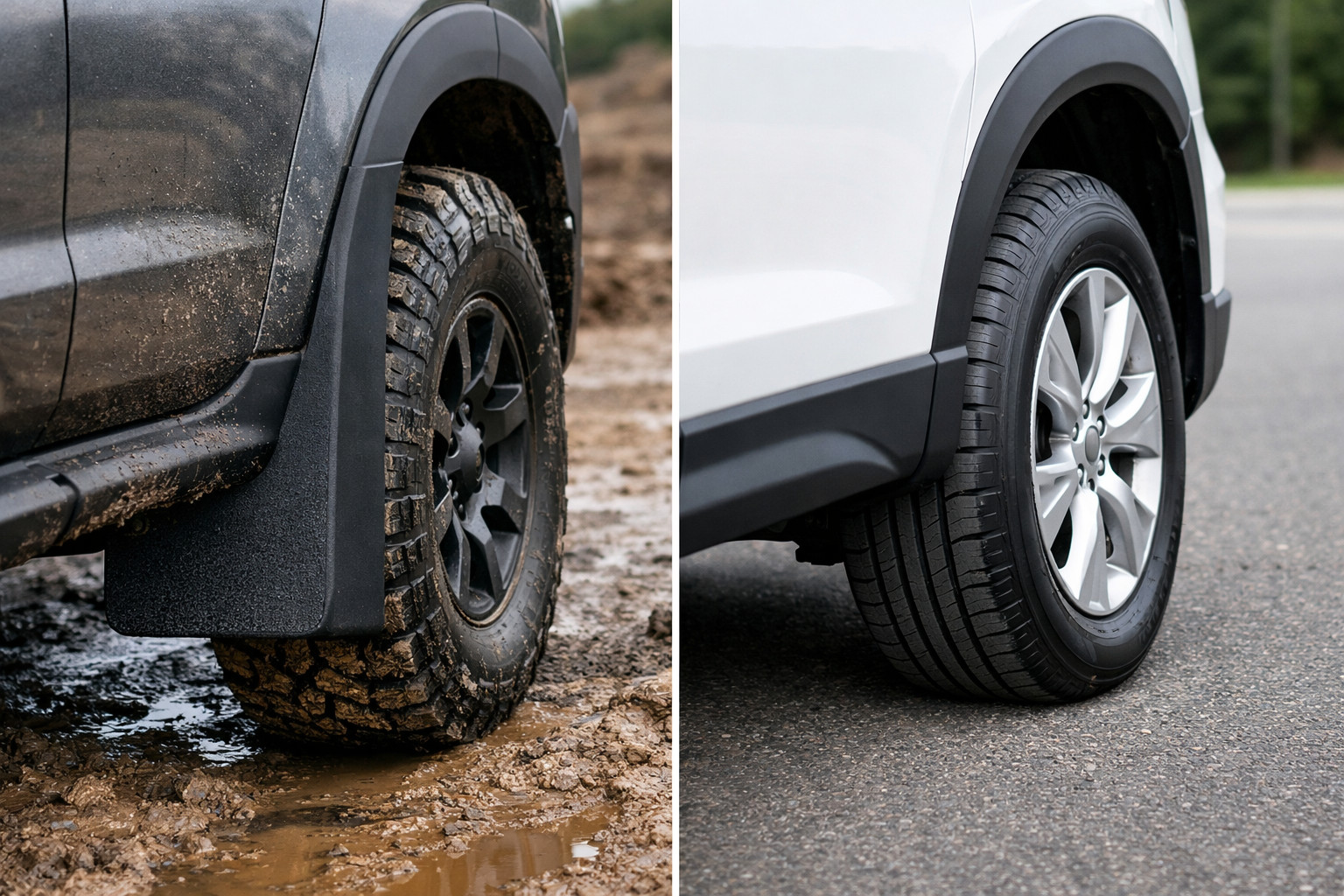
A mud flap works in a very tight area: next to the tire, the fender edge, the wheel liner, the rocker panel, and the lower bumper. A difference of just a few millimeters can create a gap, a misalignment, paint rubbing, or contact at full steering lock. That’s why the same body can require different parts across different trims.
The second reason is different expectations from the accessory. Some only need protection from sand and wet grime, others care about a clean look without “shovels” behind the wheel, and others want quick installation without lengthy fitting. Because of this, people often compare unequal solutions: a factory kit, a truly universal set, and a vehicle-specific non-OEM mud flap for one particular car.
If, already at the test-fit stage, you see a gap, misalignment, and a need to move holes significantly, paying extra for a more precise kit is usually cheaper than reworking things after a failed install.
DD Tuning expert comment: The most common mistake is buying a kit only “for this body” without checking the arch shape, wheel liner, and whether there are lower moldings. The second typical story is pulling a universal mud flap onto an unfortunate mounting point just so it holds. From the outside it looks acceptable, but after a few weeks you get play, paint rubbing, or contact with the wheel.
| Symptom | Likely cause | What to do |
|---|---|---|
| Gap along the arch or misalignment | Wrong part number, different trim level, incorrect geometry | Verify compatibility by trim, don’t force the part into place, look for a more precise option |
| You have to heavily trim the edge and relocate holes | A truly universal kit is far from the shape of your arch | Make a template first; if there are too many corrections, switch to a vehicle-specific kit |
| Rubbing on the tire at full steering lock | Poor positioning, wider wheels, too little clearance | Reposition, shorten the edge; if there’s no margin, отказаться from this kit |
| The mud flap flaps at speed | Weak clips, too few mounting points, soft wheel liner | Restore factory mounting, use stiffer attachment points or a different kit |
| Marks on paint or plastic | Unprotected contact point, misalignment, excessive tension | Correct the geometry, add protection at the contact point, don’t leave the mud flap under tension |
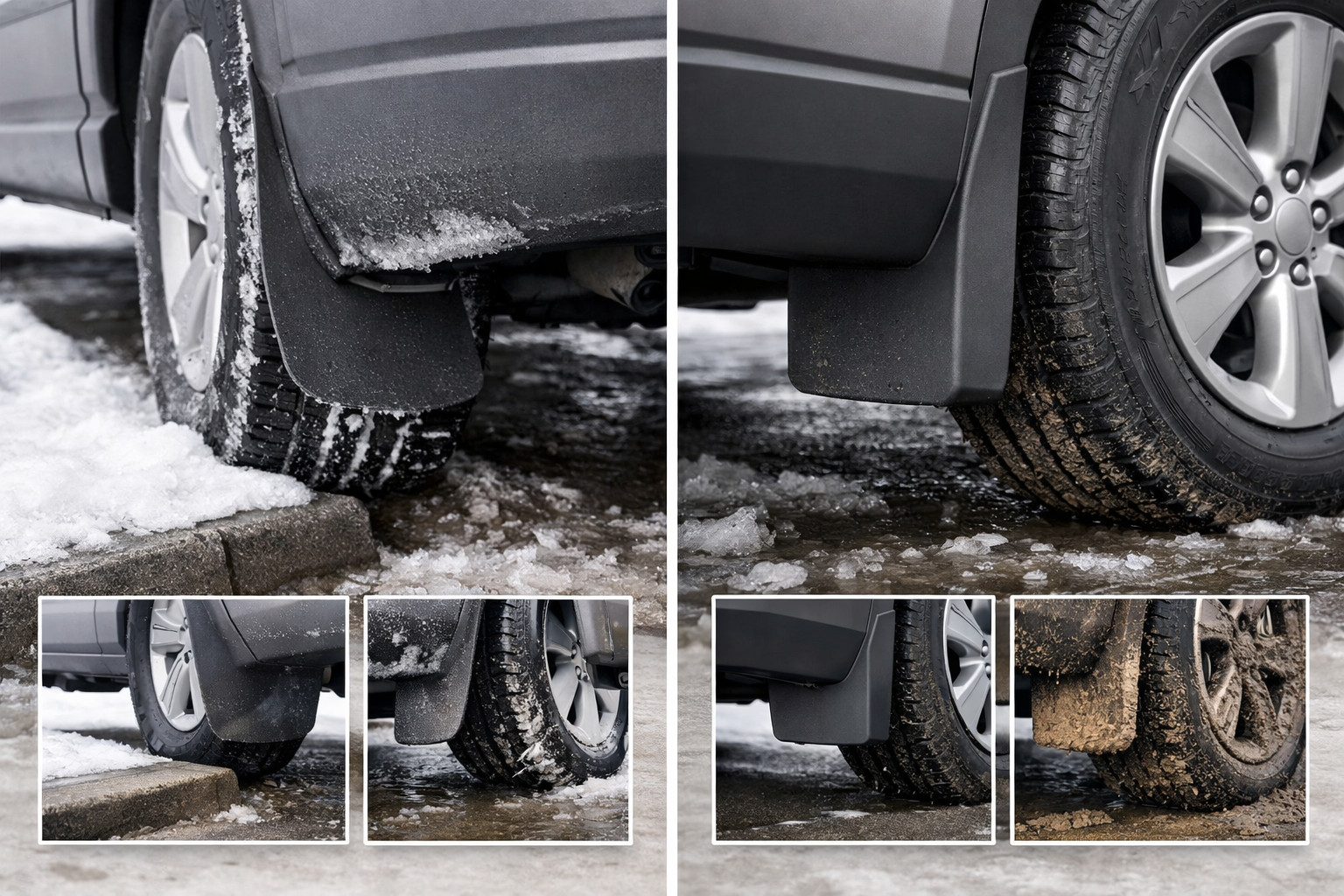
| Catches curbs, ice, or the car wash | Hangs too low, the car has low ground clearance | Choose a shorter option or raise the lower line during installation |
What works isn’t “the most expensive,” but what matches the vehicle’s design and your driving scenario. If the car is new, you want a neat look, and you don’t plan to experiment with mounting, an OEM kit justifies the price. Another plus is that some brands offer a separate warranty for OEM accessories from one to three years, or it’s tied to the vehicle’s base warranty.
It makes sense to pay for OEM mud flaps if the car is new, precise fitment for your trim is important, and you want a clear warranty. It’s also a logical choice when you don’t want to trim edges, hunt for different clips, and redo the install after the first test fit.
If your priority is a lower price and the arch has no complex body add-ons, it’s worth looking at universal mud flaps. They’re justified when you’re ready to make a template, check full steering lock, and treat minor fitting as normal.
When the issue isn’t only dirt but also damaged plastic in the arch area, a new mud flap kit won’t fit properly. In that situation, first check the wheel liners, clips, and mounting edges, and only then decide whether paying extra for a more precise kit makes sense.
| Solution | When it works | When it’s not worth spending money |
|---|---|---|
| OEM kit | New car, correct trim, warranty matters, you need a clean look and minimal fitting | If the car has non-standard wheels, modified body add-ons, and the factory kit still requires complex installation and costs too much |
| Vehicle-specific non-OEM kit for a particular car | You need quick installation without extra modifications, but don’t want to pay OEM prices | If the seller doesn’t confirm trim-level compatibility or there are doubts about mounting points |
| Universal kit | Simple arches, stock wheels, time for a template, trimming, and calm test fitting | Low ground clearance, harsh winter, wide tires, lack of experience, or no desire to modify anything |
| Replace the wheel liner and fasteners first | Old plastic is cracked, holes are worn out, clips don’t hold | If the factory parts are intact and the issue is only poor mud flap geometry |
From a customer’s experience: at first, they looked for the cheapest universal kit for a crossover with lower door moldings. After test fitting, it became clear the rear mud flap sat crooked and hung too low, so it would require a lot of trimming. In the end, they chose a vehicle-specific kit for the trim level and separately replaced a few wheel-liner clips — installation took less time, and paint rubbing never appeared.
Overpaying for OEM mud flaps is worth it when precise fitment, lower installation risk, warranty, and a restrained look without DIY fitting are critical. If the car’s geometry is simple, the budget is limited, and you’re ready to spend time on a template and checking clearances, a universal option can do the same job without extra cost.
The key is not to buy blindly: check the trim level, wheel liner condition, ground clearance, and the actual mounting points. This conclusion is based on real selection experience, installation practice, and real usage scenarios—not the myth that more expensive always means better in every case.
| ✔ | Original mud flaps provide a more precise fit for a specific trim, so there is less chance of misalignment, gaps, or rubbing against the body. This is especially important if the car has trim pieces, a different bumper, or non-standard wheels. |
| ✔ | An original set usually requires less manual fitting: there is no need to spend time trimming the edge, moving the holes, or choosing spacers. This saves time and reduces the risk of mistakes during installation. |
| ✔ | For new cars, the original is usually the more predictable option, as compatibility is clear and, in some cases, there is a separate warranty for the accessory. It is convenient when you do not want to experiment with the mounting. |
| ✔ | Model-specific aftermarket kits for a particular car can be a good compromise between price and fit. They are suitable if you need quick installation without major modifications, but without overpaying for the brand. |
| ✔ | A universal kit makes sense on simple arches and with factory wheels, when you are ready for templating and test fitting. In that case, it can provide the same basic protection from dirt for less. |
| ✘ | Universal mud flaps often require trimming, new holes, or different mounting, so installation may take longer than expected. If you do not want to deal with fitting, this is an inconvenient option. |
| ✘ | A poor fit can lead to rubbing on the paint, misalignment, or the tire catching at full steering lock. This is especially risky if wider wheels are fitted or the wheel offset has been changed. |
| ✘ | A mud flap mounted too low quickly starts catching curbs, snow, ice, and even car washes. On cars with low ground clearance, this is a practical problem, not a minor detail. |
| ✘ | Cheap rigid plastic in winter conditions is more likely to crack or deform after impacts. In other words, saving on the set may result in having to replace it sooner. |
Shipping to EU
Wholesale and retail
Own warehouse
Опис продукту
Подарунки не надаються при оформленні покупки у кредит під 0,01% або при покупці частинами.