 Author: Radomskyi Maksym Vasyliovych
A roof box starts to annoy you not because you bought it, but because of three miscalculations: it whistles at speed, it doesn’t fit into parking garages, and it prevents the tailgate from opening. In almost every case, the reason isn’t the box itself, but the combination of “car + crossbars + shell shape + position on the roof”.
To avoid suffering every day, you shouldn’t look only at the volume in liters. More important are other things: the crossbar profile, the real overall vehicle height after installation, and the clearance to the tailgate when fully opened. If you check these three points before buying, most problems are eliminated right away.
Why this problem happens
Most often, a box is chosen by the principle “to fit more” or “to be long for skis”. But in real use, capacity won’t save you if a whistle appears already at 80–100 km/h, the car no longer clears an underground parking entrance, and the rear hatch hits the bottom of the box.
The problem is also that the same box behaves differently on different cars. On one roof it’s quiet, on another it’s noisy; on one wagon the tailgate opens fine, on another hatchback it lacks a few centimeters. That’s why you shouldn’t rely on a review of “good or bad”, but on compatibility with your specific roof geometry.
Main causes
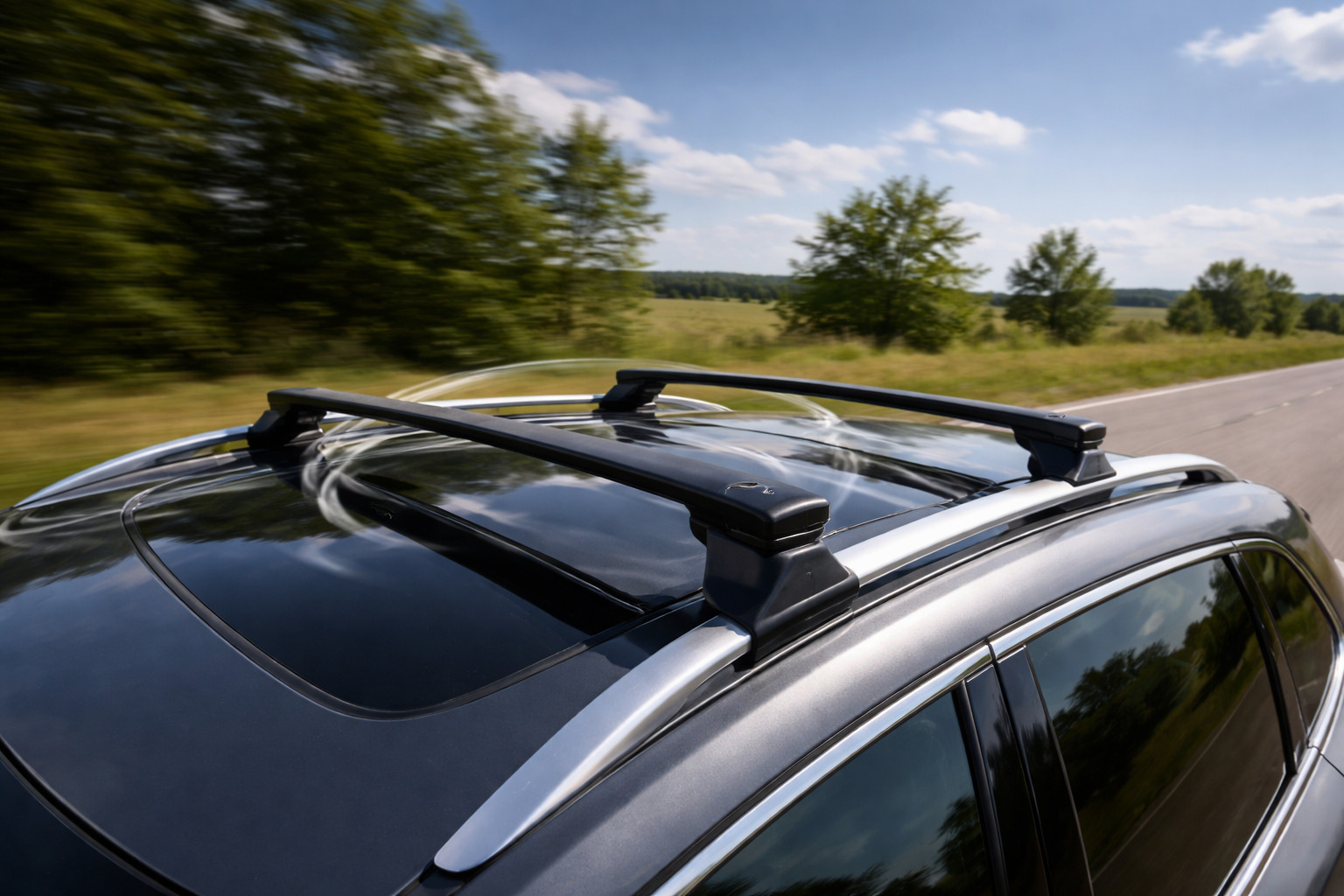
- Unsuccessful crossbar profile. If the crossbars themselves are noisy, the box only amplifies the problem. An aerodynamic profile is usually quieter than simpler shapes.
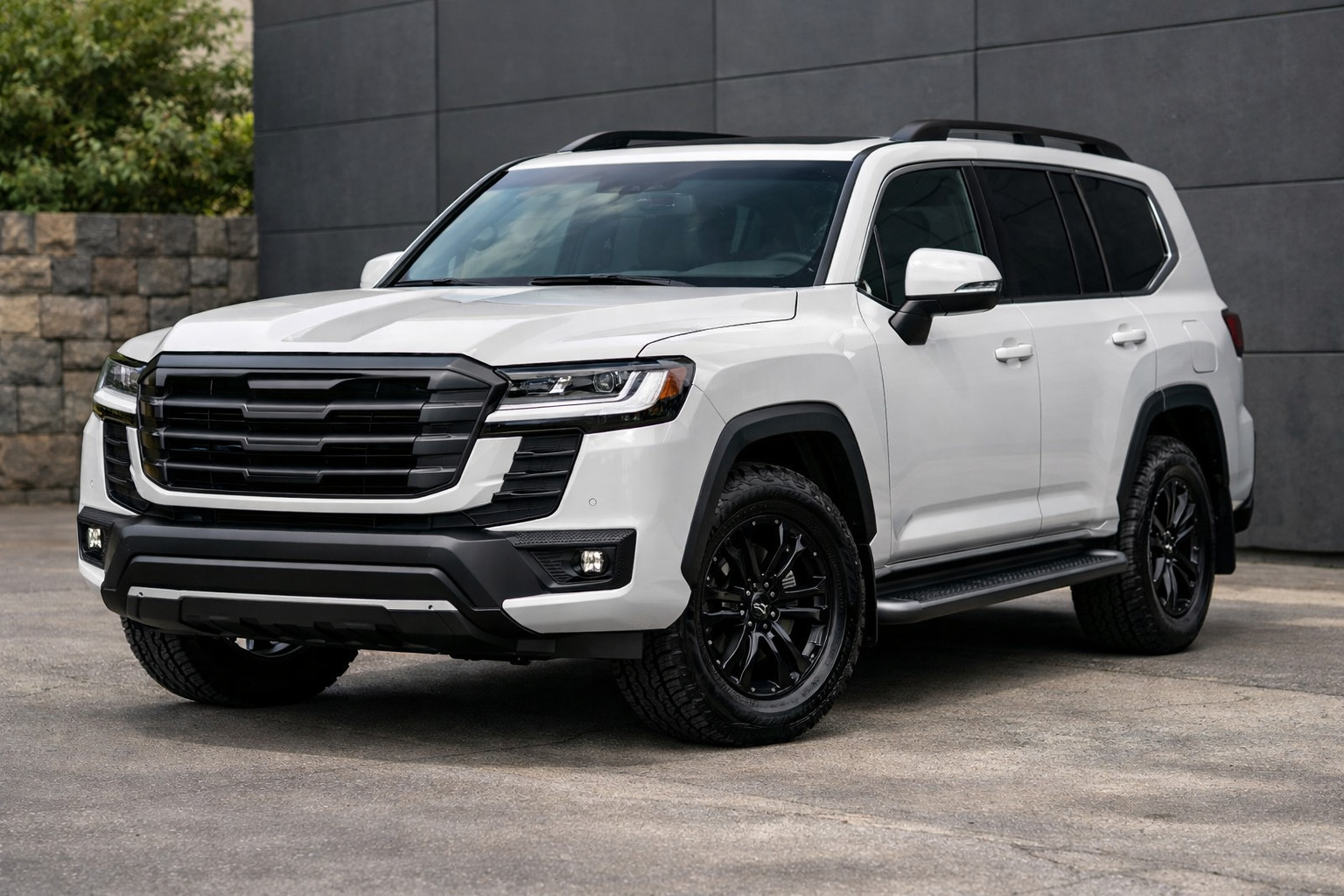
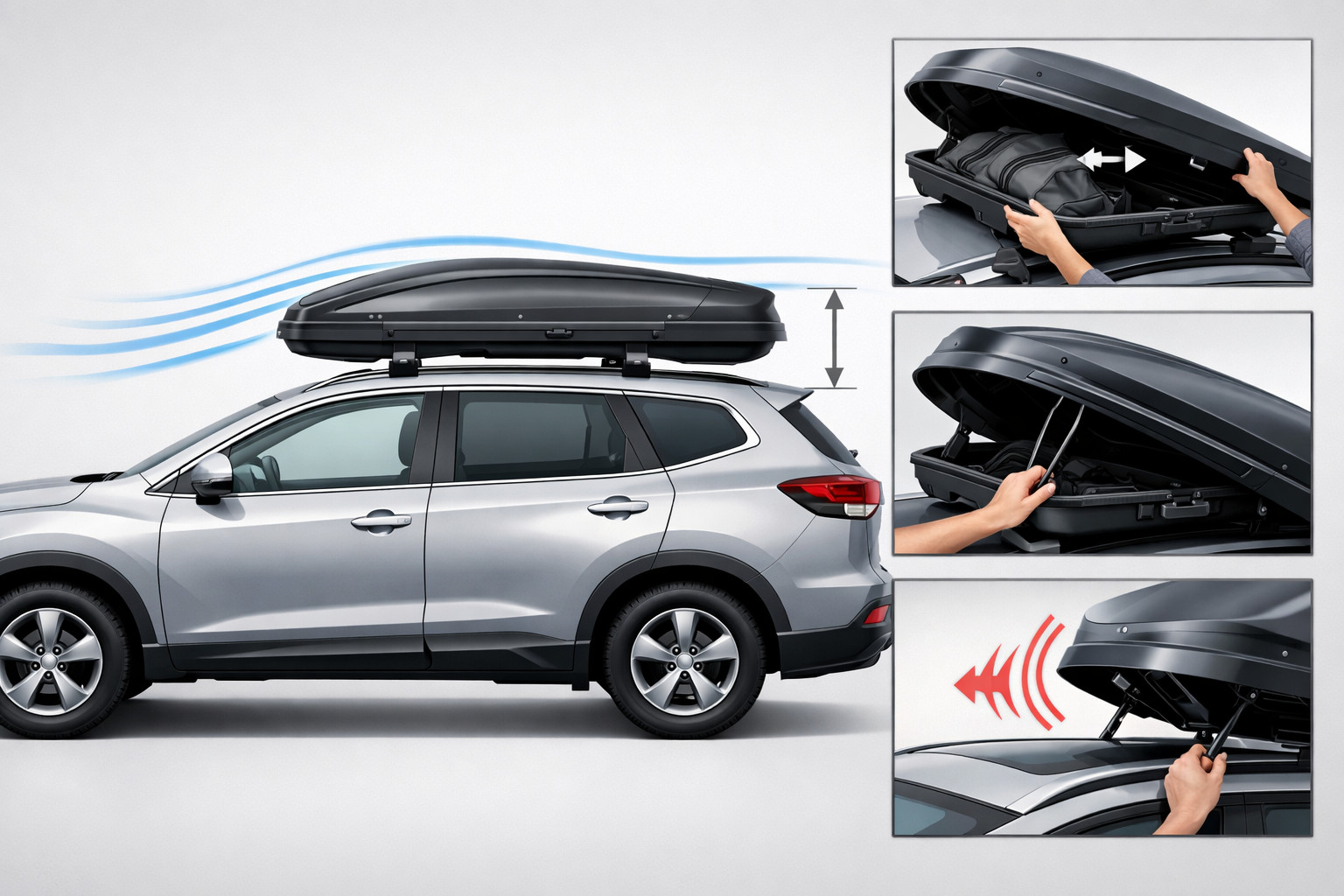
- Too tall a shell or a high mounting position. On paper a difference of a few centimeters seems minor, but in practice it decides whether you can enter a low parking garage. The overall vehicle height can increase very noticeably, sometimes up to 600 mm.
- Incorrect position on the roof. If the box sits in the wrong place or isn’t parallel to the road, you get noise, airflow buffeting, and tailgate-opening issues.
- Insufficient front clearance. This is critical for cars with a large tailgate. If there isn’t enough space from the front crossbar to the area where the roof transitions into the tailgate, a long box will conflict with the body.
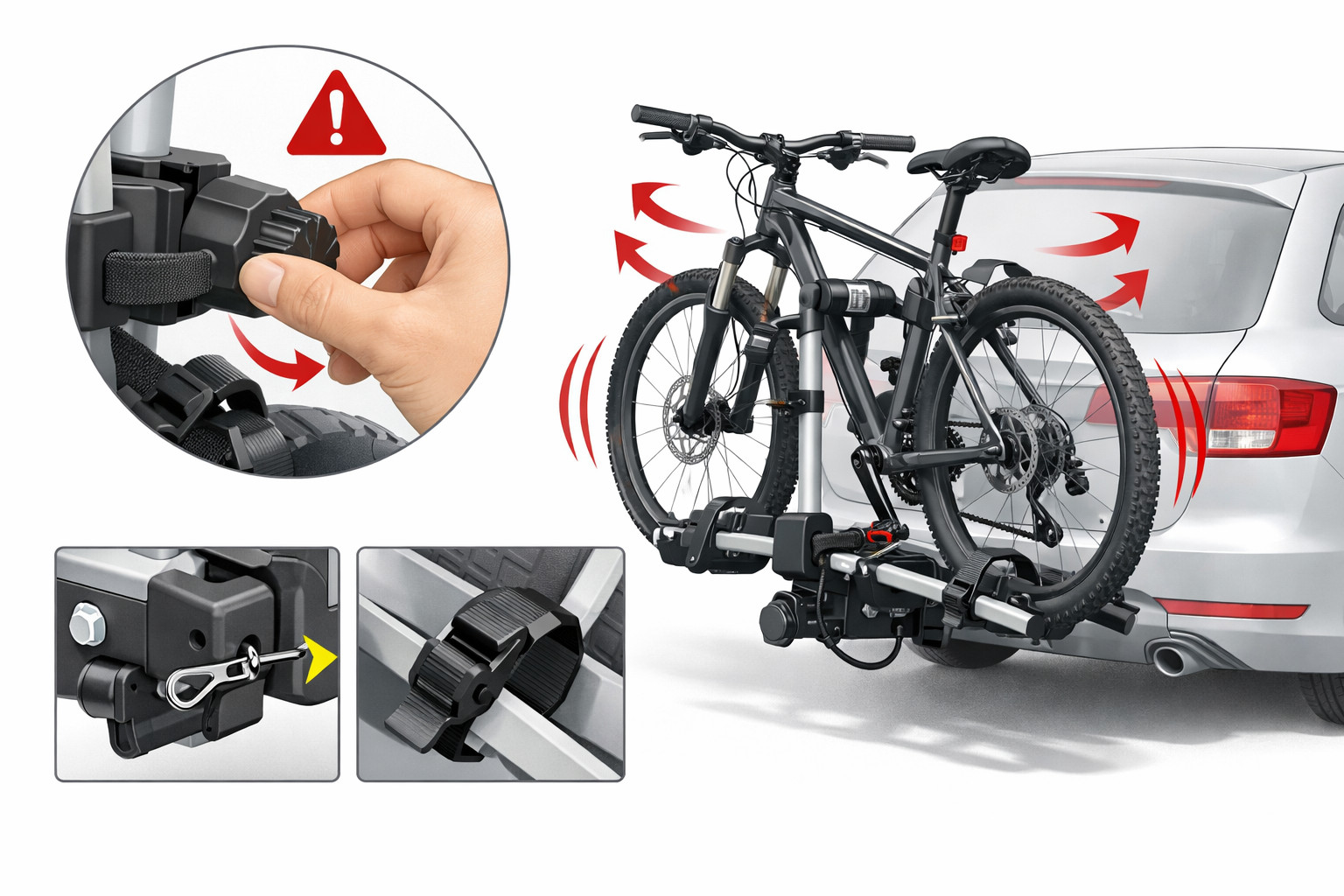
- Installation and load-securing mistakes. Loose fasteners, unsecured items inside, or a skew during installation cause not only noise, but also dull thumps or vibrations while driving.
How to understand what the cause is in your case
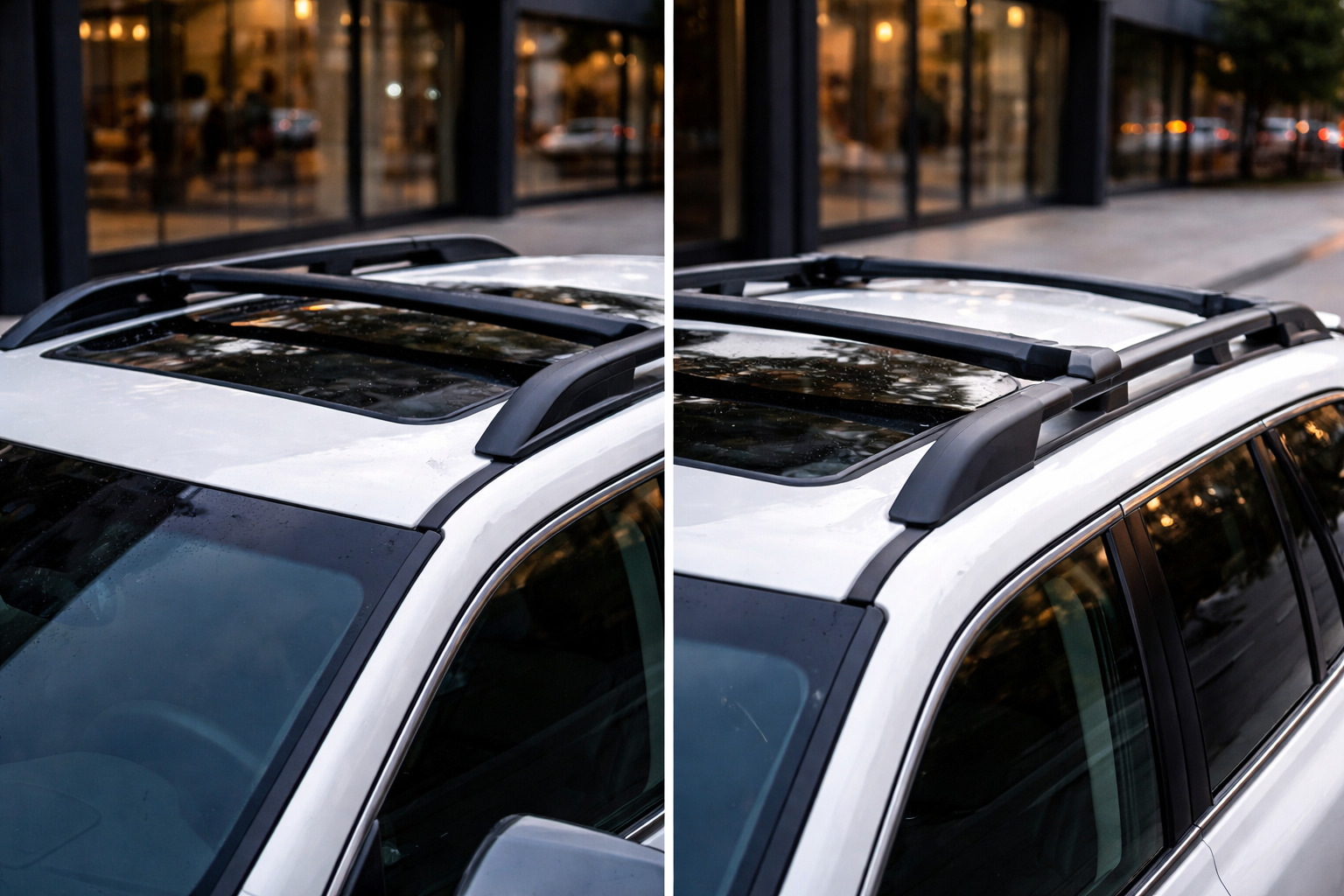
- Start with the crossbars. If you hear a whistle even without the box, the source is almost certainly the bars themselves or their position on the roof.
- After installation, actually measure the vehicle height. Don’t go by feel. Park on a flat surface and measure from the ground to the highest point. Write this number down and keep it in the cabin.
- Check the tailgate in real life, not in your head. Install the empty box and slowly open the tailgate fully. If the gap is minimal or there’s contact, you either need to shift the system forward within allowed limits or choose a different box format.
- Look at the box from the side. It should sit as parallel to the road as possible. If the nose is raised or lowered, it often worsens noise and stability.
- Do a short test at several speeds. Drive 60, 80, 100, and 110 km/h on the same stretch of road. A whistle that appears only with the box points to the shell shape or its position; a dull thump more often indicates a mounting issue or shifting cargo inside.
- Before each trip, check the basics. The box must be tightened down firmly, locked, the key removed, and the load inside secured. If even one point isn’t done, your diagnosis will be misleading.
Symptoms, causes, and what to do (table)
| Symptom | Likely cause | What to do |
|---|---|---|
| Whistling at 80–100 km/h | Noisy crossbar profile or an unfavorable box installation angle | First check the crossbars without the box, then set the box parallel to the road; if the whistle remains, consider more aerodynamic crossbars |
| Dull booming or a “pop” on the highway | Skewed installation, insufficient tightening, cargo moving inside | Reinstall the box, check all clamps and the securing of items inside |
| Tailgate hits the box | Too little front clearance or a box that’s too long for your body style | Try shifting the system forward within allowable limits; if there’s no room, you need a different box |
| The car won’t fit into a parking garage or under a gate | Overall vehicle height with crossbars and box was underestimated | Measure the height after installation; if there’s no clearance, switch to a lower box or remove the system after trips |
| It’s inconvenient to access items from one side | Single-side opening on a tall vehicle or tight parking space | For everyday use, choose a dual-side opening |
| Fuel consumption or battery usage increased noticeably | A tall or non-aerodynamic box, excessive speed | Keep a moderate pace, don’t exceed recommended limits, and if needed switch to a lower, more streamlined shell |
What actually helps
- Aerodynamic crossbars. If the noise source is the base, replacing the box may do little. Quiet crossbars often change the situation more dramatically than repositioning what you already have.
- A low-profile box. When garage access or a low parking structure is critical, it’s not only volume that matters, but also the shell height and how high it sits above the crossbars. Between models with similar capacity, the height difference can be such that one car clears the gate while another doesn’t.
- Correct forward offset. If the crossbars are adjustable, moving the box forward often saves the tailgate. But do it only within the limits allowed by the mounts and load balance.
- Dual-side opening. This isn’t a small thing—it’s real relief on crossovers, wagons, and in tight spaces. There’s less chance you’ll have to reach across the roof or struggle next to a curb.
- Speed control. Even a properly installed box can be noisy. At high speed, noise and drag increase, so it’s more practical to stay within the limits the system is designed for. A 130 km/h reference shouldn’t be treated as a daily norm.
- Removing it before an automatic car wash and seasonal use. This isn’t about comfort, but about preserving the box and mounts. If you don’t need the box every day, it makes sense to remove it after a trip—noise and consumption drop immediately.
Separately, pay attention to the numbers in the spec sheet. There are roomy boxes in the range of roughly 453–609 L, but one model can be significantly lower than another. For the city and frequent trips, that matters more than maximum liters.
What almost doesn’t work or helps only briefly
- Buy the biggest box and hope the noise “settles in”. If the issue is the crossbar profile or installation geometry, time won’t change anything.
- Move the box a few centimeters at random without checking clearances. Sometimes it gives a partial effect, but it doesn’t cure a poor combination of height, shape, and position.
- Ignore the real height of the car. Many people remember only the stock vehicle height and keep driving into places out of habit after installing the box. That’s exactly how impacts with height limiters start.
- Keep the box on the roof all year “just in case”. If you need it a few times per season, there’s no point in carrying it constantly: noise and extra drag stay with you every day.
- Put up with inconvenient opening. If the box is already awkward to close or requires extra handling, it will be even more irritating in daily life—especially in winter and on a tall vehicle.
When accessories or replacing parts makes sense
If the problem starts at the crossbar stage, it makes sense to replace the bars themselves rather than randomly searching for a “quieter” box. If the main pain point is height or a conflict with the tailgate, then you need a different shell: lower, shorter, or with a better mounting-position range.
When you’re choosing a new roof box, look at three things at once: height above the crossbar, allowable roof position, and opening type. For everyday use, mounts with clear tightening indication and a lock that prevents leaving the box half-closed are useful. This makes sense when you often remove and reinstall the system yourself.
There’s no need to replace everything at once if the problem is local. For example, if the tailgate misses the box by just a few centimeters, sometimes it’s enough to correctly reposition the crossbars or the box itself. But if the height is already critical, small adjustments won’t fix it—you need a lower format.
Solutions: when they work and when it’s not worth spending money (table)
| Solution | When it works | When it’s not worth spending money |
|---|---|---|
| Aerodynamic crossbars | When there’s noise already with the crossbars, or it increases sharply after installing the box | When the main issue isn’t sound, but lack of height clearance or contact with the tailgate |
| Low-profile box | When parking garages, gates, branches, or everyday city driving are critical | When the main task is carrying very bulky items and there’s enough height clearance |
| Dual-side opening | When the vehicle is tall, you often park in tight spaces, or you regularly use the box | When the box is installed a few times a year and access from one side suits you completely |
| Shifting the box or crossbars forward | When there’s some mounting allowance and you’re just slightly short on tailgate clearance | When the rails are short, the mounting range is limited, or shifting worsens load balance |
| Complete reinstallation with a check of parallel alignment and tightening | When there’s whistling, booming, popping, or doubt about correct installation | When the problem is in the geometry itself: the box is too tall or too long for your car |
Conclusion
A proper choice of a roof box comes down not to the brand and not to liters. You need to verify that the crossbars aren’t noisy on their own, that the overall vehicle height after installation works for you, and that the tailgate opens without contact. If these three conditions are met, the box won’t be a daily irritant.
The most practical scenario is this: a low-profile shell, aerodynamic crossbars, the correct roof position, and dual-side opening if you use it often. And after installation—measure the vehicle height honestly once and stop relying on memory.
How it works
- Check the crossbars First, find out whether the crossbars themselves are making noise without the box. If the whistling is already there at this stage, the problem is most likely in their profile or position on the roof, not in the box itself.
- Measure the actual vehicle height After installing the box, park the car on a level surface and measure the height from the ground to the highest point. You need to know this figure before entering a parking garage, driving under a gate, or going through other low-clearance areas.
- Check the clearance to the tailgate Install the empty box and fully open the rear lid. If there is contact or the gap is minimal, try shifting the system forward within the allowable range or choose a shorter body.
- Set the box straight and securely Look at the box from the side: it should sit as parallel to the road as possible. Check the clamps, the box mounting, and make sure there is no loose cargo inside, as this often causes a hum or banging.
- Assess behavior at speed Drive at 60, 80, 100, and 110 km/h on the same road and listen for when the whistling or humming appears. If the noise appears only with the box, look at its shape, height, and installation method.
- Choose a solution for your needs For everyday use, it is better to choose a low-profile box, aerodynamic crossbars, and, if needed, double-sided opening. If the main problem is height or opening the tailgate, you should not replace everything, but rather the body or the position on the roof.
Pros and cons
If you choose the crossbars, box height, and position correctly, you can immediately rule out most typical noise and inconvenience issues. The article recommends checking compatibility with the car’s geometry, not just the capacity.
A low-profile box helps where parking garages, gates, or other height limits matter. For city use and frequent trips, it is more practical than chasing maximum volume.
Dual-side opening really makes access to items easier, especially on tall cars and in tight spaces. It reduces unnecessary movements when the car is parked by the curb or there is little room on the side.
Properly shifting the box or the crossbars forward can eliminate a conflict with the trunk lid if you are short by just a few centimeters. In many cases, this is cheaper and simpler than replacing the whole set.
After installation, you can quickly identify the source of the problem with simple tests: checking for whistling without the box, measuring the height, opening the trunk, and taking a short drive at different speeds. This provides practical diagnostics without guesswork.
The box can noticeably increase the car’s overall height, and because of that the vehicle may no longer fit into low parking garages or under gates. On paper, the difference is small, but in real use it is critical.
If the crossbars are noisy or the box is installed at the wrong angle, a whistle or hum appears at speed. Replacing the box itself does not always help in such a situation.
On cars with a large rear hatch, a long body can interfere with fully opening the trunk. When there is no clearance margin, you either have to shift the system or look for a different type of box.
Incorrect installation or weak cargo securing causes dull knocks and vibrations while driving. If this is not checked, it is hard to tell whether the problem is with the box or with the installation.