18.05.2026
293
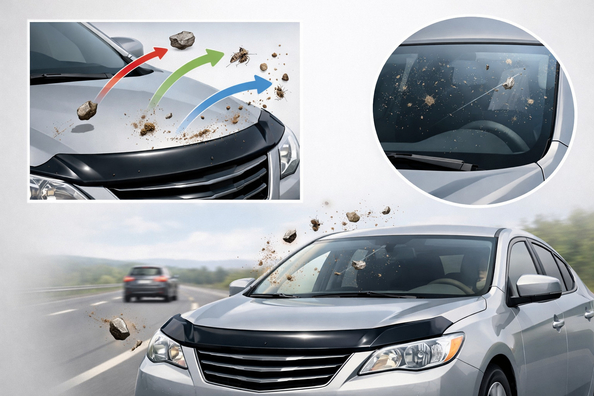

Yes, a hood deflector helps, but only partially. On the highway it changes the airflow in front of the car, so some insects, small stones, and light debris pass higher over the leading edge of the hood and the lower part of the windshield. But it’s not a solid shield: it won’t stop large stones or heavy impacts, and it doesn’t cover the entire windshield area.
It’s most noticeable at speed, not in the city. The result depends on the hood shape, windshield angle, the deflector’s height, installation accuracy, and even the season: in summer the effect on insects is more obvious, while in winter the issue is often not bugs but slush, salt, and washer performance.
On the highway, the front of the car constantly takes the airflow with insects, sand, fine gravel, and road grime. The higher the speed, the harder even light debris hits the leading edge of the hood and the lower part of the windshield. That’s why drivers often see two separate issues: chips on the hood and insects or dirt sticking in the wiper sweep area.
The deflector doesn’t “catch” debris directly. Its job is different: to lift the airflow slightly upward. Because of that, some small particles and insects change trajectory, but if an object is heavier or comes in at an unlucky angle, it still reaches the hood or windshield.
The easiest way is to look not at the overall impression, but at the impact zone. If after a highway trip the hood’s leading edge suffers the most, a deflector or other front-end protection can make sense. But if stones regularly hit the middle or upper part of the windshield, don’t expect a big effect from a deflector.
Do a practical check after the same route. Look where most bugs are: on the hood, on the lower third of the windshield, or across the whole surface. If after installing a deflector there are fewer bugs specifically at the bottom of the windshield (not everywhere), that’s a typical working result, not a sign of a weak part.
Also check the installation. After the first trips, inspect the mounts, make sure there’s no sand under the deflector, and that it hasn’t shifted. If a whistle appears at speed after installation or the washer spray pattern changes, the issue is more often in selection or installation, not in the idea of the accessory itself.
DD Tuning expert comment: The most common mistake is expecting armor-level protection for the entire windshield. When selecting a part, we always уточнюємо where impacts appear: on the hood edge, on the lower part of the windshield, or across the whole area. If the car is driven mostly in the city or a universal part is used instead of a model-specific one, the result is usually weaker than the expectations.
| Symptom | Likely cause | What to do |
|---|---|---|
| On the highway there are fewer bugs in the lower part of the windshield, but they didn’t disappear completely | This is the normal performance limit of a deflector | Evaluate the effect specifically in the lower windshield zone and on the hood edge, rather than expecting the entire windshield to be perfectly clean |
| Paint chips on the hood’s leading edge appear less often, but don’t disappear completely | The deflector reduces some minor impacts, but not all | If paint preservation is the priority, also consider adding anti-gravel protection |
| Stones still hit the windshield from trucks and oncoming traffic | The impact is too strong or the trajectory is too high for this accessory | Don’t rely on a deflector as windshield protection; keep distance and don’t spend money on it for this single purpose |
| A whistle or noise appeared at speed after installation | Wrong profile, weak fixation, or poor fit for the vehicle | Check the mounts, seating of the part, and the accuracy of the model fit |
| Dirt builds up under the deflector, and scuff marks appear | Dirty surface during installation or lack of maintenance | Remove it, clean, reinstall on a clean dry surface, and inspect the area periodically |
| In winter the windshield still gets dirty quickly from slush | The main issue isn’t aerodynamics but seasonal grime, wipers, and washer system | Service the wipers and jets, wash the car more often, and don’t expect miracles from a deflector in wet weather |
A model-specific deflector selected for your car’s exact front end works—and it works primarily on the highway. Most often the benefit is noticeable in two areas: fewer insects and debris on the lower part of the windshield, and fewer minor hits to the hood’s leading edge.
If the priority is airflow redirection, a taller deflector is usually more appropriate. If the goal is more modest and you mainly want to protect the hood edge without a pronounced protrusion, a low-profile option makes more sense. But in both cases, it’s not a replacement for anti-gravel protection when the goal is to preserve paint from chips.
Simple things also make a real difference: correct installation on a clean dry surface, regular checks of the fasteners, avoiding brush automatic washes for delicate setups, and keeping a proper following distance on the highway. Without this, even a good accessory can easily lose its point.
What almost doesn’t work is expecting a deflector to fully protect the windshield from stones. It doesn’t create a continuous barrier and won’t absorb a strong hit from a large stone. Universal solutions that “almost fit” but don’t match the hood shape also typically deliver weak results.
Installation without preparation also helps only briefly: mounting it on a dirty surface, not checking fasteners, not inspecting the part after the first trips. In that case, the owner ends up with noise, dirt under the accessory, or disappointment due to inflated expectations.
Don’t treat a deflector as a replacement for washing, wipers, or repairing already damaged paint. If the paint is already chipped down to primer, the accessory won’t “heal” the hood—it can only slightly slow down further minor impacts.
If you often drive on the highway and want to reduce the number of insects and small debris on the front end, it makes sense to look at a hood deflector. If you want to calmly figure out which design type suits you, a separate article on the pros and cons of a deflector will help. And when the main goal is to physically cover the hood’s leading edge rather than just play with airflow, it’s logical to consider a hood cover.
Replacing components makes sense when the issue isn’t the airflow itself. If the wipers smear dirt, the washer nozzles spray poorly, and the hood already has exposed chips, start with those systems and restoring the coating. An accessory is only an add-on here, not the primary solution.
| Solution | When it works | When it’s not worth spending money |
|---|---|---|
| Model-specific tall deflector | Frequent highway driving, lots of insects, dirt and small debris in the lower windshield zone | Mostly city driving or expecting full windshield protection from stones |
| Low-profile deflector | You want a subtle look and extra protection for the hood’s leading edge | If the main complaint is impacts to the center or upper part of the windshield |
| Anti-gravel paint protection | The main goal is to reduce paint chips | If the problem is only bugs on the windshield, not the paint |
| Wiper and washer service | In winter, in slush, when dirt is constantly being smeared across the windshield | If you want to use this to protect the hood edge from chips |
| Skipping universal solutions in favor of precise fitment | When you need predictable fitment, less noise, and proper aerodynamics | When you’re buying the accessory only for looks and aren’t willing to check compatibility |
From a customer’s experience: A car owner who drove the highway every week was looking for protection not from large stones, but from constant bugs and small chips along the hood edge. After installing a model-specific deflector, he noticed less dirt on the lower part of the windshield, but occasional hits to the windshield still happened. In the end, the solution worked exactly where it should: for the front end and daily highway driving, without illusions of full windshield protection.
A hood deflector should be viewed as a partial, not universal, solution. It really can reduce the number of insects, small stones, and dirt on the hood’s leading edge and in the lower windshield zone—especially on the highway and with an accurate, vehicle-specific fit. But if your main goal is to stop large stones or completely eliminate the risk of windshield chips, this isn’t the accessory to place all your hopes on.
The practical takeaway is simple: for highway driving and small debris, a deflector often makes sense; for serious paint protection, you need other solutions; and for winter grime, you need a working washer system and good wipers. This material is based on real selection experience, practice, and real-world use cases, so the key advice is one: first determine exactly where the problem hits, and only then spend money.
| ✔ | On the highway, the deflector partially lifts the airflow, so fewer bugs, small stones, and light debris hit the lower part of the glass and the front edge of the hood. This is most noticeable at speed, not in city driving. |
| ✔ | A model-specific deflector matched to a particular car gives a more predictable result. The article directly notes that the exact fit and hood shape strongly affect the outcome. |
| ✔ | The accessory can reduce the number of small chips on the front edge of the hood, although it does not eliminate the problem completely. This is useful if the main damage area is at the front rather than across the entire windshield. |
| ✔ | For frequent highway trips, it can be a practical solution in the warm season, when insects are the biggest nuisance. The effect is most noticeable against bugs. |
| ✘ | The deflector does not protect against large stones and does not create a solid barrier for the windshield. If impacts come to the middle or upper part of the glass, you should not expect much effect. |
| ✘ | The result depends heavily on the specific car geometry, the deflector height, and the quality of installation. Because of this, universal or poorly matched solutions often work worse than expected. |
| ✘ | In winter, its usefulness decreases, because the main problem is no longer bugs, but slush, salt, and dirt being smeared by the wipers and washer. For such conditions, other components are needed, not just a deflector. |
| ✘ | Incorrect installation can cause whistling, noise, or dirt buildup under the deflector. In other words, the accessory requires proper installation and periodic inspection, otherwise it will bring little benefit. |
Shipping to EU
Wholesale and retail
Own warehouse
Опис продукту
Подарунки не надаються при оформленні покупки у кредит під 0,01% або при покупці частинами.