02.06.2026
274
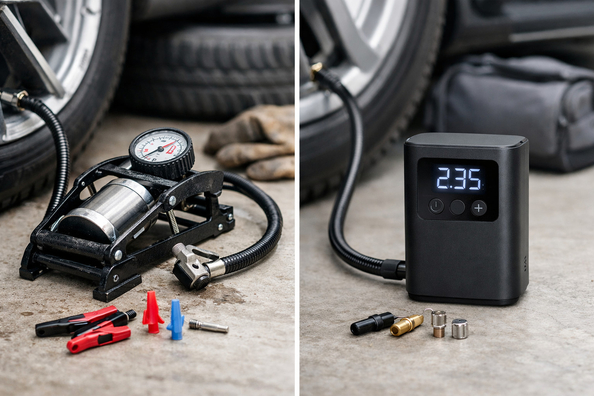
If you need a pump that doesn’t annoy you every month and doesn’t beg to be replaced after the first winter, you should look not at the peak pressure on the box, but at the power setup, auto shut-off, hose and cable length, and the ability to run without overheating. For most drivers, the least stressful option is a hybrid 12 V + battery compressor with decent ergonomics; for large wheels and frequent top-ups, a model with direct connection to the car battery wins; ultra-compact handheld pumps are only relevant where space matters more than speed.
In practice, it’s not just slowness that’s annoying. What really gets under your skin is a short hose, having to hold the pump in your hand the whole time, a dead battery in freezing weather, an inaccurate gauge, and a cigarette-lighter socket that can’t handle the load. That’s why the right choice is always tied to your use case, not the loudest marketing.
The main trade-off is simple: the more compact the pump, the more often it’s slower, more demanding on the battery, and less convenient on a big tire. The more powerful the option, the less it stresses you out while working, but the more space it takes up—and the less likely you are to use it “on the go.”
In short, there are three sensible scenarios. First: a passenger car or family vehicle, rare top-ups, and you want to press a button and not hover over the wheel—here a hybrid works best. Second: a crossover, large tires, highway trips or off-road driving—here it’s smarter to take a compressor with battery clamps. Third: you only need a pump as an emergency backup in a tiny trunk—then it makes sense to tolerate a slow mini format.
| Option | Strengths | Weaknesses | Who it’s for |
|---|---|---|---|
| Hybrid 12 V + battery with auto shut-off | Most convenient for everyday use, has a backup power option, no need to stand by the wheel watching the gauge | More expensive than basic 12 V models, the battery needs to be monitored | Most drivers who want one pump “for everything” |
| Powerful 12 V with clamps to the car battery | Works faster on large tires, less dependent on a weak socket, better for frequent top-ups | Less convenient to start: hood up, clamps, wires | Crossovers, SUVs, and those who travel far |
| Mid-range battery-only | Mobile, among the fastest battery units, often has pressure memory and auto shut-off | Depends on battery condition, weakens in the cold, without a compatible ecosystem it’s more expensive to buy into | Those who already have batteries of the right brand |
| Ultra-compact mini pump | Takes minimal space, light, easy to toss into a trunk compartment | Slow, short hose, often needs to be held by hand, lower endurance reserve | As an emergency option when space is extremely limited |
DD Tuning expert comment: the most common mistake is buying a very small pump “just to have one,” then inflating a crossover tire for 10 minutes and thinking that’s how it is for everyone. The second typical story is ignoring current draw and powering a powerful compressor through a weak cigarette-lighter socket. If you want a calm everyday option, don’t choose the smallest body—choose a model with auto shut-off, a proper hose, and a backup power method.
This is the most balanced class. DEWALT DCC020IB is a great example of why: three power sources, auto shut-off, a digital gauge, and a long cable of almost 4 meters. In real use, that means a simple routine: set the pressure, connect it, wait for it to stop, put it away. This is the format that least often irritates in everyday life.
More budget-friendly hybrids also make sense if you’re not chasing records. They’re noticeably more convenient than mini models, but you should check hose length and whether you’ll have to constantly hunt for a charged battery.
A typical example is VIAIR 88P. It has a long hose, a separate power cable, decent endurance, and good inflation speed. For large tires, this is often the least stressful scenario: the compressor isn’t limited by the cigarette-lighter socket and handles inflating several tires in a row more calmly.
The downside is obvious too: it’s less of a “household” solution. You have to pull out the clamps, open the hood, and connect to the battery. If you top up tires once every two months at home, that procedure may annoy you more than the speed gain.
Models like Milwaukee M18 2848-20 look good here: fast for their format, with auto shut-off, pressure memory, and sensible controls. If you already have batteries in that system, this pump becomes a very pleasant tool: take it out, inflate, put it away—no wires at all.
But “battery-only” always requires discipline. You need to recharge the battery at least periodically, and in the cold it performs worse. So it’s a convenient option not for everyone, but for those who actually live in a battery ecosystem and don’t forget about it.
Models like AstroAI L4 are good for exactly one thing: they’re small and light. For a tight trunk or as a backup for minor top-ups, that’s convenient. But you pay for compactness with time: these pumps are significantly slower, and the short hose often forces you to hold the unit in your hand for the entire cycle.
That’s why the mini format shouldn’t be bought “as an all-purpose” option. For a passenger car it might be tolerable, but for a crossover, winter pressure swings, or regular trips, it quickly turns into irritation.
For a typical city car where the pump comes out once every few weeks or before a trip, a hybrid is the best choice. It doesn’t lock you into one power source, has a clear operating logic, and usually doesn’t require dancing around the wheel.
For a crossover, minivan, or SUV, the logic is different: the larger tire volume quickly exposes the weakness of mini pumps. Here, direct battery connection saves time and reduces the risk that the 12 V socket becomes the bottleneck.
If you already have tools in a specific battery platform, a high-end battery-only pump becomes a smart purchase. If you don’t have batteries, its appeal drops sharply, because you’re paying not only for the pump but also for entry into the system.
| Scenario | Best choice | Why |
|---|---|---|
| Passenger car, top-up once a month | Hybrid 12 V + battery | Best balance of convenience, speed, and backup power |
| Crossover or large wheels | Powerful 12 V with clamps to the car battery | Less load on the socket, faster and calmer operation |
| You already have batteries from one brand | Mid-range or higher battery-only | No messing with wires, and the cost of entry is lower |
| Very limited space in the car | Ultra-compact mini pump | Fits anywhere, but only if you can tolerate slowness |
| Winter backup option for all occasions | Hybrid 12 V + battery | There’s a plan B if the battery is flat or you don’t want to rely on one power method |
It’s worth paying more when the pump isn’t just “for emergencies,” but a working tool. Large tires, multiple cars in the family, frequent long trips, seasonal pressure swings, or an existing battery system—these are solid reasons to look at better models. In the premium segment, the value isn’t status, but the small things that save nerves every day: auto shut-off, a longer hose, stable power, better build quality, and predictable lifespan.
If you want to see current options right away, start with tire inflator pumps. If your current compressor already seems to run suspiciously long, it’s useful to compare the symptoms with the article why a pump inflates for too long. And owners of heavier vehicles and larger wheels should also consider the load on the tires in the article how to choose tires for a crossover.
From a customer’s experience: at first, for a crossover we took a very compact battery pump because we wanted to save trunk space. In practice it turned out to be too slow, and the short hose forced you to hold the body in your hand the whole time. After switching to a hybrid compressor with auto shut-off, the problem disappeared: topping up became a quick routine action, not a separate event.
If you ignore the marketing, the least annoying pump in use is not the “most powerful” one, but the one that fits your scenario. For most drivers, that’s a hybrid 12 V + battery compressor with auto shut-off and good ergonomics. For large tires, frequent top-ups, and trips out of town, a model with direct battery connection works better. A mini pump is worth buying only when the top priority is minimal size, not speed and comfort.
This material is based on real selection experience, hands-on practice, and real use cases: what annoys you every day, what fails first, and what pump format truly saves time rather than just taking up space in the trunk.
| ✔ | A hybrid 12 V + battery pump with auto shut-off is the least annoying in everyday use: it can be connected in different ways, set to the desired pressure, and you do not have to stand by the wheel the whole time. For most passenger cars, it offers the best balance between convenience and speed. |
| ✔ | A model with direct connection to the battery is better suited for large tires and frequent top-ups, because it is less limited by the cigarette lighter socket. On crossovers and SUVs, it works more smoothly and faster. |
| ✔ | A purely battery-powered mid-range pump is very convenient if you already have batteries from a compatible system. In that case, there are no wires, and control is usually simple thanks to auto shut-off and pressure memory. |
| ✔ | An ultra-compact mini pump is useful where trunk space is critically important. It is easy to keep with you at all times as an emergency backup. |
| ✔ | The presence of auto shut-off, a proper pressure gauge, and a longer hose directly reduces hassle during inflation. These are more practical things than chasing a record pressure on the box. |
| ✘ | Mini pumps are slow, and a short hose often forces you to hold the body in your hand the whole cycle. With large wheels, this quickly turns into an inconvenience. |
| ✘ | Pure battery-powered models depend on battery condition and work worse in cold weather. If you do not keep an eye on the battery, the pump may fail exactly when you need it. |
| ✘ | Powerful models with clamps for the battery are less convenient for everyday use, because you have to open the hood and connect with wires. For occasional top-ups near home, this can be more annoying than the time saved. |
| ✘ | Saving money on no-name models often backfires because of a weak fitting and hose. The article states outright that these are the components that often fail first. |
Shipping to EU
Wholesale and retail
Own warehouse
Опис продукту
Подарунки не надаються при оформленні покупки у кредит під 0,01% або при покупці частинами.