
18.05.2026
11949
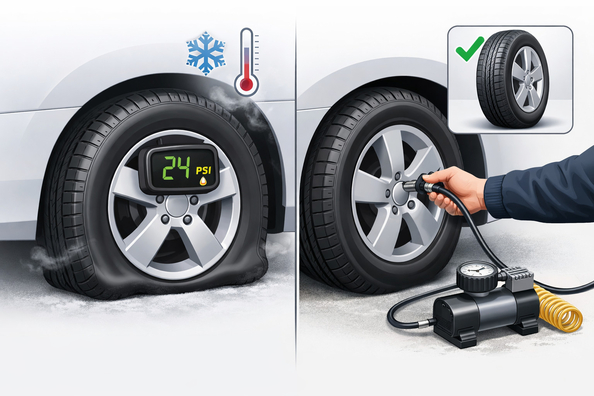
With the arrival of cold weather, tire pressure often drops not because something is broken, but because of simple physics: air contracts, and a morning TPMS warning can appear even on a perfectly healthy car. No panic: the first correct step is to measure pressure on cold tires and bring it to the spec from the door-jamb placard or the owner’s manual—not to the maximum shown on the tire sidewall.
If, after a cold snap, all four wheels drop by roughly the same amount, it’s usually a seasonal adjustment. But if only one wheel deflates quickly or the pressure drops again after topping up, the cause is local: a puncture, valve, wheel rim, or a bead that isn’t sealing.
In the cold, pressure decreases on its own: as a rule of thumb, for a 5–6°C temperature change it shifts by about 0.07 bar. That’s why after the first real cold snap the TPMS light may come on in the morning and go out after a few minutes of driving, when the tire warms up slightly.
On top of that, there’s natural monthly pressure loss. If the tires haven’t been checked in a while, an autumn or winter temperature swing simply pushes them below the lower threshold faster. That’s why the issue often feels sudden, even though the process was gradual.
Start with a cold measurement: the car should sit for at least 3 hours or have driven very little. Then compare the readings to the manufacturer’s placard. If all tires are similarly low, the cause is almost certainly the cold weather, not an emergency.
If only one tire is dropping, check locally: inspect the tread and sidewall, test the valve with soapy water, and pay attention to the rim edge and the tire bead area. Repeat loss of more than about 0.14 bar per month is no longer a normal seasonal change—it’s a reason to look for a leak.
If you inflated on a warmed-up tire, don’t treat that as the final result: a hot tire shows higher pressure. On the road it’s an acceptable temporary step, but the next morning you should recheck pressure again when cold. For cars with indirect TPMS, after inflating or swapping wheels a reset via the factory procedure is often required.
DD Tuning expert comment: the most common mistake is to inflate “by eye,” turn off the light, and consider the matter closed. The second typical mistake is to follow the number on the tire sidewall instead of the vehicle placard. If only one tire is losing pressure, don’t waste time on repeated top-ups without checking the valve and rim—the problem almost always comes back.
| Symptom | Likely cause | What to do |
|---|---|---|
| TPMS light comes on in the morning and turns off after driving | Cold weather temporarily lowered pressure below the threshold | Check all tires when cold and set pressure to the vehicle placard spec |
| All four tires dropped almost equally | Seasonal temperature drop or pressure hasn’t been checked in a while | Inflate all tires to the factory spec and recheck the next morning |
| Only one tire is losing pressure | Puncture, leak via the valve, rim, or tire bead | Inspect the wheel, test with soapy water, visit a tire shop for localized diagnostics |
| After inflating, the light still hasn’t gone out | TPMS hasn’t updated yet or a reset is required | Drive for a few minutes, perform a reset per the instructions, recheck pressure with a gauge |
| Pressure drops faster than a one-time seasonal adjustment | Abnormal air leak | Don’t delay checking the valve, rim, and tire bead seating |
| The car feels softer to steer, the tire wears on the edges | Driving on underinflated tires | Restore pressure to spec and assess whether uneven wear has started |
A simple routine works: once a month, check pressure on cold tires (including the spare) and adjust it to your vehicle’s exact spec. This is especially important after the first cold snap, before a long trip, and after sharp temperature changes.
Comparing all tires to each other also works well. A uniform drop across all wheels is almost always temperature. One problematic tire means a localized check—not a general top-up.
If you had to set pressure in a warm garage while it’s significantly below zero outside, factor in the correction: outside the reading will be lower. If you only checked after driving, treat it as a temporary measure and обязательно recheck the tires again in the morning.
It makes sense to keep a tire inflator in the trunk if you regularly correct seasonal 0.1–0.2 bar changes, travel long distances, or don’t want to search for an air compressor at a gas station every time. If it’s not clear which format is most convenient for your driving, it’s worth quickly checking which inflator is best for a car.
A more productive option like an 85 L/min compressor makes sense for larger wheels, crossovers, multiple cars in the family, or when you often inflate tires for more than just yourself. But no inflator fixes a puncture, a leaking valve, or a bent rim—in those cases you need repair or replacement of the specific component.
Replacement is justified when the leak source is confirmed: the valve is leaking, the rim won’t seal properly, the tire is damaged, or the problem repeats after correct inflation. If the drop is uniform across all four tires only after a cold snap, there’s no need to buy extra parts.
| Solution | When it works | When it’s not worth spending money |
|---|---|---|
| Inflate to spec on cold tires | After a cold snap all four tires dropped by about the same amount | If one tire quickly loses pressure again |
| Recheck the next morning | After a seasonal adjustment or inflating a hot tire | If there’s already an obvious puncture or sidewall damage |
| TPMS reset or calibration | After correct inflation, tire rotation, or on cars with indirect systems | If actual pressure hasn’t been checked with a gauge yet |
| Replace the valve or service the valve core | When a leak is confirmed at the valve | If the cause is a tread puncture or a rim defect |
| Clean the rim, reseal the bead, repair the puncture | When only one tire is losing pressure due to a local leak | If the issue was only a seasonal pressure drop in all tires |
| Buy a high-output compressor | When you often need to inflate large tires or multiple vehicles | If you want a compressor only as a substitute for diagnosing a constant leak |
From a customer’s experience: after the first frosty morning, the TPMS light came on every morning but disappeared after a few minutes of driving. A check showed evenly reduced pressure in all tires; after correcting to the factory spec, the problem went away. In another case, a similar symptom turned out to be local: one tire kept losing pressure again, and the cause wasn’t the cold—it was the valve.
When tire pressure drops with the onset of cold weather, there’s only one correct response: first measure cold, then compare with the vehicle placard, and only then draw conclusions. A uniform drop in all tires is usually solved with a simple top-up, while repeat loss in one tire almost always means a leak you need to find physically—not mask with a reset or overinflation.
Accessories are useful here as a control tool, not as a replacement for diagnostics. This material is based on real selection experience, hands-on practice, and real usage scenarios—so the main advice is simple: don’t panic, but don’t postpone checking if the pressure drops again.
Shipping to EU
Wholesale and retail
Own warehouse
Опис продукту
Подарунки не надаються при оформленні покупки у кредит під 0,01% або при покупці частинами.