
































































 Author: Radomskyi Maksym Vasyliovych
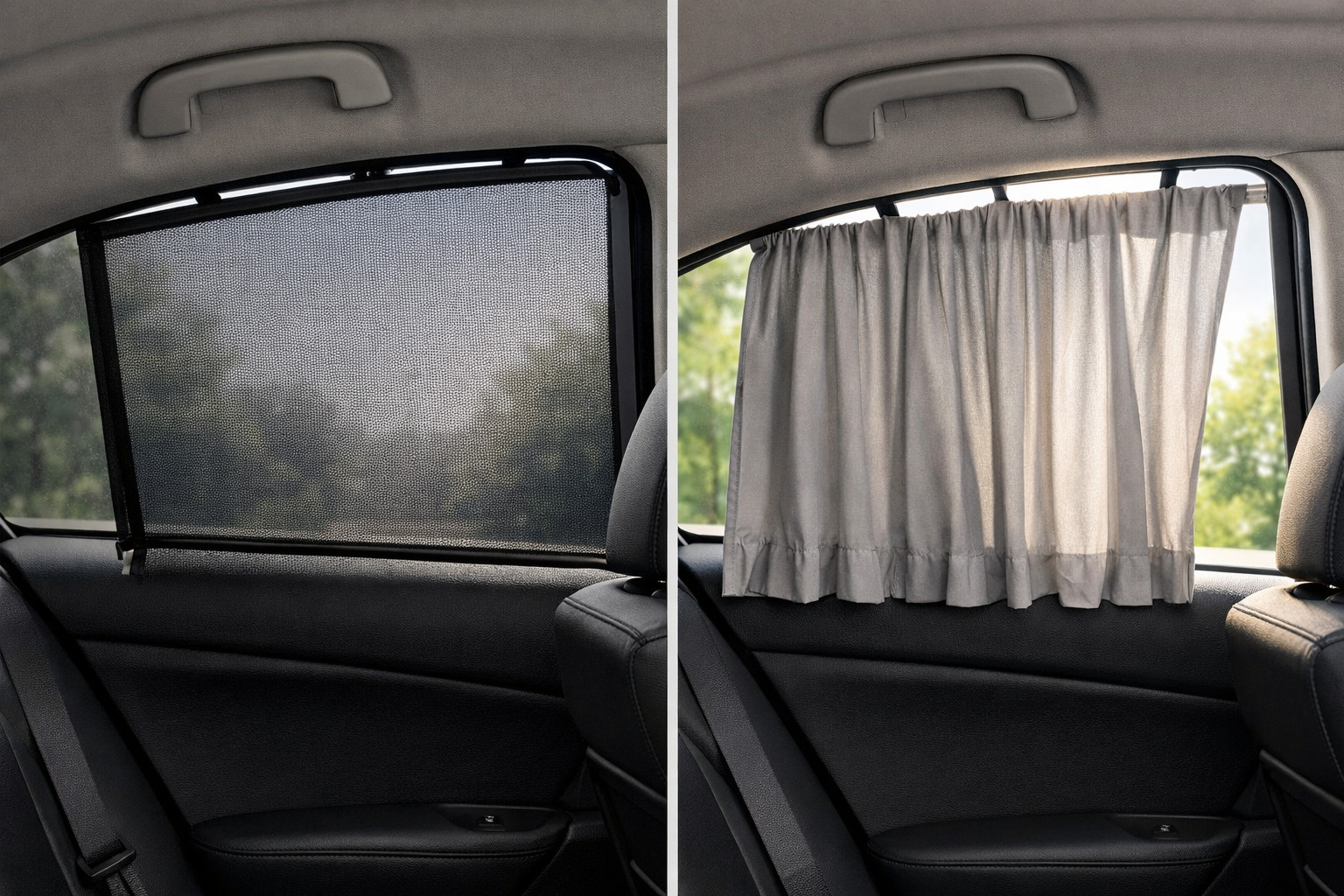
If you need real sun protection—not just an accessory on the glass—you should look not at a pretty mesh, but at the material density and how precisely it fits. In real use, dense vehicle-specific shades with exact fit and full-blackout solutions work best; magnetic mesh models offer a compromise between shade and visibility; and window deflectors don’t replace a shade at all.
The mistake behind most purchases is simple: people buy a universal option for an “approximate size,” then wonder about gaps, noise, or weak effect. Choose based on the task: parking in the sun, a child in the back seat, daily driving with the window opening, or sleeping in the car.
What the choice is really about
The point isn’t which shade is “more fashionable,” but how much direct light it actually blocks and how tightly it sits in the window opening. A dense vehicle-specific shade or a full-blackout solution gives a more noticeable effect on surface heating and cabin comfort. Mesh works softer: it removes glare and reduces harsh sun in your face, but it doesn’t make the cabin dark.
So “really works” isn’t always “the darkest.” For a child in the back, a mesh shade with decent visibility is often better; for a car that sits in the sun, density and fit matter more; and for sleeping or changing clothes you need full blackout. A deflector sits outside this logic: it’s about ventilation, rain, and wind—not sun protection.
What criteria to compare by
- Installation. A magnetic shade is convenient only where there’s a proper base for mounting. Suction cups depend heavily on the glass and careful installation. Vehicle-specific insert-type solutions are usually more stable.
- Noise. If the shade has play or sticks out, at speed it can cause rustling, shifting, or simply annoy you. The more precise the fit, the lower the chances of these little issues.
- Durability. Moving roller mechanisms and suction cups are more sensitive to heat and daily removal. A simpler rigid or frame design often lasts longer.
- Practicality. It matters whether you can lower the window, whether you have to remove the shade every time, whether it blocks visibility, and whether it takes up half the trunk when removed.
- Price. In the higher-priced segment, you’re paying not so much for the material as for accurate shape, stable mounting, and daily convenience.
Quick comparison of options (table)
| Option | Strengths | Weaknesses | Who it suits |
|---|---|---|---|
| Dense vehicle-specific mirrored shades | Block direct sun best, tightly cover the opening, quieter with proper fit | More expensive, tied to a specific car model, less universal | For those who often leave the car in the sun and want maximum benefit, not “decor” |
| Magnetic mesh | Comfortable while driving, cuts glare, often lets you lower the window | Don’t provide full blackout, don’t mount equally well on every car | For rear passengers, children, everyday city use |
| Mesh or roller shades on suction cups | Affordable entry option, quick installation, easy to try without a big budget | Less stable, more dependent on heat, glass, and installation quality | For those who need a simple budget solution without high expectations |
| Full-blackout shades | Maximum darkness and privacy, work well for parking and sleeping | Not universal for daily driving, may be excessive where visibility is needed | For road trips, sleeping in the car, camping, changing clothes |
| Window deflectors | Provide ventilation in rain and heat, reduce wind with the window slightly open | Hardly protect from direct sun, don’t cool the cabin like a shade | For those who need ventilation, not blackout |
DD Tuning expert comment: The most common mistake is buying a universal shade “more or less for the window size” and expecting the effect of a vehicle-specific solution. In practice, gaps around the edges, poor mounting, or daily-use inconvenience eats up the benefit. If you need a shade every day, easy installation matters more than loud promises on the packaging.
Detailed breakdown of each option
Dense vehicle-specific mirrored shades
This is the strongest option against heat when the car is parked in the sun. The secret isn’t only in the dense material, but also in the fit: the fewer gaps near the frame, the better the result. Such kits can include several pieces for different windows, so they cost more, but they also deliver a more noticeable difference.
Magnetic mesh shades
A good compromise for everyday driving. They don’t “mute” the cabin, but they remove some glare and direct sunlight, which is especially useful for the rear row. Their main advantage is convenience: if the vehicle design allows it, you can lower the window without constant removal. The main downside is that they don’t create full shade and aren’t always compatible with a specific vehicle’s frame.
Mesh and roller shades on suction cups
This is the “quick and cheap” option. As long as the glass is clean and the suction cups hold well, they perform the basic function. But this is also where complaints about durability and practicality appear most often: in heat the mounting works worse, the roller mechanism adds another weak point, and after a few removal cycles all the convenience disappears.
Full-blackout shades
If the goal is not only sun, but complete darkness and privacy, this type works better than any mesh. It’s appropriate for travel, sleeping in the car, parking at dawn, camping. But for a normal daily scenario it’s a narrow solution: where visibility and ease of use are needed, full blackout is often excessive.
Window deflectors
They’re often confused with shades, but the logic is different. A deflector is useful when you want to crack the window in the rain or vent hot air without a strong draft into the cabin. But as a barrier against the sun it’s weak: it doesn’t shield the dashboard, seats, or passenger from a direct beam.
Which option is best for different scenarios
For a car that sits in an open parking lot every day, a dense vehicle-specific shade makes the most sense: every covered gap matters. For rear passengers on the move—especially with a child in the car—the smarter choice is magnetic mesh: it doesn’t turn the cabin into a dark box and doesn’t interfere with window use.
If the budget is minimal or you need a shade only occasionally, you can look at suction-cup options, but without illusions about lifespan and stability. For sleeping, travel, and privacy, it’s better to go straight to full blackout. And when the main task is fresh air in rain or heat, you should be looking not for a shade, but for a deflector.
Use-case scenario and what to choose (table)
| Scenario | Best choice | Why |
|---|---|---|
| The car often sits in direct sun | Dense vehicle-specific mirrored shades | Gives the best effect on cabin and surface heating thanks to density and fit |
| A child rides in the back seat every day | Magnetic mesh shade | Reduces sun in the face, keeps visibility, and is more convenient for everyday use |
| Needed occasionally, without big spend | Mesh or roller shade on suction cups | The simplest entry option if you can accept lower stability |
| Need darkness for sleeping or changing | Full-blackout shade | Mesh won’t provide the required privacy and blackout level |
| Want to open the window while driving | Magnetic mesh shade | With proper compatibility, you don’t need to remove it every time you lower the window |
| Need ventilation in rain or on the highway | Window deflectors | That’s their intended scenario, not fighting direct sunlight |
Common mistakes when choosing
- Confusing ventilation with sun protection. A deflector doesn’t replace a shade.
- Choosing a universal size instead of a proper fit to the window shape. Gaps most often kill the result.
- Not checking the mounting type. A magnetic solution doesn’t always work with the design of a specific frame.
- Expecting full darkness from mesh. It’s for comfort and glare, not absolute blackout.
- Buying a roller or suction-cup shade for daily use if any small nuisance bothers you. For constant use, stability matters more than a low price.
- Ignoring visibility and local rules for front and side windows. What can physically mount isn’t always appropriate while driving.
When a more expensive solution makes sense
A more expensive shade is justified not when you want “something better,” but when it will actually work every day. If the car regularly sits in the sun, children ride in the cabin, and you don’t want to constantly adjust suction cups or put up with gaps, it makes sense to pay for an accurate fit, quiet operation, and decent lifespan.
To choose more precisely, you can start with the sun shades category, separately check the breakdown do shades help with cabin overheating, and compare shades and window deflectors for your scenario. In short, the more expensive solution makes sense where you need not a one-time effect, but a predictable result every day.
From a customer’s experience: someone was looking for protection for the rear doors because their child was constantly blinded by the evening sun, and cheap suction-cup shades fell off almost every week. In the end, they chose a vehicle-specific mesh shade with a proper frame fit, because daily comfort and the ability to lower the window mattered more than full blackout. Satisfaction came not from a “wow effect,” but from the shade simply working without constant adjustments.
Conclusion
If you strip away the marketing, the picture is simple: against heat, dense vehicle-specific shades with precise fit really work; for driving and rear passengers, the most convenient compromise is magnetic mesh; for sleep and privacy, you need full blackout; and deflectors are worth buying only for ventilation. The worst-case scenario is buying a universal solution not matched to your task and expecting it to do everything at once. This material is based on real selection experience, practical use, and real scenarios, so the key takeaway is simple: first define what exactly you want protection from, and only then choose the shade type.
How it works
- Define your task First, understand exactly what you need: protection from direct sunlight, comfort for a child in the back seat, blackout for sleeping, or simply ventilation. This will determine whether you need a curtain, a mesh screen, or a deflector at all.
- Assess how tightly the solution should cover the window If maximum protection from heat is important, look at dense model-specific curtains with a precise fit. Gaps along the edges are what most often reduce the effect, even if the material looks “right.”
- Compare types by usage scenario For everyday driving and rear passengers, a magnetic mesh screen is the most convenient: it reduces glare and does not interfere with visibility. For parking in the sun or sleeping in the car, model-specific blackout curtains work better, and for ventilation you need deflectors.
- Check the mounting and practicality Before buying, consider whether magnetic fastening is suitable, whether suction cups will hold properly, and whether you will have to remove the curtain every time you lower the window. If the solution is intended for daily use, stability and convenience matter more than a low price.
- Do not expect a mesh screen to create complete darkness Mesh curtains reduce glare well and soften sunlight, but they do not darken the cabin completely. If you need privacy or sleep in the car, choose a full-blackout option right away.
- Avoid universal solutions without fitment Do not choose a curtain that is only “approximately the size of the window” if you want real results. Universal options often lose out due to gaps, noise, and poor stability, while model-specific solutions work predictably every day.
Pros and cons
Tight, model-specific shades with a precise fit really block direct sunlight and better reduce cabin and surface heating. For a car that often sits in direct sun, this is the most practical option.
Magnetic mesh shades are well suited for everyday driving because they reduce glare and partially block the sun, without turning the cabin into a dark box. They are convenient to use in the rear row, especially if you sometimes need to lower the window.
Full-blackout shades provide maximum darkness and privacy. They work best for sleeping in the car, changing clothes, and traveling.
Model-specific insert solutions are usually more stable than universal suction-cup or approximate-size options. It really makes sense to pay extra for the exact shape, mounting, and everyday convenience if you use them regularly.
Deflectors are useful in their own scenario: they help ventilate the cabin in rain or heat and reduce the airflow through a slightly open window. This is a convenient solution specifically for ventilation.
Universal “roughly the right size” shades often have gaps along the edges, which reduces their effectiveness. Because of this, the purchase may deliver weaker results than expected.
Mesh shades do not provide full blackout. They reduce discomfort from the sun, but they are not suitable if you need darkness or complete privacy.
Roller mechanisms and suction cups are less reliable in everyday use, especially in heat and with frequent removal. Over time, they may start to hold worse or become annoying due to noise and shifting.
Deflectors are not a proper replacement for sun shades. They hardly help against direct sunlight and do not cool the cabin the way blackout shades do.