24.05.2026
513
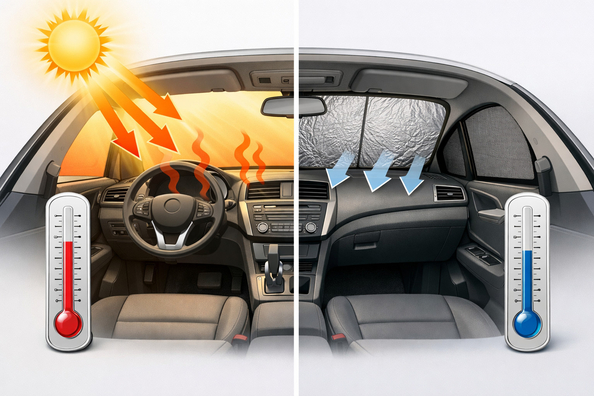
Yes, sun shades do have a noticeable effect—but not in the sense of making a parked car cool. Their main benefit is reducing direct heating of the dashboard, steering wheel, seats, and plastics so that after parking the cabin isn’t as scorching to the touch.
The problem is that people often judge a shade only by the air temperature. But overheating in a car isn’t just “hard to breathe”—it’s also a steering wheel that burns your hands, a dashboard that heats up almost to the limit for plastic, and a child seat that’s unpleasant to touch. This is exactly where a good shade really works.
Solar radiation passes through the glass, heats the dashboard, steering wheel, seats, door panels, and headliner, and then those surfaces release heat into the cabin air. Because it’s a closed volume, that heat doesn’t escape as quickly as it comes in, so the temperature inside rises very sharply—especially in the first 15–30 minutes after parking.
The biggest load usually comes through the windshield, because the sun hits the dashboard and steering wheel through it. If the car has a large glass area, a panoramic roof, or a near-vertical windshield, overheating will be worse. How the car is parked also matters: changing orientation in a parking lot noticeably changes the heat load.
DD Tuning expert comment: The most common mistake is buying a universal shade that’s “roughly the right size” and expecting the performance of a dense vehicle-specific one. The second typical problem is incorrect installation: the reflective layer must face outward, and the shade should be pressed in with the sun visors—otherwise a lot of light leaks around the edges. If the car has a panorama or a very large windshield, it’s better to plan a comprehensive solution right away, not just one shade.
| Symptom | Likely cause | What to do |
|---|---|---|
| Steering wheel and dashboard burn, but the lower part of the cabin isn’t as hot | The main load comes through the windshield | Use a dense windshield shade, preferably with a precise fit and a reflective layer |
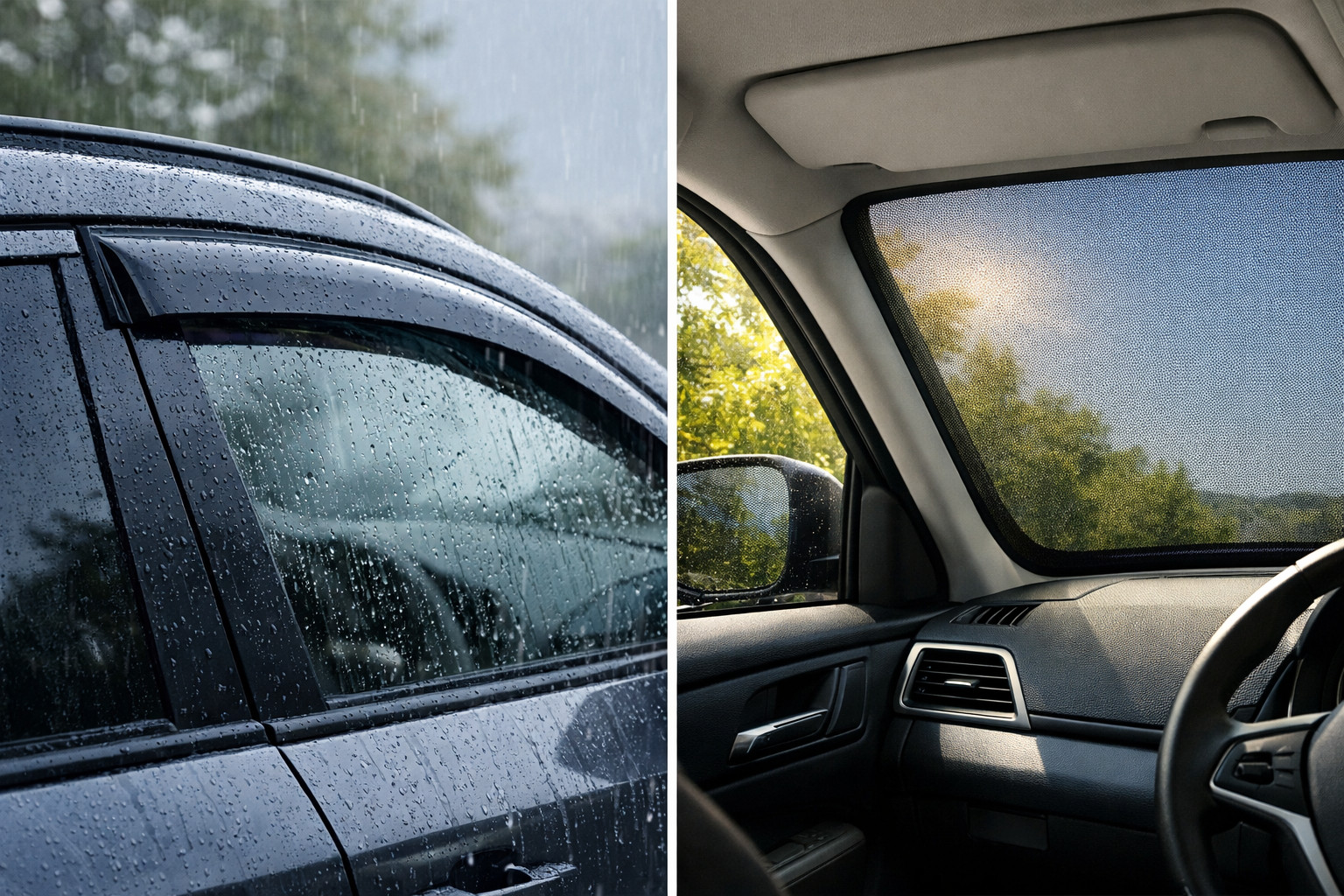
| Child seat or rear row gets very hot from the side | Sun enters through the side windows | Add side protection, change the car’s orientation while parked |
| It’s hard to breathe immediately after opening the doors | Long parking in direct sun, lots of glazing | Don’t rely on one shade: you need shade, brief ventilation, and, if necessary, window tinting |
| There’s almost no difference with the shade and without it | Cheap mesh model, large gaps, or incorrect installation | Check the fit and installation side; switch to a rigid or vehicle-specific shade |
| After starting the A/C, the cabin cools down very slowly | The issue isn’t only the sun, but also weak cooling | Check the cabin filter, A/C service, and recirculation mode |
A dense windshield shade that covers as much area as possible works best. In tests, even a simple shade noticeably reduced air temperature, and the dashboard became cooler by dozens of degrees compared to a car without protection. Models with a high-quality reflective layer add a few more degrees of advantage.
The second level of effectiveness is combination. A shade, shade from the environment, правильна orientation in the parking lot, brief ventilation before driving, and properly working A/C deliver a much better result than any single accessory alone. If the car sits for a long time in an open area, a комплекс always beats a single “magic” shade.
Another important point: a shade is especially useful not so much for the air as for surfaces. When the steering wheel, seat belts, armrest, and the top of the seat aren’t scorching, the first minutes in the car become tolerable, and plastics and upholstery age more slowly.
A cheap thin mesh with large gaps around the edges often has a weak effect. It may reduce glare a bit, but it doesn’t block the main heat flow the way a dense shade made for the specific glass shape does.
Don’t expect a single shade to make the cabin cold at peak heat. The air inside will still warm up—especially if the car sits for a few hours and has a panoramic roof or lots of side glass. The difference will be felt primarily on the dashboard, steering wheel, and seats—not as a “feels like shade” sensation.
A tiny window crack and small solar fans sometimes help, but their effect is unstable. It depends heavily on wind, weather, parking safety, and body design. As a standalone solution, it’s weak.
If the car is parked in an open lot every day, there’s almost always a point in sun shades. The most practical option is a rigid or vehicle-specific windshield shade that’s easy to install and remove without skewing.
If the issue isn’t only a hot steering wheel but overall excess sun through the glass, it’s worth separately considering window tinting. It doesn’t replace a shade, but together they work more logically—especially for long parking periods.
When you use micro-ventilation in the heat, window deflectors are appropriate: they make a small gap less noticeable and partly protect from rain. Replacing elements makes sense when the factory panoramic shade doesn’t work, a roller blind is torn, or old tint has started peeling and provides almost no effect.
| Solution | When it works | When it’s not worth spending money |
|---|---|---|
| Dense windshield shade | Daily parking in the sun; the dashboard and steering wheel overheat | If the car is almost always in shade, or the problem mainly comes through the panorama and side windows |
| Side insert shades | Sun hits the cabin from the side; there are kids or rear passengers often ride | If the main overheating is only through the windshield |
| Window tinting | You need long-term reduction of solar load while driving and while parked | If you expect it alone to remove a scorching dashboard after several hours in direct sun |
| Micro-ventilation through a gap | Hot day, safe parking spot, and the ability to leave a minimal gap | When the car is left unattended in a risky place or you need a guaranteed, stable effect |
| Solar fans | As an auxiliary measure, if you don’t expect a big difference | If you want them to noticeably lower the temperature on their own |
| External cover for the glass or roof | Long parking in open sun; maximum priority is cabin temperature | If you need a quick daily solution without extra bulk and hassle |
From a customer’s experience: the owner of a family car wasn’t looking for a “cool cabin,” but for a way to avoid burning hands on the steering wheel and child seat after a two-hour stop. At first he tried a cheap universal mesh and barely felt a difference. After switching to a dense, glass-shaped shade and getting into the habit of parking so the sun hit the windshield less, the effect became noticeable exactly where it matters every day.
A sun shade isn’t a myth—but it’s not a complete cure for heat either. It cuts direct solar load well, reduces surface overheating, and makes getting into the car less painful in the literal sense. It works best on the windshield when it fits tightly and is used together with shade, smart parking, ventilation, and a properly working A/C.
If you expect a single shade to deliver a cool cabin after several hours in open sun, you’ll be disappointed. The practical conclusion is simple: it’s worth buying when you want fewer scorching surfaces and less heat shock after getting in—not magical cooling. The material is based on real selection experience, practice, and real-world usage scenarios.
| ✔ | A snug windshield sunshade noticeably reduces heating of the dashboard, steering wheel, and upper part of the seats. This is especially useful after parking, when these surfaces are what burn your hands and create the feeling of a “scorching” cabin. |
| ✔ | The effect is most noticeable in everyday use in an open parking lot. For a car that often stands in direct sunlight, the sunshade makes a practical difference in the first minutes after getting in. |
| ✔ | A quality sunshade with a precise fit and reflective layer works much better than a thin universal mesh. It blocks most of the sun’s heat through the windshield and is less dependent on how it is installed. |
| ✔ | The sunshade improves not only comfort, but also the condition of interior materials. When the plastic, steering wheel, seat belts, and upholstery do not overheat as much, they age more slowly and deform less from the heat. |
| ✔ | It is convenient to combine it with other simple actions — shade, proper parking, and a short airing-out before the trip. In such a combination, the result is noticeably better than from one accessory alone. |
| ✘ | A sunshade does not make the cabin cold. The air inside still heats up, especially if the car has been standing for several hours or has a lot of glass. |
| ✘ | If the overheating comes not only through the windshield but also through the side windows or panoramic roof, one sunshade will not solve the problem. In such cases, additional protection or another solution is needed. |
| ✘ | Cheap thin mesh models often have a weak effect. Large gaps at the edges, incorrect installation side, or a universal size noticeably reduce the benefit. |
| ✘ | It does not replace proper air conditioner performance and does not fix other causes of slow cooling. If the cabin cools down very slowly, the problem may be in the cabin filter or the climate system itself. |
Shipping to EU
Wholesale and retail
Own warehouse
Опис продукту
Подарунки не надаються при оформленні покупки у кредит під 0,01% або при покупці частинами.