21.03.2026
192
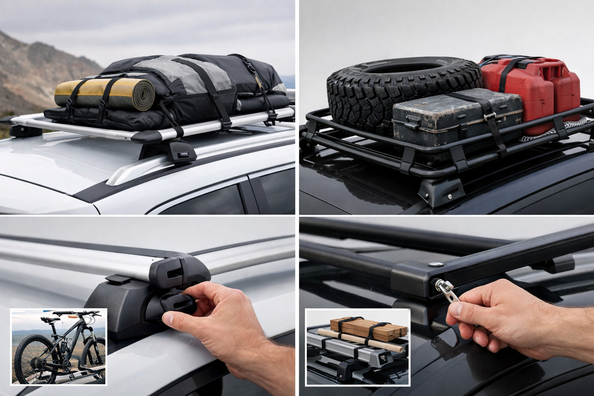
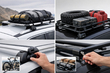
In short: aluminum roof bars/crossbars are usually more convenient (lower weight) and tend to hold up better against corrosion in “normal” weather thanks to a protective oxide layer. Steel often feels stiffer, but its service life depends heavily on coating quality and whether that coating remains intact at chips/contact points.
In practice, the difference between “quieter/noisier” and “lasts longer/problems show up sooner” is often determined not only by the bar material, but also by the profile, fit accuracy, the condition of the seals, and how you re-torque the fasteners after installation.
Roof bars/crossbars are a system of three things: the stiffening element itself (material and geometry), the mounting to rails/roof points, and pads/protection from vibrations. The material sets the baseline: aluminum is lighter and more corrosion-resistant; steel is often stiffer, but requires high-quality corrosion protection. Then installation becomes decisive: whether there’s play, whether the pads are properly compressed, and whether the clamps are tightened to the correct torque.
That’s why the “aluminum or steel” choice is best made based on your use case: how often you remove/install them, whether you drive on rough roads, whether you plan to use a roof box (it changes aerodynamics and high-speed behavior), and what load level you need.
Installation and day-to-day practicality. Aluminum’s lower weight makes removal/installation easier with two people—and even more so alone. But even aluminum can start to “whistle” or develop play if pads/covers aren’t mounted snugly. For any material, it’s important to re-tighten the joints after the first trips: many manuals specify a check after a short distance/time and during the early stages of use.
Noise and vibrations. What matters is not only what the crossbar is made of, but how it’s clamped and whether there’s any gap. At speed, noise often appears due to micro-movement at mounting points and interaction with airflow (especially with a roof box/cargo). That’s why the same material with different mounts can produce different acoustics.
Service life. For aluminum, the key is the protective oxide film (passivation), which in the atmosphere is “largely” protective. For steel, service life is defined by the coating: galvanizing and polymer shells work as long as they aren’t damaged. A chip becomes a starting point for corrosion, and then it depends on how quickly you notice the defect and what you do about it.
Price and the “cost of a mistake.” Cheaper solutions sometimes save on material cost, but don’t always make up for it with the quality of mounts/seals. As a result, you pay with time spent re-tightening, hunting for play, or replacing accessories.
| Option | Strengths | Weaknesses | Who it’s for |
|---|---|---|---|
| Aluminum roof bars/crossbars | Lower weight (for the same volume, steel is ~2.91× heavier). Better corrosion behavior in most atmospheric conditions thanks to oxide-film passivation. | Has a higher coefficient of linear expansion, so after installation it’s critical to re-torque the fasteners during the first trips. Requires attention to the condition of seals and contact points. | For those who often install/remove the rack, drive in rain/above-freezing winter, and want to minimize corrosion risk without complicated maintenance. |
| Steel roof bars/crossbars | As a material, steel is stiffer (higher Young’s modulus), and with quality manufacturers the coating (galvanizing + polymer/shell) delivers good durability. | Heavier, making handling more difficult. Service life strongly depends on coating integrity: chips/defects accelerate corrosion. | For scenarios where “dry” stiffness matters and you don’t mind inspecting the coating and keeping the joints in good condition. |
Installation and convenience. The main practical advantage of aluminum is lower weight. In real products, this means it’s easier to lift the bars onto the roof and easier to remove them before washing/parking without “fighting” the weight. But convenience doesn’t mean you can install it carelessly: seals and clamp torque determine whether there will be play and whether a whistle appears at speed.
Noise. Acoustics often come from contact points (clamp/bracket — rail — pad) and from aerodynamics. So aluminum can be either quieter or not—fit accuracy decides. If you notice a sound after you start using it, the first step is to check tightening according to the manual (for different brands this can be after the first few hundred kilometers or the first few trips after installation).
Service life and corrosion. Aluminum forms a protective oxide layer in air. For aluminum and its alloys, this layer is thin, but it provides a “significant degree” of protection against atmospheric corrosion. At the same time, that doesn’t mean damage to the oxide film and aggressive environments are never an issue: it’s just that under typical conditions (moisture/salts in moderate scenarios) aluminum usually performs better without complex maintenance routines.
Thermal factors. Aluminum has a higher coefficient of linear expansion. This matters in practice: as temperature changes, joints can slightly “settle,” so checking torque after the first trips genuinely affects stability. If you like “install and forget,” aluminum still requires at least an initial torque check.
Installation and weight. Steel roof bars/crossbars are often heavier because steel density is much higher (approximately 7850 kg/m³ versus 2700 kg/m³ for aluminum). This is a downside for daily practicality: frequent repositioning, working without help, working in an awkward posture near the roof. But when the system stays on “season to season,” weight becomes less critical.
Stiffness and vibrations. By Young’s modulus, steel is stiffer. With the right profile geometry and quality mounting, this can mean less deflection under load. But real “anti-vibration” performance still depends on how well the joints are clamped and whether there’s any play. In other words: the material helps, but it doesn’t replace proper installation.
Noise. Steel by itself guarantees neither silence nor whistling. Noises often “are born” because steel in the structure contacts metal/plastic without sufficient damping. So assess whether there are polymer shells, whether the seals are intact, and how the system behaves at speed in your specific setup (with a roof box/without it, with different cargo shapes).
Service life and corrosion. Steel corrodes due to the reaction of iron with oxygen in the presence of moisture. So durability depends on the coating: galvanizing and polymer shells work well if they aren’t damaged. In winter use, paint/coating chips at impact and joint points are especially critical. The practical approach is simple: regularly inspect the areas where scuffs appear most often, and don’t wait until corrosion “takes off.”
| Scenario | What to choose | Why |
|---|---|---|
| Frequent removal/installation (work, travel, one-off loads) | Aluminum | Lower weight simplifies handling and reduces the chance you’ll put off proper re-torquing of the mounts. |
| Driving in rain/wet conditions, want to think about corrosion as little as possible | Aluminum | The protective oxide layer provides higher corrosion resistance in most atmospheric conditions. |
| Long trips with regular checks and a desire to control the joints | Aluminum or steel | More important than material are pad condition, absence of play, and correct re-tightening after the first trips. |
| Heavier loads and an emphasis on profile stiffness | Steel (with high-quality coating) | Steel is stiffer as a material, and real durability is only possible when the coating remains intact. |
| Bad roads/potholes, risk of impacts | Steel or aluminum, but with a focus on protection | Here it matters more how contact areas are protected and whether chips have appeared: any system depends on coating integrity and correct tightening. |
| Scenario | What to choose | Why |
|---|---|---|
| Family trips 1–2 times a month, rarely change accessories | Aluminum | Comfort in routine operations (lifting/removal) + lower corrosion “background” in normal weather conditions. |
| Winter trips with de-icing chemicals, frequent contact with moisture and dirt | Aluminum | The likelihood of corrosion issues is usually lower thanks to passivation; still, don’t forget periodic inspection of the mounts. |
| Regular high-speed driving, acoustics matter | The option with better fit and no play | Noise is more often determined by mounting accuracy, pads, and aerodynamics (especially if there’s a roof box), not by material alone. |
| Seasonal transport and minimal handling, willingness to inspect the coating | Steel | Can be practical if the coating is high-quality and you monitor damage points. Plus: stiffness can reduce deflection. |
| Need to frequently “take out” and “put away” the bars yourself | Aluminum | Lower weight is a direct factor in convenience and safety during handling. |
Paying more often makes sense when you’re looking not for “a pricier material,” but for overall system quality: precise fit, proper seals, a well-designed bracket, and consistent repeatable installation without play. If you plan frequent long-distance trips, a roof box, or regular cargo transport, it’s the mounting stability and vibration behavior that make a noticeable difference.
If you’re interested in how to correctly choose a roof rack for your vehicle and avoid missing the right configuration, it helps to cross-check the installation criteria on the roof rack page. Only after that does it make sense to compare bar materials: more expensive systems often “pay you back” specifically by delivering stable installation from the first attempt.
It’s also worth paying more if you frequently change accessories (swap different loads/mounts) and want each assembly not to turn into manual tightening and play hunting.
If we give a short practical verdict: for most users, aluminum is more universal and simpler to choose—it’s lighter and in typical weather conditions usually holds up better against corrosion. Steel makes sense when you need profile stiffness and you’re ready to monitor coating condition and install/re-torque the mounts carefully.
Regardless of material, your “real service life” is determined by installation: pads, no play, and torque checks after the first trips. If you do that, the difference between aluminum and steel often becomes less critical, and the choice comes down to convenience (weight) and corrosion risk in your specific region and driving style.
| ✔ | Aluminum bars are lighter, so they are easier to remove and install with two people, and even alone, without the risk of “putting off” the right actions because of the weight. |
| ✔ | Aluminum usually retains its corrosion resistance better in typical atmospheric conditions thanks to its protective oxide film. |
| ✔ | A steel конструкtion can be practical if you need greater profile rigidity and are ready to monitor the condition of the components and coating. |
| ✔ | In both cases, real stability is often determined by correct clamping and the condition of the seals, so you can get predictable performance with proper installation. |
| ✘ | Aluminum has a higher coefficient of linear expansion, so after installation it is critical to retighten the fasteners on the first trips; otherwise, play or whistling may occur. |
| ✘ | For steel, service life depends heavily on the integrity of the coating: chips/damage and issues at contact points sharply increase corrosion risks. |
| ✘ | Noise and vibrations are not guaranteed by the material itself: they often appear due to micro-movements at the mounting points, gaps, and improper/worn seals. |
Shipping to EU
Wholesale and retail
Own warehouse
Опис продукту
Подарунки не надаються при оформленні покупки у кредит під 0,01% або при покупці частинами.