 Author: Radomskyi Maksym Vasyliovych
In short: for conventional (raised) roof rails, a roof rack is usually easier to match, quicker to install, and cheaper to assemble. For integrated roof rails, the kit is more often pricier and more vehicle-specific, but it sits lower on the roof, usually makes less noise at highway speeds, and suits those who drive with crossbars regularly.
The main mistake here is in the wording. You’re not choosing which type of rails is better in general: on your car, it’s already defined by the design. The real choice is different: which rack kit is compatible with your exact roof, whether it’s enough for your load, and whether it’s worth paying extra for a lower profile, less noise, and more precise mounting.
What the choice really comes down to
Conventional rails have a gap between the rail and the roof—you can literally “wrap” a clamp around them. Integrated rails sit close to the roof without that gap. Because of this, the rack mounting differs: for conventional rails, feet and crossbars are often enough, while for integrated rails you usually also need an adapter or vehicle-specific fitting kit.
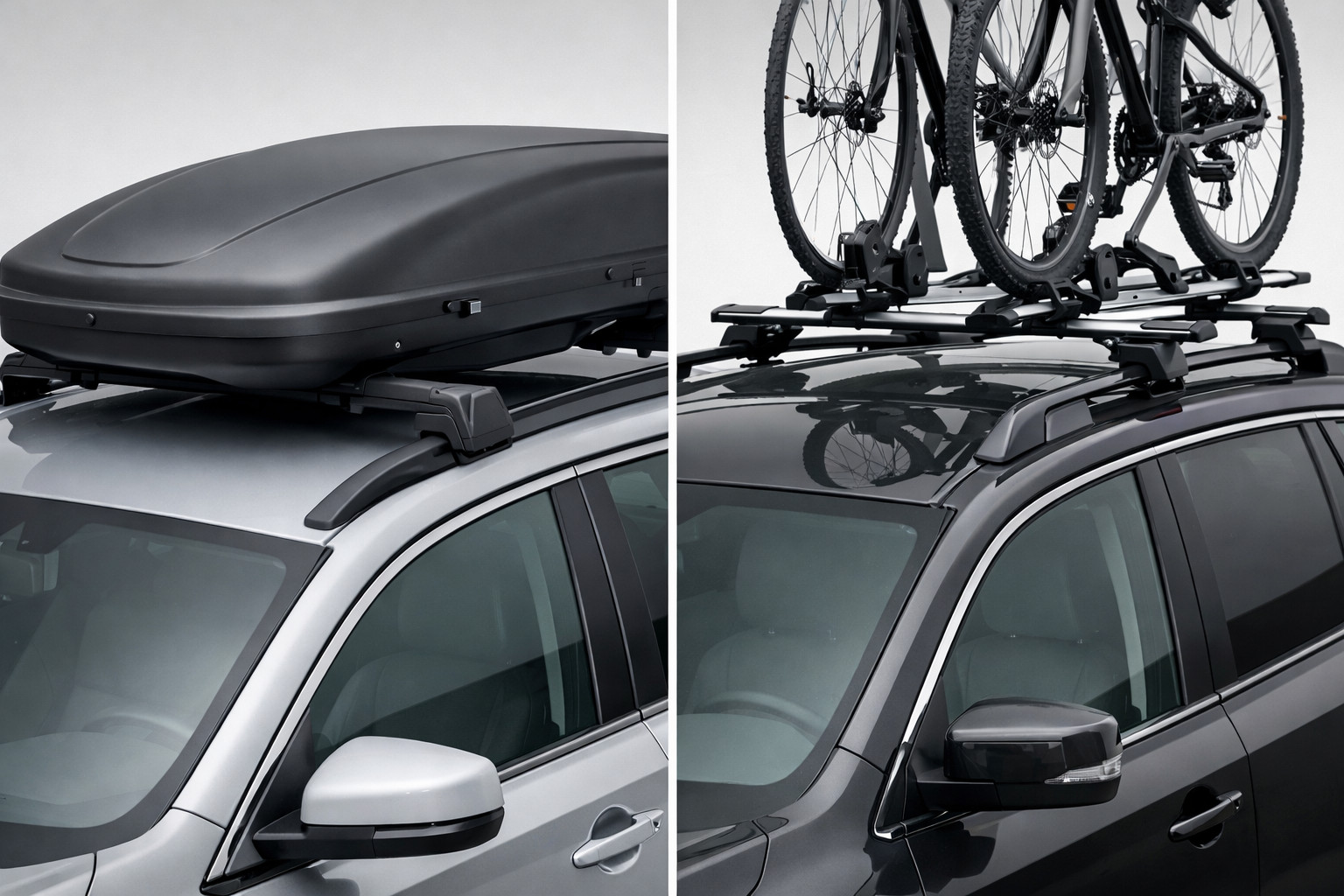
The second key point is not to confuse roof rails with a working load-carrying rack. The rails on the roof alone do not mean you can mount a roof box, bike, or tent. The system that actually carries the load is the crossbar setup, and it’s not universal: roof shape, mounting type, permitted load, and even the installed height depend on the specific vehicle.
What criteria to compare by
To avoid buying the wrong thing, you should compare not by one parameter, but by five practical criteria at once:
- Installation. How many parts are needed, whether there’s a vehicle-specific adapter, and how easy it is to remove and reinstall the system.
- Noise. It’s affected not only by the type of rails, but also by the crossbar shape, installation height, and whether the bars stay on the roof permanently.
- Durability. It’s determined not by the rail type name, but by fit accuracy, correct torque, clean contact areas, and avoiding overload.
- Practicality. Whether you need the rack a few times a year or it will live on the roof all season; whether height is critical for parking garages; and whether you plan a roof box, skis, bikes, or heavier cargo.
- Price. Calculate the full kit: feet, crossbars, adapters, locks—not just the “bare” bars.
Load rating is a separate consideration. For everyday systems, a dynamic limit around 75 kg is common, sometimes higher, but the rule is always the same: use the lower of what the vehicle and the specific rack allow. If we’re talking about a rooftop tent, both dynamic and static loads matter—and the static limit can be several times higher than the dynamic one.
Quick comparison of options (table)
| Option | Strengths | Weaknesses | Who it suits |
|---|---|---|---|
| Rack for conventional roof rails | Easier initial installation, fewer separate parts, usually a lower entry price | Higher profile, more noise more often with permanently installed crossbars, a rougher look | Those who carry cargo occasionally, don’t want to overpay, and value fast installation |
| Rack for integrated roof rails | Lower fit, cleaner look, usually better aerodynamics and less whistling with good crossbars | More expensive kit, stronger dependence on the vehicle model, higher cost of a mistake if chosen incorrectly | Those who often drive on highways, keep a roof box on for a long time, or want a compact system without extra height |
If you boil it down to one line: conventional rails more often win on simplicity and budget; integrated rails win on profile, quietness, and a cleaner look. But for heavy-duty use, it’s not the rail type that decides—it’s the certified limits of the specific kit.
DD Tuning expert comment: most often people make a mistake even before choosing a brand—they look at the roof from a distance and confuse conventional rails with integrated ones. If there’s a gap under the rail, it’s one mounting type; if the rail almost lies on the roof, you need a different kit. The second common mistake is focusing only on the kilogram number without considering crossbar shape, installation height, and whether the system will stay on the car permanently.
Detailed breakdown of each option
Rack for conventional roof rails
This is the most straightforward scenario for most wagon, crossover, and minivan owners. Because there’s a gap under the rail, mounting is simpler: the foot clamps around the rail, the system uses fewer parts, and the starting cost is usually lower. If you need a rack a few times per season for a roof box, skis, or a trip to the seaside, this option often gets the job done without overpaying.
The downsides are predictable too. The fit is higher, so aerodynamics are worse, and noise depends more on crossbar shape. If you leave the system on the roof for a long time, you can get whistling at speed and a small but noticeable impact on fuel consumption. For longevity, it’s important not to overtighten the mounts and to remove the crossbars periodically when they’re not needed.
Rack for integrated roof rails
Here the system is more often vehicle-specific. Because there’s no gap, you need an exact fit to the rail and roof shape, so the kit often includes a separate adapter. That’s what adds cost, but it also brings an advantage: the rack sits lower, looks more compact, and with aerodynamic crossbars it usually runs quieter on the highway.
This option makes sense when the vehicle frequently covers long distances, regularly carries a roof box, or when overall height is critical for parking. But an integrated setup is less forgiving of selection mistakes: the wrong kit won’t provide the correct clamping geometry, and all the benefits of the expensive solution disappear. For rooftop tents, heavy roof boxes, or driving on rough roads, don’t look at whether the rails are “nice” or “factory”—look at the permitted load of your exact system and the vehicle.
Which option is better for different scenarios
For rare use—when you just need to install a roof box once or twice a month or transport long items—there’s usually no point in overpaying: systems for conventional rails are more practical. If the crossbars live on the car all the time, the vehicle spends a lot of time on the highway, and the driver is sensitive to whistling and extra height, the integrated option more often turns out to be the better choice.
For heavier tasks, the picture changes. A rooftop tent, expedition basket, multiple bikes, or driving on uneven roads—these are scenarios where rail type is secondary. What matters are the certified limits, the distance between crossbars, system rigidity, and whether the vehicle manufacturer allows that mode of use.
Use scenario and what to choose (table)
| Scenario | What to choose | Why |
|---|---|---|
| A few trips a year with a roof box | Conventional rails with aerodynamic crossbars | Easier to assemble, cheaper start, and noise can be kept at a reasonable level with the right bar shape |
| Weekly highway driving, crossbars installed permanently | Integrated rails with a low-profile system | Less height, a cleaner fit, usually quieter at speed |
| Low parking garage or overall vehicle height is critical | Integrated rails | Every extra centimeter matters, and the lower fit is truly noticeable here |
| Budget start without permanent use | Conventional rails | Fewer parts and a lower total kit cost |
| Rooftop tent or heavy touring use | Choose by the system’s specs, not by rail type | You need to verify dynamic and static loads, the vehicle’s limit, and crossbar spacing |
Common mistakes when choosing
- Buying a kit “by eye” without checking whether there’s a gap under the rail.
- Thinking that roof rails alone are already ready for cargo. In reality, the crossbar system does the work.
- Comparing only the price of the bars, ignoring the cost of adapters, locks, and vehicle-specific feet.
- Relying only on the rack’s stated kilograms without checking the vehicle roof limit.
- Choosing noisy rectangular crossbars for constant highway driving and then being surprised by the whistling.
- Leaving crossbars on the roof all year even though they’re only needed a few times per season.
- Assuming any OEM rails work equally well for a tent or heavy gear.
When a more expensive solution makes sense
Paying extra is justified when you use the rack often, drive fast and far, are sensitive to noise, or are limited by parking height. In those conditions, the money isn’t spent “on the brand,” but on a precise mounting kit, a lower fit, and better aerodynamics. A pricier option is also logical if an expensive roof box or other gear will be on the roof—something you don’t want to check for play after every trip.
For a practical selection, it’s worth looking separately at systems for integrated rails, comparing them with options for conventional rails, and not skimping on bar shape if quietness matters to you: the difference is well explained in the piece on aerodynamic crossbars. This is exactly where the more expensive solution most often turns out not to be a luxury, but a way to avoid unnecessary noise, extra height, and incorrect installation.
From a customer’s experience: an estate car owner with integrated rails was looking for a kit for a roof box and initially wanted the cheapest “almost universal” feet. After verifying the roof type, he switched to a vehicle-specific low-profile kit with aerodynamic crossbars. As a result, he got less whistling on the highway, a solid height margin for parking, and didn’t have to revisit the issue by reworking the mounts.
Conclusion
It’s easy to get this wrong if you think in terms of “what’s better in general.” In reality, if you have conventional rails, the simpler and more affordable kit often wins; if you have integrated rails, it’s justified to choose a precise vehicle-specific system—especially for highway driving, permanent use, and a lower profile. For heavy-duty scenarios, what matters isn’t the rail type but the certified load rating and compatibility of all elements. This material is based on real-world selection experience, installation practice, and real usage scenarios—not abstract promises.
How it works
- Determine the type of roof rails on the car First, check whether there is a gap between the roof rail and the roof. If there is a gap, they are standard roof rails; if the rail sits almost flush with the roof, they are integrated. The type of roof rack mount depends on this, not on your personal preference.
- Compare the compatible kit, not just the bars For standard roof rails, feet and crossbars are often enough, while integrated rails usually also require an adapter or a vehicle-specific kit. Check the full set: feet, crossbars, adapters, and locks to avoid mistakes with price and compatibility.
- Assess how often you will use the roof rack If you need a roof rack only a few times a year, simpler systems for standard roof rails are usually more practical. If the crossbars will stay on permanently and you often drive on the highway, integrated roof rails can provide a lower profile, less noise, and a cleaner look.
- Check the load and intended use Focus not only on the type of roof rails, but also on the vehicle and rack load limits stated in the manual. For heavy-duty tasks, a roof tent, or expedition gear, dynamic and static load, the distance between the crossbars, and the manufacturer's approval are important.
- Consider noise, height, and the total budget For regular driving, the shape of the crossbars, installation height, and overall aerodynamics matter. Calculate the total cost of the kit, not just the bars: for integrated systems, the higher price is often justified by quieter operation, a lower profile, and a more precise fit.
Pros and cons
For standard rails, the roof rack is usually easier to choose and quicker to install. This is convenient when the system is needed not constantly, but only for a few trips per season.
A kit for standard rails is more often cheaper, because it usually requires fewer parts and is not as tied to the car model. This reduces the initial cost of a complete set.
A roof rack for integrated rails sits lower and looks more compact. For those who often drive on the highway or have parking height limits, this is a practical advantage.
Integrated rails with aerodynamic crossbars usually make less noise at speed. If the crossbars stay on the roof all the time, this is noticeable in everyday driving.
For frequent use, a more expensive model-specific solution may be justified, because it provides a more precise fit and less risk of making a mistake with the fit. This is especially important for a roof box or regular highway trips.
A system for integrated rails is usually more expensive, because it often requires adapters and more precise selection for a specific car. Because of this, a mistake when buying costs more.
A roof rack for standard rails sits higher, which leads to worse aerodynamics and more often creates whistling at speed. If you leave it on the roof for a long time, this can be a noticeable drawback.
Integrated rails are less forgiving of choosing the wrong kit. If the mount does not fit exactly, the benefits of the lower position and quietness are effectively lost.
For heavy-duty scenarios, both options depend not so much on the type of rails as on the vehicle’s official limits and the roof rack itself. This means that not every system is suitable for a roof tent or heavy gear.