19.07.2026
365
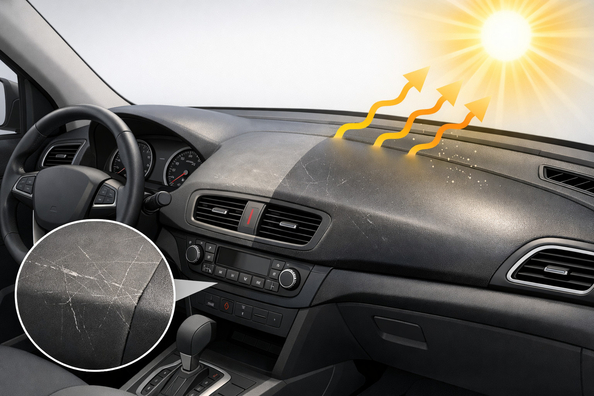

A dashboard turns dull and gets scratched in the sun not because of a single factor. Usually it’s a combination: UV and overheating age the top layer of plastic or coating, while dust, sand, and dry wiping quickly make that aging visible.
If the panel becomes sticky in the heat and looks dry or chalky when it cools down, the issue is no longer just dirt. It’s important to distinguish thermal aging, chemical damage, and ordinary scratches from improper care, because the fixes are different.
The top of the dashboard sits right under the windshield, meaning it receives the most light and heat. That’s where the coating loses elasticity faster, turns cloudy, dries out, or, conversely, starts to feel tacky. The most vulnerable area is near the glass and the air vents.
Then mechanics come into play: once the top layer is weakened by the sun, even wiping dust with a dry cloth leaves micro-scratches. On a dark panel, they show up as dull patches, white streaks, or glossy rubbed areas.
DD Tuning expert comment: the most common mistake is wiping dust dry and immediately applying a glossy polish to a hot dashboard. People mask the problem for a few days, but then end up with even more stickiness, smears, and scratches. First you need to reduce the thermal load, and only then decide whether gentle care is enough or whether masking or replacement is needed.
| Symptom | Likely cause | What to do |
|---|---|---|
| The panel has turned uniformly dull on top | UV and constant overheating | Reduce sun exposure, park in the shade, use windshield protection, clean only gently |
| Sticky in the heat, dry or chalky when cool | Heat-and-moisture breakdown of the coating | Don’t mask with gloss, reduce heating, assess whether a cover or replacement makes sense |
| White streaks and fine “webbing” | Dry friction, dust, rough cloth | Switch to damp microfiber and a mild product; don’t rub abrasively |
| A localized spot or sticky area | Chemicals: perfume, creams, glass cleaner | Clean gently, stop using aggressive products, watch for peeling |
| One area is worse than the others | Localized overheating or reflected sunlight | Change parking location, add sun protection, check whether the pattern repeats |
| Cracks or delamination | The coating is already destroyed | Cosmetics will hardly help; consider a cover or replacing the part |
What works is what reduces the cause itself: less direct sun, lower temperature, less rough contact. The most noticeable effect comes from shade, a screen or curtain when parked, and glass with proper UV and heat protection.
For care, a simple routine works: soft microfiber, warm water, a gentle non-aggressive cleaner, and no heavy pressure. If cream, perfume, or glass chemicals get on the panel, it’s better to remove them right away rather than spread them over the entire surface.
When the surface has already started to age, the key is not to “treat” it with shine. First you need to stabilize the condition: reduce overheating, change the cleaning method, and stop drying and “polishing” the panel with daily wiping.
Glossy polishes and silicone products often deliver only a short visual effect. On a hot panel, they can dry quickly, stain, attract dust, and emphasize unevenness in the coating.
It’s a bad idea to rub the dashboard with a dry cloth, a stiff brush, an abrasive sponge, or a strong cleaner. If micro-cracks and haze have already appeared, aggressive cleaning makes them deeper and more noticeable.
A questionable option is any “miracle restoration” without addressing overheating. If stickiness returns in the heat, the cause hasn’t been removed—the product merely masked the symptom temporarily.
Accessories make sense when they either reduce sun load or cover an already worn surface without making things worse. For long parking periods, the simplest solution is sunshades: they don’t repair the coating, but they do significantly reduce direct heating.
If the top layer is already worn but the base is intact, dashboard covers can be appropriate. It’s more logical than endlessly polishing an area that will keep turning matte or sticky again.
When the cabin overheats regularly, it makes sense to look broader and evaluate whether window tinting within your region’s rules will help. Replacing a part is justified when there are cracks, peeling, or stickiness returns even after proper cleaning and sun protection.
| Solution | When it works | When it’s not worth spending money |
|---|---|---|
| Shade, curtain, windshield screen | For prevention and slowing aging, especially with daily parking | If you expect it to remove existing cracks or deep stickiness |
| Gentle cleaning with microfiber | When the issue is dust, smears, light care marks | When the top layer is already destroyed or peeling |
| UV and heat protection for glass | As a systematic reduction of load on the interior | If the panel is already cracked and you need a visible fast repair |
| A cover over the damaged area | When you need to hide a worn look without fully replacing the dashboard | When the issue is localized stickiness that continues spreading under the coating |
| Part replacement | When there are cracks, delamination, persistent stickiness, and chemical breakdown | When the surface is only slightly dull and it’s enough to reduce overheating and change care |
From a customer’s experience: a person was looking for a quick fix for a dull panel because after every wash the effect disappeared in a few days. After inspection it turned out the upper zone near the glass had already been overheating, and dust was constantly wiped dry. In the end, they ditched glossy products, added sun protection, and covered the worn area with a cover where cosmetics no longer delivered a decent look.
Fast dulling and scratches on a dashboard almost never appear out of nowhere: sun and overheating destroy the surface, and dust, dry wiping, and poor chemical choices finish it off visually. So the correct order is: understand the damage scenario, remove overheating, switch to gentle care, and only then decide whether protection is enough or a cover or replacement is already needed.
If the panel has only dulled, it’s better to invest in prevention. If it’s sticky, peeling, or cracking, cosmetics rarely save it for long. This material is based on real selection experience, hands-on practice, and real usage scenarios—not myths about “magic” polishes.
Shipping to EU
Wholesale and retail
Own warehouse
Опис продукту
Подарунки не надаються при оформленні покупки у кредит під 0,01% або при покупці частинами.