05.08.2026
189
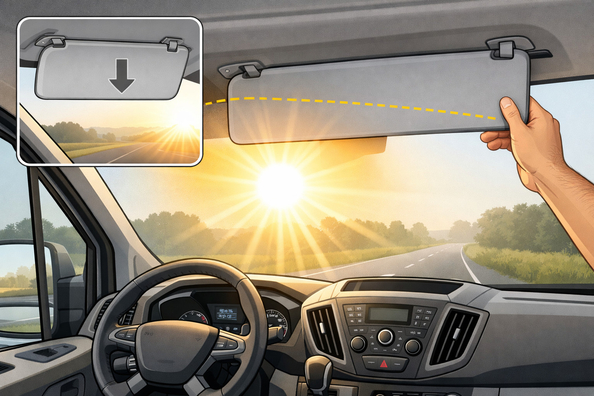
In a Ford Transit, the morning sun dazzles you not because of one small thing, but because of a combination of a low light angle, a large windshield area, and the condition of the glass itself. If you immediately install a dark sun strip or buy an external visor, you can spend money while the real cause remains.
The fastest path to results is this: first separate dirt and glass wear from the sun’s geometry, then use the factory sun visor correctly, and only after that decide on accessories. For Transit this is especially important, because even a slight film on the inside of the glass sharply increases glare in morning light. If you need basic tips for driving into the sun, it helps to keep at hand tips for driving into the sun and checking the glass before departure, and to understand the factory logic, check the Transit sun visor user instructions once again.
On morning trips the sun is low, so light enters the windshield almost in a straight line. In a Ford Transit the windshield is large, the seating position is high, and the route often runs east–west, so the driver stays in the same blinding sector for a long time rather than getting a short flash.
The second part of the problem is not the sun itself, but how the glass scatters light. An oily film on the inside, wiper streaks, fine scratches, chips, and pitting turn a bright beam into a milky haze across the whole area. That’s why two identical Transits at the same time can behave completely differently.
DD Tuning expert comment: The most common mistake is buying a sun strip or an external visor before cleaning the inside of the glass and checking for pitting. The second mistake is ordering a visor without verifying the model year, roof height, and mounting method. If the glass is already peppered with small impacts, an accessory will only help partially.
| Symptom | Likely cause | What to do |
|---|---|---|
| White haze across the entire windshield right after sunrise | Oily film, streaks, micro-scratches | Wash the glass on both sides, check wiper condition, inspect the glass under angled light |
| The sun hits right at the upper edge of your field of view | The factory sun visor doesn’t cover the needed sector | Flip down, extend, and rotate the visor fully; if the gap remains every day, consider an upper strip or an external visor |
| The problem almost disappears after 10–15 minutes | The main factor is the route and the sun angle | Shift departure time, change the route if possible, add polarized sunglasses |
| After the wipers sweep, glare becomes stronger | Worn blades or dirty glass | Replace blades, refresh washer fluid, remove streaks |
| Even after washing, there are sparkling points and scattered light at night and in the morning | Pitting or a sandblasted windshield | Don’t waste time on cosmetics; assess whether windshield replacement makes sense |
What works is a combination of simple things, not one magic part. First: clean glass on both sides and decent wipers. Next: the correct position of the factory sun visor, because in Transit it’s often underused—left unextended or not rotated toward the side window.
The second level is polarized sunglasses and a small shift in departure time, if your schedule allows. When the problem repeats daily on the same route, these two steps deliver more impact than random stickers on the glass.
If the glass is clean, the visor is set correctly, and the sun still regularly hits the same upper sector, then additional shading makes sense: a neat upper strip within regulations or an external visor. If the driver is already blinded, there’s only one solution—reduce speed and don’t try to drive “by habit” while effectively blind.
Washing only the outside of the glass almost doesn’t work. In many Transits the stronger haze comes from an inner film that you can’t see in the shade. Cosmetic treatments also give a weak result if the windshield is already covered with micro-chips.
Overly dark strips in the viewing zone and the cheapest external visors with weak mounting work only briefly or with side downsides. The first can ruin visibility and go beyond what’s allowed; the second can create noise or vibration at speed.
It’s worth moving to accessories after the basic checks. If you consistently lack shade from above, take a look at the external windshield visor or the entire category of visors for Ford Transit. If you want to compare adjacent solutions for the upper part of the glass, it makes sense to view windshield deflectors.
An accessory is justified when the problem repeats daily, the blinding sector is clearly the same every time, and the factory sun visor no longer reaches high enough. Windshield replacement is justified in another scenario: when washing changes nothing, and you can see pitting, micro-scratches, or chips that scatter light across the whole area.
| Solution | When it works | When it’s not worth spending money |
|---|---|---|
| Thoroughly washing the glass inside and out | There’s film, streaks, deposits; glare got worse after using the wipers | Pitting and micro-scratches are already visible across the whole area |
| Correct use of the factory sun visor | The sun comes from above or from the side, and the visor simply isn’t set properly | Light is scattering through the entire windshield, not through one gap |
| Polarized sunglasses | Direct bright glare dominates; the route is short or daily | The main issue is a sandblasted windshield that glows across the whole field |
| Shift departure time by 10–15 minutes | The problem is tied to a specific morning time window | Your schedule is rigid, or it dazzles throughout the whole stretch regardless of time |
| Upper tint strip within the rules | You need to remove exactly the upper blinding sector | You want to darken the main viewing zone or hide glass defects |
| External visor | The factory visor isn’t enough, the problem is daily, and you’re ready for proper installation | You need a silent solution without modifications, or mount compatibility hasn’t been checked |
| Windshield replacement | There’s pitting, chips, scratches, and cleaning no longer helps | After washing and setting the visor, the glare almost disappeared |
From a customer’s experience: On a Transit used for morning deliveries, the problem turned out to be not the sun itself but a combination of a dirty inner glass surface and an unextended factory sun visor. After deep cleaning, new wiper blades, and polarized sunglasses, glare decreased so much that not everyone needed an external visor. In similar scenarios, the accessory only makes sense when the basic steps didn’t cover the required sector.
In most cases, morning glare in a Ford Transit is solved not with a single product but with the right sequence of actions: clean glass, checking its wear, fully using the factory sun visor, polarized sunglasses, and, if possible, a small shift in departure time. If after that a distinct upper sun sector remains, then it’s logical to move to a strip or an external visor; if the entire glass area glows, consider replacing the windshield.
The material is based on real selection experience, hands-on practice, and real usage scenarios: first we rule out simple causes, then we check the geometry of the glare, and only after that do we spend money on accessories or replacing parts.
Shipping to EU
Wholesale and retail
Own warehouse
Опис продукту
Подарунки не надаються при оформленні покупки у кредит під 0,01% або при покупці частинами.