
































































 Author: Radomskyi Maksym Vasyliovych
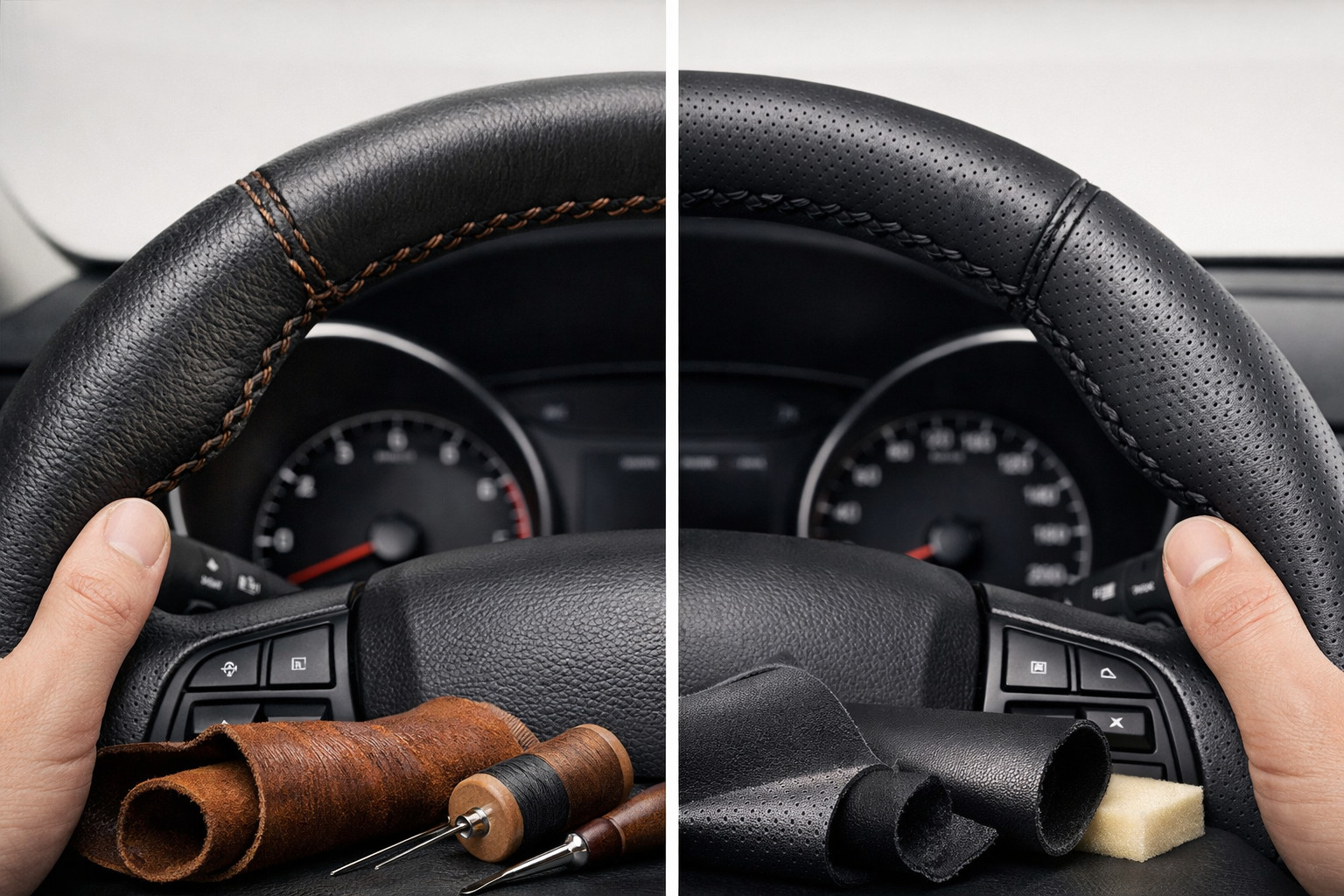
For everyday driving, genuine leather usually wins on grip, breathability, and longevity, while eco-leather wins on price, ease of care, and installation speed. But it’s not only the material that decides: if the cover is inaccurately sized or poorly tightened, it will slip, rustle, and ruin the steering feel regardless of what it’s called.
So you should look not at the marketing label, but at the fit, thickness, driving scenario, and whether the car has a heated steering wheel. For some, long service life and consistent grip matter most; for others, it’s about quickly covering a worn steering wheel without extra expense.
What the choice comes down to
The main trade-off is simple: genuine leather behaves better over long-term use, feels nicer in the hands, and tolerates constant friction better, while eco-leather more often attracts with a lower price and simpler care. For daily trips, you can feel this within a few weeks—especially if you drive a lot in the city, maneuver often, or keep your hands on the wheel for long periods.
The second important point: the term “eco-leather” doesn’t guarantee anything by itself. Sellers may use it for different synthetic materials, so you should judge not only by the name, but by the actual composition, thickness, surface type, and installation method.
Criteria to compare by
- Installation and fit. A stitch-on cover takes longer to install but usually fits more precisely. A universal slip-on installs in minutes, but it’s less forgiving of sizing mistakes.
- Grip and thickness. If the cover is too thick, the steering wheel feels “fat” and less precise in turns.
- Noise and stability. Squeaks, rustling, and micro-shifts appear more often where the fit is loose or tension is poor—not simply because it’s the “wrong material.”
- Longevity. Genuine leather typically keeps a good feel in the hands longer and ages better. Eco-leather can dry out, crack, or delaminate faster, especially from heat and aggressive chemicals.
- Care practicality. Eco-leather is easy to wipe with a damp cloth. Genuine leather is also not hard to maintain, but it requires a gentler approach without harsh cleaners.
- Price. If the budget is tight, eco-leather often looks more logical. If you’re buying a cover for the long run, paying extra for genuine leather is often justified.
- Compatibility with steering wheel heating. Any cover partially insulates heat, but thick and less dense options make this more noticeable.
Quick comparison of options (table)
| Option | Strengths | Weaknesses | Who it’s for |
|---|---|---|---|
| Genuine leather | Better grip, breathability, higher longevity, ages better, easier to restore | More expensive, more sensitive to careless maintenance, often longer and more complex installation | For those who drive a lot, want precise steering feel, and are buying a cover for the long term |
| Eco-leather | Lower price, simple daily care, often quick installation | Worse breathability, risk of cracking and delamination, cheaper models more often slip | For those who need a budget-friendly, fast way to freshen the steering wheel or cover wear |
DD Tuning expert comment: The most common mistake is buying a cover only by steering wheel diameter and not accounting for rim thickness. The second typical issue is weak tightening of a stitch-on option: the customer expects the cover to “seat itself,” and ends up with wrinkles, micro-shifting, and squeaking. If the steering wheel is heated, cover thickness must be controlled especially carefully.
Detailed breakdown of each option
Genuine leather
This is the option for those who care about the steering feel every single day. Genuine leather breathes better, works more pleasantly with the palm, and usually withstands constant friction longer. Over time it looks more convincing—rather than simply “lasting until the first hot season.”
But you pay for that with both money and attention to installation. A quality stitch-on cover must be tightened firmly during installation, not just pulled at the end. If you choose material that’s too thick or stitch it carelessly, the wheel will become bulky and grip precision will suffer.
Maintenance also matters: excess chemicals can damage the finish. If you often drive with hand cream on, leave the car in the sun, or rarely wipe the steering wheel, even good leather will wear faster.
Eco-leather
The strong side of eco-leather is practicality up front. These covers are often cheaper, and daily care usually comes down to a simple damp cloth. If you need to quickly make a worn steering wheel look tidy, it’s genuinely a convenient option.
The weak point isn’t the name itself, but the real quality of the specific material. Under the term “eco-leather,” very different coatings in density and wear resistance may be sold. In cheap universal models, the issue is more often not that it’s synthetic, but that the fit is inaccurate—then slipping, rustling, and the feel of a foreign layer on the wheel appear.
Another nuance is heat. Eco-leather is more sensitive to overheating and rough care, so in an interior that often sits in the sun, its service life may drop faster. For a temporary or budget solution that’s fine; for long-term daily use, it’s already a compromise.
Which option is better for different scenarios
If daily hand comfort, stable grip, and proper material aging matter to you, genuine leather has the advantage. It makes more sense for those who drive a lot on highways, like precise steering feel, and don’t want to replace the cover after a season or two.
Eco-leather is justified when budget, easy care, and a quick interior refresh come first. It’s a solid choice for a car that needs a neat update without an expensive re-wrap, or when the cover is seen as an interim solution.
For a heated steering wheel, I’d look not only at the material, but also at thickness. If the cover is thick and soft, the heating effect will be weaker in any case. In that scenario, it’s better to use a thin, tightly fitted leather option—or skip a cover altogether.
Use scenario and what to choose (table)
| Scenario | What’s better to choose | Why |
|---|---|---|
| Daily city driving, lots of turns and parking | Genuine leather | Feels better in the hands, less irritating in constant contact, keeps solid grip longer |
| Need to quickly and cheaply cover a worn steering wheel | Eco-leather | Lower budget and faster installation, especially if a temporary solution is needed |
| Car with a heated steering wheel | Thin, tight genuine leather cover | Steals less heat than thick universal options and sits more securely |
| The car often sits in the sun | Genuine leather or quality thin eco-leather without skimping on material | Cheap synthetic coatings dry out and age faster from heat |
| Need the simplest possible care | Eco-leather | It’s less demanding for daily cleaning |
Common mistakes when choosing
- Buying a cover only by steering wheel diameter and not accounting for rim thickness.
- Believing that the word “eco-leather” means natural or automatically high-quality material.
- Choosing a cover that’s too thick, after which the steering wheel loses precision.
- Ignoring steering wheel heating: after installing a cover, it almost always feels weaker.
- Tightening a stitch-on cover too loosely and expecting it to “tighten itself.”
- Cleaning any material with aggressive products or rubbing the surface hard.
When a pricier solution makes sense
Paying extra is justified when the steering wheel isn’t just an interior element, but a constant contact point with the car. If you drive every day, maneuver a lot, want a neat grip for years, and don’t like the feel of a cover, the more expensive leather option usually pays back in comfort and longevity.
A practical path is this: first look at leather steering wheel covers, then compare the nuances in the materials overview, and if the problem is already slipping and fast wear, it’s also useful to review the separate article about steering wheel slipping. This approach usually saves more than trying the cheapest option at random.
From a customer’s experience: At first we looked for an inexpensive cover just to hide scuffs on the steering wheel, and chose a universal eco-leather option. After some time, slight slipping and weaker heating became annoying, so we switched to a thinner, tightly stitched leather cover. In the end, the wheel felt more natural, and the extra cost proved justified specifically in daily driving.
Conclusion
For most everyday scenarios, genuine leather is the stronger choice if grip, breathability, and longer service life matter to you. Eco-leather makes sense when the priority is budget, quick installation, and easy care, but it’s critical not to confuse a convenient label with real material quality. Most mistakes happen not in choosing between “leather” and “eco-leather,” but in choosing the size, thickness, and type of fit. This material is based on real selection experience, practice, and real usage scenarios, so the main advice is simple: measure the steering wheel and evaluate the installation first, and only then look at the material.
How it works
- Determine What Matters Most to You First, choose your priority: a secure grip, longer service life, and breathability, or a lower price, easier care, and a quick steering wheel refresh. For everyday driving, genuine leather is usually more comfortable, while eco-leather is more practical as a budget option.
- Check the Size, Thickness, and Fit Don’t choose a cover based only on the steering wheel diameter: the rim thickness and how snugly it fits also matter. A cover that is too thick or not precisely matched will slip, make noise, and reduce driving feel.
- Evaluate the Installation Method A sewn-on cover takes longer to install, but it usually fits more precisely and stays more stable. A universal stretch cover installs faster, but size mistakes are felt more strongly with it.
- Consider the Operating Conditions If the car has a heated steering wheel, choose a thin, snug-fitting option so less heat is lost. If the car often sits in the sun, pay attention to material quality, because cheap synthetic coverings age faster.
- Choose the Material for Your Use Case For daily trips, frequent maneuvers, and long service life, it makes more sense to look at genuine leather. If you need to quickly and inexpensively cover a worn steering wheel or want the simplest possible care, eco-leather will be more suitable.
- Avoid Common Care Mistakes Do not clean any material with harsh products, and do not rub the surface too hard. For eco-leather, a damp cloth is usually enough, while genuine leather needs more delicate care without harsh chemicals.
Pros and cons
Natural leather is better suited for everyday driving: it feels nicer in the hands, provides a more stable grip, and handles constant friction better. For those who make a lot of maneuvers or hold the steering wheel for long periods, this is especially noticeable.
Natural leather has a longer service life and performs better over time. It keeps a good feel in the hands longer and ages better than most eco-leather options.
Eco-leather is usually cheaper, so it is convenient if you need an inexpensive way to cover a worn steering wheel or quickly refresh the interior. It is a practical option when a cover is needed as a temporary or budget solution.
Eco-leather is easier to care for in everyday use: usually, it is enough to wipe it with a damp cloth. This is convenient for daily use without complicated cleaning procedures.
A stitched natural leather cover usually fits more precisely if it is stretched properly. A good fit reduces the risk of creaks, micro-slips, and the feeling of an extra cover on the steering wheel.
Natural leather is more expensive and often requires more careful installation. If the material is too thick or the cover is poorly stitched, the steering wheel can become bulky and less precise.
Caring for natural leather is less forgiving of mistakes. Harsh chemicals, sunlight, and frequent contact with hand cream can speed up wear of the coating.
Eco-leather handles prolonged heat worse and may dry out, crack, or peel faster. This especially applies to cheaper models and cars that are often parked in the sun.
Eco-leather universal covers more often have fitment issues. If the size is not chosen precisely, slipping, rustling, and the feeling that the overlay sits unnaturally can appear.