22.07.2026
230
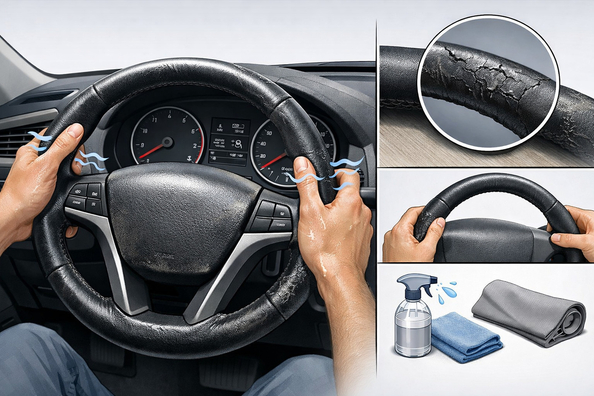

If your steering wheel has become slippery and is wearing out quickly, the problem is usually not aging itself but either a film of grease, sweat, hand cream, and sanitizer on the surface, or the fact that the top protective layer has already been worn away. These two scenarios can feel similar to the touch, but they’re solved differently: in the first case, proper cleaning helps; in the second, you’re looking at restoration, re-wrapping, or replacement.
The most expensive mistake is smearing a slippery steering wheel with greasy products or hiding the issue under a random cover. First you need to understand the material and the real condition of the surface, and only then decide whether care is enough, whether an accessory makes sense, or whether it’s better to invest straight into a repair.
A steering wheel starts to slip when the surface loses normal friction. This happens either because of a thin residue from hands and household chemicals, or because the finish layer of leather, eco-leather, or another coating is wearing out. To the touch, both options may feel simply “smooth,” but in the first case the surface is still intact, while in the second it’s already breaking down.
Heat, direct sun, sand and fine dirt, as well as the habit of touching the wheel after using hand cream, sanitizer, or sunscreen, accelerate wear. If left on the rim for a long time, the material doesn’t just get dirty—it starts aging faster. A separate factor is very smooth or decorative inserts, which naturally provide less grip, especially in summer.
DD Tuning expert comment: The most common mistake is trying to “revive” a shiny slippery steering wheel with a greasy conditioner. If the surface is already polished and slipping, first remove the residue—or honestly admit the finish is worn off. The second typical mistake is installing a random cover without checking rim thickness and compatibility with steering wheel sensors.
| Symptom | Likely cause | What to do |
|---|---|---|
| The steering wheel shines evenly and slips, but doesn’t flake | Greasy residue, sweat, creams | Gentle cleaning according to the material type, then wipe dry |
| The surface is tacky, especially after heat | Cabin overheating or early-stage breakdown of the top layer | Do a test clean; if tackiness remains, prepare for restoration or re-wrapping |
| A dark mark remains on the wipe; there are crumbs or flaking | The finish layer is already destroyed | Don’t waste money on conditioners; consider repair, re-wrapping, or replacement |
| The problem appears after sanitizer or hand cream | Aggressive or greasy chemicals on the surface | Remove residue immediately; avoid alcohol and greasy products for regular care |
| The steering wheel became uncomfortable after installing a cover | The cover is too thick or rotates | Remove it and choose a tighter option or skip the accessory |
| After a cover or gloves, the system asks you to keep your hands on the wheel | Sensors in the rim read contact worse | Remove the cover or gloves and check recommendations for your specific vehicle |
The best first step is basic cleaning without aggression. For a leather steering wheel, a soft cloth, water, and a gentle soap are usually enough, with mandatory drying. For synthetic leather, a weak washing solution works, after which the surface should be wiped with clean water and dried. Alcantara requires a dedicated product; otherwise you can clog the nap and worsen grip.
The second thing that truly works is removing contamination immediately rather than letting it build up for weeks. Sand, dirt, grease, cream residue, and alcohol-based product remnants shouldn’t live on the steering wheel. If the car sits in the sun, simply shading the cabin also helps, because the material overheats less and ages more slowly.
If, after proper cleaning, the steering wheel still feels tacky, shines in patches, or crumbles in places, the smartest move is to stop experimenting with care products. At that point, cosmetics won’t help—surface restoration, re-wrapping, or replacement will. For natural leather, preventive care only makes sense in moderation and not weekly: a few times a year is enough if the surface is healthy.
Accessories only make sense once you understand what’s happening to the surface. If the factory coating is still intact but you want better grip and protection from further polishing, you can look at steering wheel covers. If you need a tighter option without the “loose stretch” effect, a leather steering wheel cover is often more practical.
When the steering wheel is already tacky, crumbling, or worn through to the base in spots, an accessory won’t fix the cause. In that case, it’s more logical to consider steering wheel re-wrapping or rim restoration right away. This is especially relevant if the surface was damaged not by dirt but by chemicals or overheating.
Compatibility also matters. On cars with heating and hands-on detection sensors, any cover must be chosen carefully: extra thickness, a slippery material, or a poor seam can ruin both grip and electronics performance. And if the rim is already thick, an extra layer often just makes steering less comfortable.
| Solution | When it works | When it’s not worth spending money |
|---|---|---|
| Gentle cleaning according to the material type | There’s residue; the wheel shines evenly, but the coating doesn’t flake | The surface is already crumbling, stays tacky after cleaning, or has worn-through areas |
| Light care for natural leather | The material is intact; after cleaning it’s not slippery; you need prevention | The steering wheel is already greasy and shiny, or it’s not natural leather |
| Special Alcantara cleaner | An Alcantara wheel has lost texture due to contamination | The covering isn’t Alcantara or the issue is already mechanical wear |
| Tight stitched cover | You need better grip, protection, or neat masking of cosmetic wear | There are steering wheel sensors, the rim is already too thick, or you want to “cure” a crumbling coating |
| Simple stretch-on cover | You need a temporary solution on a basic wheel with no accuracy demands | The cover rotates, worsens grip, or interferes with hands-on monitoring systems |
| Restoration, re-wrapping, or steering wheel replacement | The finish layer is worn off; there is tackiness, flaking, crumbs, or localized damage | The problem completely disappeared after proper cleaning and the base coating is intact |
From a customer’s experience: A crossover owner came in convinced the steering wheel needed re-wrapping because it had become shiny and slippery. After proper cleaning, it turned out the top layer was still intact, and the issue was a heavy residue from hand cream and sanitizer; the grip returned, and the person simply changed their care routine. In another case, when the surface was already crumbling along the upper part of the rim, they skipped a cheap stretch-on cover and went with re-wrapping, because it delivered a normal, longer-lasting result.
If the steering wheel slips in your hands, don’t immediately buy the first cover you see or smear the surface “for softness.” First determine what actually happened: residue, the wrong chemicals, or real wear. Gentle cleaning often brings normal grip back if the coating is still alive, but tackiness, crumbling, and flaking almost always mean cosmetics can’t cover the problem anymore.
This material is based on real selection experience, hands-on practice, and real-world usage scenarios. So the main advice is simple: don’t mask the symptom—first distinguish dirt from coating breakdown, and only then spend money on care, an accessory, or a repair.
| ✔ | Gentle cleaning often restores normal grip if the issue is only buildup from sweat, lotion, sanitizer, or dirt. This lets you avoid unnecessary repair costs. |
| ✔ | There are clear ways to tell contamination apart from real wear: inspection in daylight, a test clean, and checking for stickiness, crumbs, and peeling. This helps avoid replacing the steering wheel too early. |
| ✔ | Different materials require different approaches: leather, artificial leather, and Alcantara need separate products. This approach reduces the risk of damaging the surface even more with improper care. |
| ✔ | If the steering wheel is still intact but you want a better grip or protection from further wear, you can use a thick cover. The article states directly that this only makes sense for a sound base. |
| ✔ | Regularly removing dirt and shading the cabin really do slow steering wheel aging. It is simple prevention that reduces the impact of heat, sun, and sand. |
| ✘ | Heavy conditioners, alcohol-based cleaners, and household cleaners can make the situation worse rather than better. Because of this, a light “treatment” of the surface can sometimes only speed up deterioration. |
| ✘ | If the top layer is already crumbling, sticky after cleaning, or peeling, care will not help. In such a case, restoration, reupholstering, or replacement is needed. |
| ✘ | A cover is not always a safe solution: it may be too thick, slip around, or interfere with hand detection sensors. This is especially important to consider in modern cars. |
| ✘ | Gloves are not a universal solution either: they can worsen the feel of the steering wheel and interfere with the electronics. In other words, this solution does not suit all cars and all drivers. |
Shipping to EU
Wholesale and retail
Own warehouse
Опис продукту
Подарунки не надаються при оформленні покупки у кредит під 0,01% або при покупці частинами.