09.08.2026
105
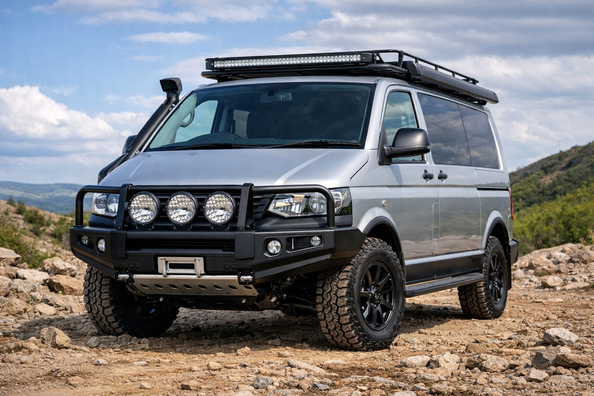

This upgrade plan is for a Volkswagen T5 Transporter owner who drives a lot on highways, regularly turns onto gravel or broken access roads, gets stone chips, and wants to protect the front end without extra weight or flashy “decorative” noise. This isn’t a hardcore off-road build: what matters here is that the van tracks steadily on the motorway, doesn’t scrape the underside on exits, and doesn’t pick up unnecessary damage up front.
The logic is the same for cargo and passenger T5s, but the details depend on the model year, short or long wheelbase, double-cab setup, and drivetrain. If you’re planning larger wheels, underbody protection, or serious side protection, compatibility must be checked for your exact configuration—not “all T5s at once.”
In your scenario, the upgrade has to solve three problems at the same time: grip and stability on poor surfaces, resistance to stones from below, and fewer front-end chips from highway debris. So it’s not just about how the front looks—it’s about real wheel behavior, ground clearance, and protecting vulnerable components.
For the T5, it’s important not to confuse chip protection with heavy-duty impact protection. If the main issue is the hood edge, sand, and small stones, that’s one story. If the van is hitting the underside on ruts, rocks, or the edge of an embankment, you need to address the underbody, sump, transmission, and sills. And if there’s a real risk of animals or a hard frontal impact, then a separate front protection system should be selected.
Top priority: tires. For highway + stones, the T5 gains far more from all-terrain tires with the correct load index than from a heavy front bar. The tire is what changes behavior on gravel, broken roads, and wet dirt, without ruining highway handling as much as an overly aggressive tread—and it delivers more day-to-day benefit.
Second step: a mild lift. This makes sense not for looks, but so the wheel can work without constant rubbing and the underbody gains a height buffer. For some practical sizes on the T5, you can do it without cutting arches, but moving to 245/75 R16 or 245/70 R17 is a different story: without arch work and clearance checks, it’s not worth going there.
Third step: engine and transmission protection. This is what takes the hits from stones and contact with terrain. If you often drive on bad access roads, it’s more useful than any shiny front add-on. If you change wheel diameter, also don’t forget about speedometer correction if your configuration requires it.
| Upgrade | Why it’s needed | Who really benefits |
|---|---|---|
| All-terrain tires | Work better on gravel, broken asphalt, and wet exits than pure highway tires | Those who often drive on the highway and regularly turn onto gravel or dirt |
| Mild lift | Adds ground clearance and helps fit a practical tire size without constant rubbing | Those who already scrape the underside or are moving to a larger tire diameter |
| Engine and gearbox protection | Takes impacts from below and protects vulnerable components | Almost everyone who drives on more than just smooth asphalt |
| Additional protection for vulnerable underbody zones | Covers areas that suffer in ruts, on rocks, and on embankments | Those who often deal with broken access roads, fields, construction sites |
| Rock sliders | Protect the sill from below and from the side when the vehicle lands on a rut edge or a rock | Those who actually hit the sills—not those who just want a step |
| Front protection system | Only makes sense where there’s a risk of a hard frontal impact | Those who drive routes with animals or very harsh conditions ahead |
| Hood deflector | Helps reduce sandblasting along the hood edge | Those annoyed by highway chips but not looking for impact protection |
DD Tuning expert comment: the most common T5 mistakes are simple—people fit wide tires without preparing the arches, buy decorative side tubes instead of real sill protection, and forget the tire load index. As a result, the van either rubs the arches or gets heavier with no practical benefit. If you’re 80% highway and 20% bad exits, an overly aggressive tread and a massive front body kit are usually unnecessary.
After the basic bundle of “tires + lift + engine and transmission protection,” it’s logical to look at what completes your use case rather than duplicating what’s already done. That means additional protection for vulnerable underbody zones, real sill side protection, and speedometer correction if the wheel diameter changed.
This is where body nuances start. Parts differ for short and long wheelbases, and for double-cab vehicles rear clearances are even more critical. If you want to move to large 245 sizes, budget not only for tires but also for separate arch work. This is no longer “bolt on and go,” but a full geometry modification.
Side protection is worth choosing in a rigid, heavy-duty format if the van truly works on rocks and ruts. Decorative tubes often help as steps, but in a side hit they don’t solve the problem they’re usually bought for.
In this group I’d include window deflectors, some exterior trim overlays, decorative side steps, and light hood-edge protection. All of this can be appropriate, but you shouldn’t replace basic technical prep with these items.
For highway use, a hood deflector makes sense if chips and fine sandblasting along the front edge annoy you. But it won’t protect the sump, won’t add clearance, and won’t replace good tires. Same with side steps: they make getting in easier, but they’re not functionally equivalent to rigid sill protection.
| Scenario | What to install first | What you can postpone | What is not required |
|---|---|---|---|
| Highway + occasional gravel | Tires with the correct load index, engine and gearbox protection | Mild lift, if the stock geometry is still enough | Massive front body kit/protection |
| Highway + bad access roads every week | Tires, mild lift, basic underbody protection | Sill side protection, additional underbody plates | Decorative overlays and shiny tubes |
| Rocky ruts and risk of side contact | Tires, lift, engine and gearbox protection | Rock sliders, protection for vulnerable underbody zones | Steps without any impact-protection function |
| Routes with a real risk of a frontal hit | All the basics from the previous points | Model-specific front protection after verifying compatibility | Generic front tube of unknown origin |
More expensive solutions make sense when you’ve already covered the basics and you’re hitting a specific, narrow problem. If you need true front-end protection for difficult routes, look at model-specific front protection or bull bars and side steps—but only in versions that fit the T5 properly and don’t contradict the vehicle’s safety logic.
If your real pain isn’t impacts but chips and sandblasting along the hood edge on the highway, a lighter solution like a hood deflector is often enough. It doesn’t replace impact protection, but it doesn’t add unnecessary weight and it doesn’t pretend to provide a function no one will actually get from it.
From a customer’s experience: the owner of a cargo T5 initially looked for massive front-end protection because after highway runs the hood edge quickly got covered in chips, and on access roads the van kept scraping the underside. In the end he went a different way: tires with the correct load rating, a small lift, engine and gearbox protection, and he отказed the heavy front bar in favor of a lighter hood solution. After that the vehicle stopped constantly hitting the underbody, and the front end began to wear much more slowly.
For a Volkswagen T5 Transporter in the “highway, stones, front-end protection” scenario, the right sequence is almost always the same: tires first, then a mild lift, then engine and transmission protection, after that side protection, and only at the end a front system—if it’s truly needed. This order delivers practical results and doesn’t force you to overpay for looks.
In short, what’s useful here is geometry, tire contact with the road, and protecting vulnerable components. Everything else is either added for a specific risk or can be safely postponed. This material is based on real selection experience, practical work, and real usage scenarios—not a decorative approach of “put something big on the front and consider the problem solved.”
| ✔ | Universal off-road tires deliver the biggest practical benefit in this scenario: they perform better on gravel, broken surfaces, and wet ramps without turning the van into a heavy project. |
| ✔ | A moderate lift adds extra ground clearance without going overboard and helps fit a working wheel size without constant rubbing against the arches. |
| ✔ | Engine and transmission protection really takes the impacts from underneath, so on bad approaches and rocky sections it is more useful than a decorative front body kit. |
| ✔ | Rigid rocker protection makes sense where the van actually sits on a rut or a rock, because it works not only from the side but also from below. |
| ✔ | A hood deflector can be appropriate specifically for highway use if the main problem is stone chips and sandblasting along the hood edge. |
| ✘ | A massive front bumper or a universal body kit does not solve the main problems of the scenario if the tires, ground clearance, and underbody protection are not addressed first. |
| ✘ | Wide wheels without checking the wheel arches and offset may start rubbing, and moving to 245-size tires often requires separate bodywork already. |
| ✘ | Decorative side tubes do not replace proper rocker protection and do little in a real side impact with rocks or ruts. |
| ✘ | An overly aggressive tread for a vehicle that mostly drives on the highway worsens everyday handling and is often unnecessary in such a mode. |
Shipping to EU
Wholesale and retail
Own warehouse
Опис продукту
Подарунки не надаються при оформленні покупки у кредит під 0,01% або при покупці частинами.