04.08.2026
147
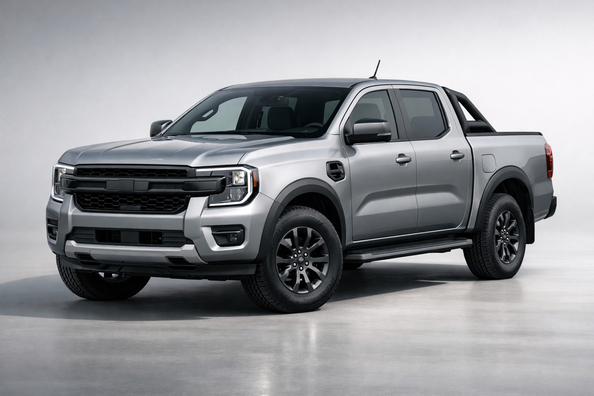
Ford Ranger Plug-in Hybrid 2025 is not a separate urban hybrid, but an electrified version of the current body-on-frame Ranger pickup. The main idea is simple: keep towing ability, payload practicality, and four-wheel drive, but add quiet electric driving for short daily routes and lower dependence on fuel in the city.
For the buyer, what matters here is not the word “hybrid”, but the use case. If the pickup drives to job sites every day, tows a trailer on weekends, and also has access to regular charging, the PHEV version looks logical. But if the vehicle is constantly doing long highway runs without charging, the simpler diesel Ranger variants may remain more practical.
Ranger Plug-in Hybrid became Ford’s first plug-in hybrid pickup. Its role in the market is to bridge the gap between a standard work pickup and the demand for quieter, more economical urban use. In other words, it’s not a replacement for every Ranger version, but a targeted answer for those who need one vehicle for both work and everyday life.
It makes the most sense for private owners, service crews, suburban users, and small businesses where the vehicle often runs short routes but occasionally carries cargo or tows a trailer. It makes less sense for those who want minimal complexity, have nowhere to charge the battery, or use the pickup mainly for long intercity mileage.
To understand Ranger Plug-in Hybrid, it’s more important to look not at the model’s long past, but at the modern global lineup it grew out of. The plug-in hybrid didn’t appear as a separate model, but as a new powertrain variant within the current generation.
This matters in practice as well: most accessories and body solutions for Ranger 2022+ are potentially relevant for the PHEV too, but compatibility should be checked separately due to the battery, wiring, sensors, and trim-level differences.
In the Plug-in Hybrid version, one key powertrain layout is announced: a 2.3-liter EcoBoost turbo gasoline engine works together with an electric motor integrated into a 10-speed automatic transmission. For this version Ford stated 279 hp total output and 697 Nm, plus a battery with 11.8 kWh usable capacity. For short trips, the promised electric-only range is over 45 km under WLTP.
| Parameter | Data |
|---|---|
| Version production years | from 2025 |
| Powertrain | plug-in hybrid |
| ICE | 2.3-liter EcoBoost turbo gasoline engine |
| Electric motor | 75 kW, integrated into the hybrid transmission |
| Battery | 11.8 kWh usable capacity |
| Total power | 279 hp |
| Torque | 697 Nm |
| Transmission | 10-speed automatic |
| Drive | four-wheel; the version is stated to have off-road modes, low range, and a rear differential lock |
| Electric driving | over 45 km under WLTP |
| Towing | up to 3500 kg |
| Payload | up to 1 ton, depending on version |
The key takeaway is this: Ranger PHEV doesn’t abandon what makes it a pickup. It’s not a “soft” compromise, but an attempt to keep working capability close to a regular Ranger, while making the vehicle more convenient where short trips can be covered on electric power.
Architecturally, it’s the same large body-on-frame pickup from the current Ranger family. For the double-cab body style on which most public PHEV data is based, you can ориентate around an overall length of about 5370 mm, a wheelbase of 3270 mm, and a width of 1918 mm without mirrors. Height and ground clearance depend on trim, tires, and load; for the Ranger family it’s typically around 226-235 mm.
With the “trunk” of a vehicle like this, you need to think correctly: it’s not an enclosed compartment measured in liters, but a cargo bed. In practice, its dimensions matter more—roughly 1638 mm in length, 1584 mm in width, and 1224 mm between the wheel arches. If you need a truly enclosed volume, it’s effectively created not by the body itself, but by a canopy or a roll cover. For off-road use and work, an 800 mm wading depth and the ladder-frame construction also matter—meaning the pickup’s base remains genuinely utilitarian.
The latest-generation Ranger interior has become more modern without losing its work-first logic. The seating position is high, there’s enough space in the front row, and the second row in the double cab is suitable for more than occasional trips. Equipment depends on trim: screens, materials, and the electronics package vary between versions, so you need to look not only at the model name but also at the specific configuration.
The comfort difference in the PHEV is felt most in the city: smooth electric pull-off, less noise on short routes, and a more pleasant response at low speeds. As for safety, the situation is typical for a modern Ranger: a wide range of driver-assistance systems is available, but the exact set is also tied to trim level and market.
In daily life, Ranger Plug-in Hybrid makes sense only when the battery is charged regularly. If work routes are short and charging is available at home or at the depot, some trips can be made with little to no use of the gasoline engine. In this mode, the vehicle delivers exactly the advantage people expect from it: less noise, smoother take-off, and better control of running costs in the city.
On the highway, with cargo or a trailer, the picture is different. A large body-on-frame pickup doesn’t turn into a passenger car, and under load the gasoline engine will be working actively. So for constant long-distance towing work, you need to assess the PHEV realistically: it doesn’t cancel the physics of mass—it simply adds a useful urban layer to the familiar Ranger format.
Another practical point is size. A length over 5.3 m and a wide cab mean that in a dense city it won’t always be convenient, even if the powertrain has become quieter. That’s why this vehicle reveals itself best where there’s room for pickup life: private property, a depot, a job site, trailers, gear, and trips out of town.
The strength of Ranger Plug-in Hybrid is that it doesn’t try to be “just a trendy hybrid”. Its advantage is combining useful electrification with real towing and payload function. The weakness follows from the same formula: the hardware becomes more complex, and the benefit depends more heavily on the usage scenario.
| Strengths | Weaknesses |
|---|---|
| Short daily routes can be done on electric power | Without regular charging, the main advantage of the version quickly diminishes |
| 697 Nm and towing up to 3500 kg keep the pickup’s work purpose intact | Under load and on long highway runs, the efficiency benefit will be more modest |
| Ladder-frame base, four-wheel drive, and off-road logic haven’t gone anywhere | The hardware is more complex than in simpler diesel variants |
| Quieter take-off and a more pleasant response in the city | Large dimensions won’t make parking and maneuvering easier |
| Works as a single vehicle for work and daily life | Not a very logical choice for those who don’t have access to charging |
For Ranger Plug-in Hybrid, tuning should be functional rather than decorative. The most useful items are those that either protect the cabin and body in everyday work or turn the open bed into a truly convenient cargo space. That’s why with the PHEV it makes more sense to start not with exterior styling, but with solutions for the bed, cargo, and interior.
Since the PHEV is based on the current Ranger 2022+, you should start choosing accessories from compatible solutions for this generation. But before ordering, it’s important to check the details of your specific version: the presence of sensors, electrical specifics, bumper shape, side step type, and whether the accessory interferes with charging equipment or factory components.
Ford Ranger Plug-in Hybrid 2025 looks like a strong fit exactly when you don’t try to judge it as a replacement for every other pickup. It’s a version for those who need four-wheel drive, a frame, a trailer, and a cargo bed, but also have a real urban or suburban cycle with the ability to charge. For that scenario, the PHEV offers noticeably more substance than just the loud “hybrid” status.
If, instead, you need the simplest possible work tool without charging discipline, the point of this modification is no longer so obvious. The material is based on real selection experience, practical know-how, and real usage scenarios, so the main conclusion is simple: the Ranger PHEV is worth choosing not for novelty, but when your daily routine truly allows you to use its strengths.
| ✔ | Can cover short daily trips on electric power, so noise and fuel use are reduced in the city. This is especially useful if there is regular charging at home or at the base. |
| ✔ | Retains pickup practicality: 4x4, body-on-frame construction, low-range gearing, and rear differential lock all remain in place. In other words, this is not a compromise urban crossover, but a work vehicle with electrification. |
| ✔ | Combined 279 hp and 697 Nm, as well as towing of up to 3500 kg, make it suitable for trailers, cargo, and work. For small businesses or service crews, this is an important advantage. |
| ✔ | In city driving, starts and low-speed movement should be more pleasant thanks to the electric motor. This makes daily use more comfortable than in pure ICE versions. |
| ✔ | Built on the current Ranger 2022+, so some accessories and body solutions may be compatible. This makes it easier to choose a roller cover, canopy, or other practical work-focused elements. |
| ✘ | Without regular charging, the main advantage of PHEV quickly disappears, and the point of the hybrid noticeably drops. For those who constantly drive without the option to recharge, this version looks less successful. |
| ✘ | On the highway, with a load or trailer, the fuel-saving effect will be more modest than in the city. For long-distance hauling, simpler diesel Ranger versions may be more practical. |
| ✘ | The technology is more complex than in standard pickup versions, due to the battery, electric motor, and hybrid transmission. This means more potential nuances in ownership and maintenance. |
| ✘ | The dimensions remain large: a length of over 5.3 m and a wide cabin do not make it convenient in dense city traffic. Parking and maneuvering will not get any easier, even despite the quieter powertrain. |
Shipping to EU
Wholesale and retail
Own warehouse
Опис продукту
Подарунки не надаються при оформленні покупки у кредит під 0,01% або при покупці частинами.