
































































 Author: Radomskyi Maksym Vasyliovych
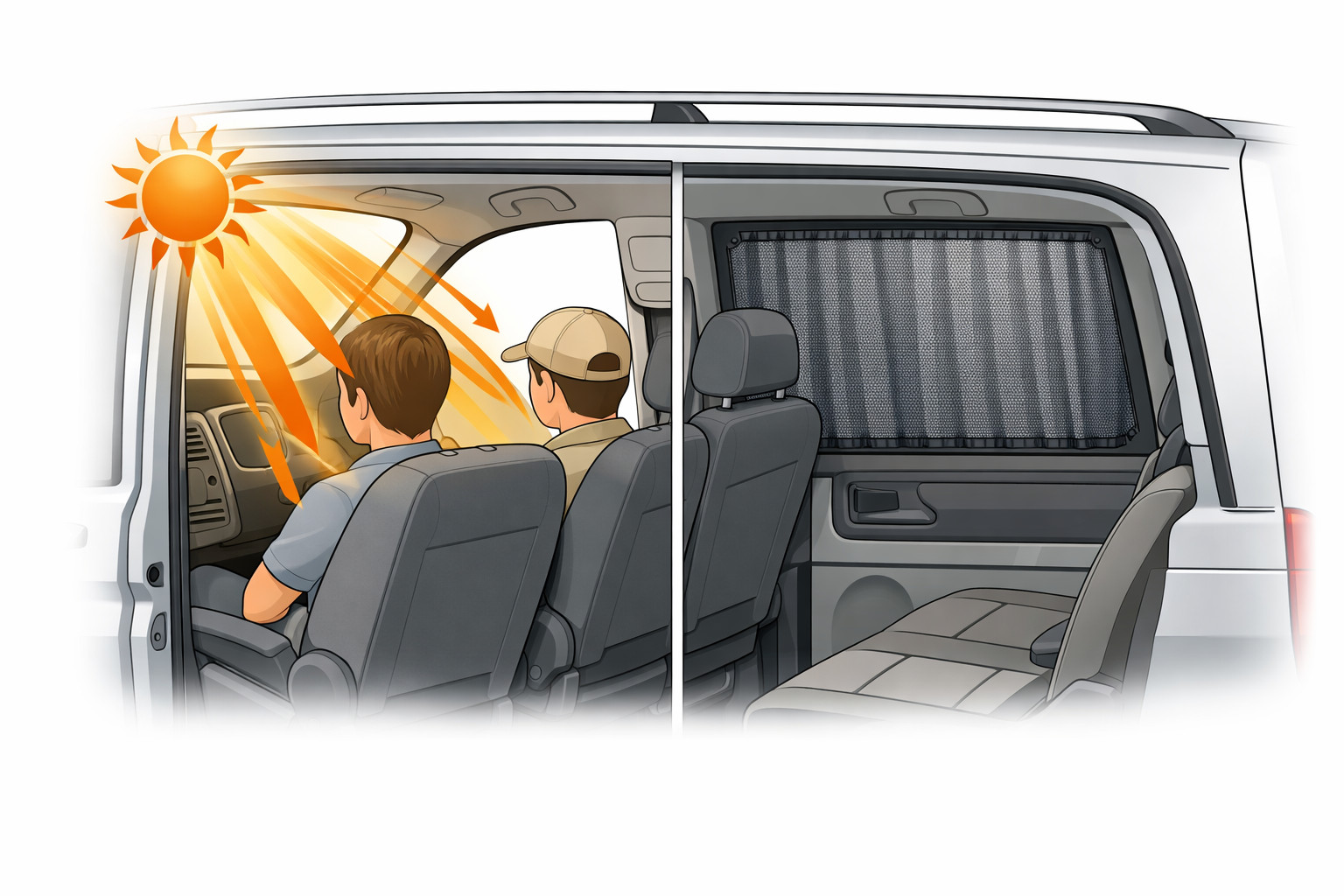
In the Mercedes Vito, rear passengers often get scorched by the sun not because the heater or A/C is faulty, but because of the cabin architecture itself: large side windows, seating close to the glass, and a long passenger compartment. Factory tint reduces discomfort, but it doesn’t fully eliminate direct sun through the large glass.
To avoid spending money blindly, first distinguish between two situations: the passenger is burned by a beam hitting the side and shoulder while driving, or the entire rear row overheats after parking. In the first case you need to screen the glass; in the second, ventilation, the rear climate circuit, and the right type of shades also matter.
Why this problem occurs
The Vito has a large glazing area, and the second and third rows sit close to the side windows. So even when the cabin air is already cooling down, the passenger still feels heat from direct sun coming in from the side. This is the typical difference between a simply hot cabin and localized overheating from the glass.
The issue is more noticeable on longer bodies and on vehicles without factory opaque window coverings. If there’s a panoramic sunroof, extra heat also comes from above. Rear climate control helps cool the air, but it doesn’t block the sunbeam through the glass.
Main causes
- Large side and rear glass. There’s a lot of it in the passenger Vito, so the sun reaches the second and third rows with almost no obstruction.
- Seating close to the window. In a minibus, the passenger sits closer to the glass than in a regular passenger car, so overheating is felt more strongly.
- Relying only on factory tint. It reduces glare, but in hot weather it often doesn’t solve comfort.
- Rear climate not turned on or set incorrectly. If the rear circuit isn’t working properly, the cabin air stays hot longer.
- Sunroof, vent windows, door type, and body not taken into account. Because of this, people often buy shades for the wrong windows or with gaps around the edges.
How to understand what the cause is in your case
- Look at when exactly it becomes unbearable. If only the sunny side burns while driving, the cause is almost always direct light through the side glass. If the whole rear row is hot after parking, overall cabin overheating is also involved.
- Check the rear climate circuit. Turn it on separately, set a moderate temperature, and see whether the airflow changes in the rear.
- If you have a panoramic sunroof, close the sunroof and the roller blind. If your head and shoulders heat up less afterward, part of the problem was coming from above.
- Clarify the body and configuration: W447, W639, or W638; short or long body; sliding or hinged doors; vent windows or not. This is critical for shades.
- Before choosing a magnetic set, test the frame with a small magnet. If there’s a lot of plastic around the glass or a different material, it’s better to look at clips or another mounting method.
DD Tuning expert comment: The most common mistake with the Vito is ordering universal shades based on photos without verifying the body, length, and window set. The second typical miss is buying only for the sliding doors, even though the rear vent windows or quarter windows are what actually overheat. Before selecting anything, you always need to understand which exact glass catches the sun and whether there’s a proper place to secure the frame.
Symptoms, causes, and what to do (table)
| Symptom | Likely cause | What to do |
|---|---|---|
| Your shoulder and side burn on only one side while driving | Direct sun through the side glass | Install a vehicle-specific shade for that exact window, not just rely on tint |
| The entire rear row is hot after parking | Overheated cabin plus weak ventilation | Ventilate the cabin, turn on the rear climate, and add shades on the main windows |
| Your head heats up from above | Panoramic sunroof or an open roller blind | Close the sunroof and blind first, then assess the need for additional shading |
| The shade falls off or leaves large gaps | Universal size or poor mounting | Switch to a vehicle-specific kit for the exact body and frame type |
| Comfortable in the daytime, but the cabin is bright at night | A mesh shade provides privacy but not full darkness | For parking, add full blackout or a separate night kit |
| After fully closing the windows it’s stuffy and condensation appears | There is shading, but no ventilation | Leave a controlled gap for air or combine with a ventilation solution |
What actually helps
In a Vito, the best option is vehicle-specific shades for the exact glass. They close the opening along the contour, leave fewer gaps, and don’t turn into a decorative mesh hanging somewhere in the middle of the window. For driving, this is more practical than universal suction cups.
If the vehicle is used on the move with passengers, mesh shades are more convenient: they reduce direct sun and don’t suffocate the cabin. If the Vito is used for parking, отдых, or sleeping, full blackout works better—but it must be combined with ventilation, otherwise you’ll end up with stuffiness.
Separately, it’s worth checking the rear climate and the sunroof. If the rear circuit is off and the sunroof blind is open, even good side-window shades won’t deliver full effect. The best results usually come from a combination: block the sun source, keep proper airflow, and use correctly selected shades.
What almost doesn’t work or only helps briefly
Factory tinted glass alone often doesn’t save you in extreme heat. It reduces glare, but it doesn’t remove the sensation of heat for a passenger sitting almost right up against the window.
Universal suction-cup shades also rarely solve the Vito problem for long. They’re often too small, leave gaps at the edges, and can fall off in a heated cabin. This option can sometimes work as a temporary fix, but not as a proper solution for a minibus.
A not-so-smart scenario is choosing solid blackout for everyday driving and not thinking about airflow. On the move and when parked without ventilation, it quickly creates stale air and condensation—one problem simply gets replaced by another.
When accessories or replacing components makes sense
If you have a W447 and the issue shows up specifically on the sunny side during a trip, it makes sense to start with vehicle-specific shades for Vito W447. It’s important to choose not just “for Vito,” but for your exact body and window set: separately for the sliding doors, for the rear vent windows, or for the full rear section.
When it becomes stuffy after shading, it makes sense to combine shades with window deflectors. They don’t block the sun by themselves, but they allow you to leave a small gap for airflow without annoying whistling and without opening the window wide.
If you want to build a complete cabin solution, it’s also worth looking at interior accessories for Vito, but don’t confuse aesthetics with real sun protection. Replacing components only makes sense when there’s already damaged tint, a poor aftermarket mounting, or the shades physically don’t fit due to a different configuration. Any mounts should not be installed in the deployment zone of side airbags.
Solutions: when they work and when it’s not worth spending money (table)
| Solution | When it works | When it’s not worth spending money |
|---|---|---|
| Vehicle-specific mesh shades | Daily trips, children or passengers in the second and third rows, direct side sun | If you need complete darkness for overnight stays without an additional kit |
| Full blackout | Parking, sleeping in the cabin, camper use | If you’re not ready to organize ventilation |
| Rear climate setup | When the entire rear compartment gets hot, not just the sunny side | If the cause is direct sun hitting your shoulder or face |
| Window deflectors | When you need to ventilate the cabin with a small gap | If you expect them to remove heat from the glass on their own |
| Re-tinting or replacing old solutions | When the vehicle already has a poor film job, peeling, or old mismatched shades | If the only issue is that the glass is large and there are no shades at all |
From a customer’s experience: On a long Vito W447, a family first bought universal suction cups only for the sliding doors, but while driving there were still gaps, and rear passengers’ shoulders were still getting scorched. After choosing a vehicle-specific kit for the needed side windows and a separate solution for ventilation, the problem disappeared on daily trips, and for overnight stops they added a different, more opaque blackout option. They kept this exact combination because it works both on the road and at stops.
Conclusion
In the Mercedes Vito, rear passengers are most often scorched by the sun due to large windows, seating close to the glass, and the fact that the climate system cools the air but doesn’t block the direct sunbeam. So the first step is to understand whether the problem is localized at the glass or an overall cabin overheat, and only then choose the type of shades.
In most cases, it’s worth investing not in universal small fixes, but in a vehicle-specific solution for your body, length, doors, vent windows, and sunroof. This material is based on real selection experience, practice, and real usage scenarios where what matters is not loud promises, but a tight fit of the shade, proper ventilation, and correct compatibility with your specific Vito.
How it works
- Identify what is overheating the passengers First, find out when the problem is worse: while driving on the sunny side or after parking, when the entire rear row gets hot. In the first case, you need window shading; in the second, you also need proper ventilation and rear climate control.
- Check the rear climate system and sunroof Turn on the rear climate circuit separately and see whether the airflow in the back changes. If there is a panoramic sunroof, close it together with the roller shade to understand whether it is what adds heat from above.
- Specify your Vito configuration Note the body, length, door type, presence of quarter windows and a sunroof. This is critical for selecting shades, because universal options often do not fit tightly or leave gaps.
- Choose shades for the specific glass For everyday trips, model-specific mesh shades made for a particular body and windows work better than universal suction-cup ones. If you need complete darkness while parked or for sleeping, choose full blackout, but take ventilation into account.
- Check the mounting before buying Before a magnetic kit, check whether there is a metal frame around the glass: if there is almost none, it is better to look at clips or another mounting method. Do not install mounts in the deployment zone of the side airbags.
- Choose additional ventilation solutions If the cabin gets stuffy after shading, combine the shades with window deflectors and leave a controlled gap for air. This helps reduce heat from the glass without excess condensation or stale air.
Pros and cons
Model-specific sunshades for the exact window block side sunlight better because they fit the outline and leave fewer gaps. For everyday trips, they are more practical than universal suction-cup options.
Mesh sunshades reduce direct glare without “suffocating” the cabin. This is useful when passengers are in the car and normal airflow needs to be maintained while driving.
For parking or sleeping in the cabin, full blackout provides better protection from light than mesh. If ventilation is added to it, it works as a separate nighttime setup.
Checking the body, door type, quarter windows, and whether there is a sunroof before purchase helps avoid choosing the wrong kit. This lowers the risk of buying sunshades that do not physically fit or leave gaps.
Window deflectors are useful as a supplement to sunshades when you need to leave a small gap for air. They help ventilate the cabin without having the window fully open.
A single factory tint is often not enough: it reduces glare, but does not remove the feeling of heat for a passenger sitting close to the glass. In strong heat, it does not solve the problem completely.
Universal suction-cup shades in Vito often leave gaps at the edges and can fall off in a heated cabin. As a temporary solution they are still acceptable, but as a permanent one they are weak.
Solid blackout without ventilation quickly makes the cabin stuffy and can cause condensation. In other words, one heat problem is replaced by another.
Mesh sunshades do not provide complete darkness, so for overnight parking or sleeping they may not be enough. If privacy and blackout are needed, you will have to choose another set.