
































































 Author: Radomskyi Maksym Vasyliovych
If the goal is to remove everyday scuffs from shoes, bags, kids’ feet, and getting in and out, interior door-sill covers are the more practical choice. But if the body regularly takes hits from small stones, dirty spray, salt, and road abrasive, exterior covers for the lower part of the sill work better.
The main mistake when choosing is to compare these two options as if they fully replace each other. In reality, they protect different areas, are mounted differently, and give different results in terms of maintenance, durability, and price.
What the choice really comes down to
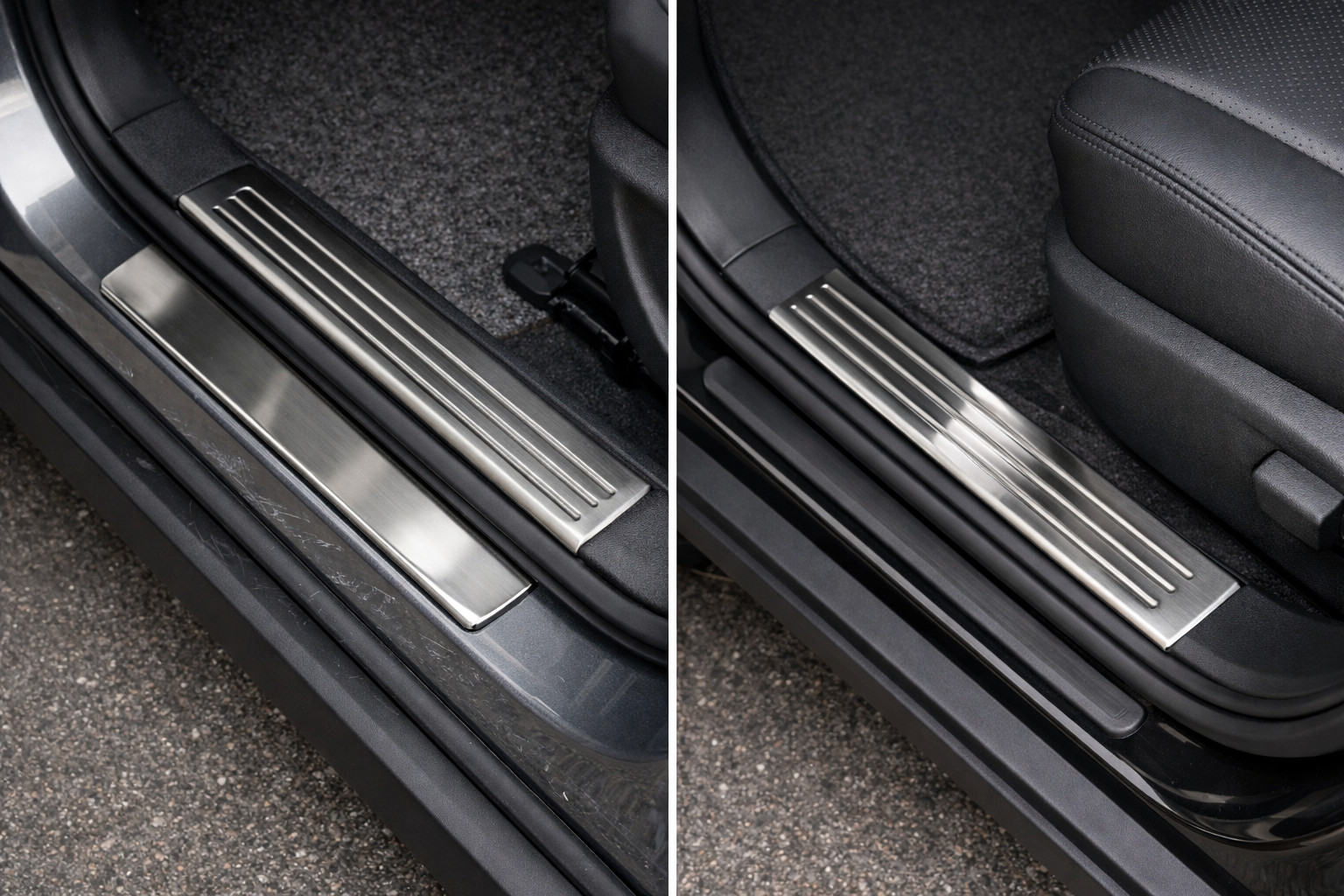
Interior covers are installed in the door opening, where the sill constantly rubs against footwear. This solution fits city driving, family cars, taxis, fleet vehicles, and any situation where damage appears not from below, but on the visible upper part of the sill.
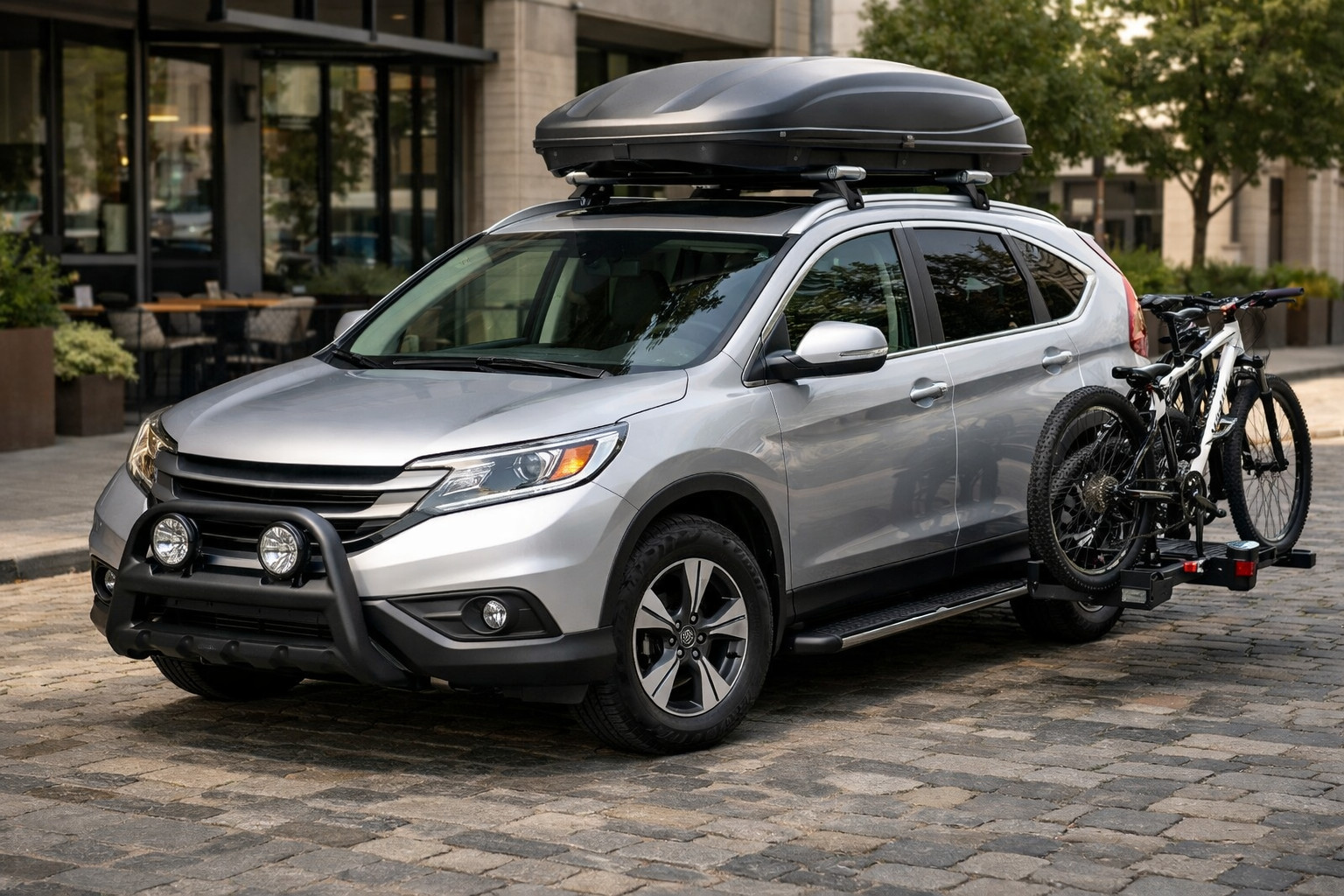
Exterior covers work lower—along the outside of the body. They make sense when the car often drives highways, gravel, rural roads, or in winter through mud and salt. In this scenario, an interior cover doesn’t solve the main problem, because stones and spray hit not the door opening, but the lower edge of the body.
So the answer is simple: for everyday wear, interior is better; for road abrasive, exterior. If the car lives in a mixed mode, these solutions don’t conflict and can complement each other.
Which criteria to compare by
- Protection area. Interior covers protect the top surface of the sill inside the door opening. Exterior covers shield the lower part of the body that takes stones, sand, and dirt.
- Installation. Interior ones are usually easier: adhesive backing, precise shape, quick install. Exterior ones can be adhesive as well, or mounted on brackets/bolts, so compatibility and accuracy requirements are higher.
- Noise and side effects. Interior covers hardly affect anything besides appearance and protection. With exterior ones, the risk of unwanted noises or dirt/moisture buildup appears not because of the concept itself, but due to poor fitment, weak fastening, or bad sealing.
- Service life. With interior covers, everything depends on material quality, adhesive strength, and whether the cover actually overlaps the sill edge. With exterior covers, durability depends more on metal/plastic thickness, anti-corrosion coating, and fastening quality.
- Maintenance practicality. Interior covers are easier to wash because it’s a cleaner area. Exterior ones will need more frequent rinsing from sand, salt, and packed dirt.
- Price. Interior covers are almost always the cheaper, simpler route. Exterior covers cost more not only because of the kit itself, but also because of installation and higher precision requirements.
Quick comparison of options (table)
| Option | Strengths | Weaknesses | Who it fits |
|---|---|---|---|
| Interior door-sill covers | Good at catching marks from shoes, bags, and everyday use; easier to install; easier to wash; less noticeable | Almost don’t protect the lower part of the body; some kits cover only the top, without the sill edge; effectiveness depends on shape accuracy | City driving, family car, frequent entry/exit, keeping a “new interior” look without complicated installation |
| Exterior door-sill covers | Work better against stones, gravel, spray, and salt; can cover already damaged lower areas; stronger in harsh conditions | More expensive; more visible from the outside; more complex installation; require attentive care around the mounting area | Highway, gravel, winter, rural roads, crossovers and pickups with constant load on the lower body |
DD Tuning expert comment: The most common mistake is this: people see a scratched sill in the door opening, but order an exterior kit that doesn’t cover that area at all. The second typical mistake is not checking whether the cover overlaps the sill edge, not just the flat top surface. If the car often drives in mud, it’s important to think not only about the cover itself, but also about keeping the mounting area clean and overall spray protection.
Detailed breakdown of each option
Interior covers
This is the most logical solution when the sill is damaged by normal everyday use. They work exactly where a person places their foot, catches the edge with footwear, or sets down a bag. For a city car this is the most common scenario, so the effect is visible immediately: fewer new scuffs and easier maintenance.
The strong side of interior covers is simple installation. Most kits don’t require special tools, and accurate fit matters more than “thicker material.” The weak spot is also clear: some sets don’t cover the entire working edge, so real protection may be less than the owner expects.
In terms of service life, it’s a low-stress accessory: if the surface doesn’t peel and doesn’t wear through at the edges, it lasts a long time. Noise and side-effect risks are minimal. But you should be honest: they hardly protect against stones, salt, and sand thrown up from the wheels.
Exterior covers
This option is closer to underbody protection than cosmetics. It makes sense where the sill suffers not from footwear, but from the road environment. This is especially noticeable on cars that often drive on bad roads or in winter slush with sand and salt.
With exterior covers, designs vary greatly. Some are light decorative elements, others are stiffer kits with mounting that actually take the abrasive hits. That’s why you can’t buy “by photo” here: you need to check where the part sits, how it mounts, and whether someone is confusing sill protection with a side step or just decor.
The weak point of the exterior solution is installation and maintenance. It’s more expensive, more noticeable, and more dependent on installation quality. If installed neatly, the benefit is real; if there’s misalignment, poor fit, or dirt left in the mounting area, you won’t get protection—you’ll get a new problem spot.
Which option is better for different scenarios
For a typical city car where people get in and out every day, interior covers are better. They’re cheaper, simpler, and hit the problem directly. For a family with kids, this is usually the smartest first step.
For a crossover, pickup, or a vehicle that often sees highways, gravel, and salt, the advantage shifts to exterior protection. It’s more complex, but it works in the area where chips, sandblasting, and dirty buildup form on the lower part of the body.
If a clean look without bulky parts matters and the damage risk is moderate, you should look at interior covers or clear protection. If you want to cover both everyday wear and road abrasive, the most practical path is not to look for one magic kit, but to combine solutions to match your conditions.
Use case and what to choose (table)
| Scenario | What to choose | Why |
|---|---|---|
| City car, daily entry/exit | Interior covers | Protect specifically against shoe marks and minor scuffs in the door opening |
| Family car with kids | Interior covers | Kids’ feet and passengers most often catch the upper part of the sill, not the lower body |
| Highway, gravel, trips to the countryside | Exterior covers | You need a barrier against stones, sand, and spray along the lower body |
| Winter use with salt and mud | Exterior covers with quality installation | The load is on the lower area; not only the part matters, but correct installation and maintenance |
| You want minimal changes to the car’s appearance | Interior covers or clear protection | Less visual interference than a bulky exterior kit |
| Maximum practicality in mixed driving | A combination of interior covers and exterior spray protection | One part rarely covers both everyday wear and road abrasive at the same time |
Common mistakes when choosing
- Mixing up protection zones. The owner wants to remove shoe marks, but looks at an exterior kit that sits lower and doesn’t solve the issue.
- Buying only by appearance. Nice texture or shine doesn’t mean the cover protects the needed area.
- Not checking the mounting method. For interior covers it’s about simplicity; for exterior covers it’s about compatibility, durability, and avoiding issues after installation.
- Expecting interior covers to protect from stones. That’s not their job, so disappointment is predictable.
- Ignoring maintenance. Especially with exterior solutions, dirt, sand, and salt need to be washed out regularly—otherwise the point of protection is partly lost.
When a more expensive solution makes sense
Paying extra is justified when the cheaper option doesn’t cover your real risk. If you need neat protection for the door opening with simple maintenance, it’s logical to look at stainless steel door-sill covers: it’s a direct solution for daily contact with shoes and luggage. If you want almost invisible protection without a pronounced cover, consider protective sill film.
Another case where spending more makes sense is when the issue isn’t only the sill, but the constant flow of sand and spray from the wheels. Then it’s smarter to invest not in a decorative kit, but in exterior protection together with mud flaps, because they reduce the load on the lower part of the body. For a purely city scenario, a bulky exterior kit is often unnecessary in both budget and installation effort.
From a customer’s experience: the owner of a family crossover initially wanted exterior covers because they worried about winter and dirty roads. After inspection it became clear that what suffered most wasn’t the lower body, but the upper sill from kids’ shoes and frequent city trips, so they chose an interior kit and were happy with the easy maintenance. For the lower area they separately added spray protection, and it turned out to be more practical than one expensive “universal” option.
Conclusion
In short, interior covers are better for everyday wear, and exterior ones are for real road exposure on the lower part of the body. Don’t look for an abstract “best” option: the right choice starts with answering where exactly your car gets damaged.
The material is based on real selection experience, practical know-how, and real usage scenarios: city, family use, highway, winter, and bad roads. That’s why in most city cases it makes sense to install interior covers first, and choose exterior protection when the sill truly lives under the impact of stones, dirt, and salt.
How it works
- Determine where the damage appears First, look at what is damaging the sill in your car: shoe marks, bags, and the daily getting in and out, or stone chips, dirt, and road salt. This is key, because inner and outer trim protect different areas.
- Choose inner trim for urban wear If the sill is rubbing in the door opening, you need inner trim. It is better suited for city use, family cars, taxis, and other vehicles with frequent passenger entry and exit.
- Choose outer trim for road abrasion If the main issue is stones, gravel, splashes, and salt along the lower body, go for outer trim. It is suitable for highways, country roads, winter, and harsher operating conditions.
- Check installation and fastening method For inner trim, simple installation and an exact fit are important, while for outer trim, compatibility, fastening, and a proper fit without misalignment matter most. Poor installation of outer solutions can lead to noise, dirt buildup, or moisture.
- Assess maintenance and budget Inner trim is usually cheaper, simpler, and easier to maintain. Outer trim is more expensive and requires regular cleaning of the mounting area from sand, salt, and dirt.
- Combine solutions if needed If the car is used in mixed conditions, one set does not always cover all risks. For urban wear, inner protection is installed, and for the lower body, outer protection or mud flaps are added.
Pros and cons
Interior trims do a good job of covering the area that suffers most from daily contact with shoes, bags, and children’s feet. For city driving, this directly removes minor scuffs in the door opening.
They are easier to install: the article notes that most kits have an adhesive backing and do not require special tools. This makes them a convenient option for quick installation without extra work.
Interior trims are easier to wash because this is a cleaner area, and they almost do not add side effects. The article states directly that the risks of noise or moisture issues for them are minimal.
Exterior trims work better where there is stone, sand, road spray, and salt. They protect the lower body exactly in the conditions where interior protection will no longer help.
For mixed use, both options do not conflict and can complement each other. This is practical if the car has both everyday wear and road abrasive exposure at the same time.
Interior trims almost do not protect the lower body from stones, salt, and road dirt. In other words, they address not all risks, but only wear in the door opening.
In some interior kits, not the entire working edge of the sill is covered, so the actual protection may be less than expected. The result depends heavily on the accuracy of the shape and the quality of the overlap.
Exterior trims are more expensive and more difficult to install, and they also depend more on correct installation. If there is misalignment or weak fastening, you can end up not with protection, but with additional problems.
Exterior solutions require more careful maintenance: they need to be regularly rinsed of sand, salt, and packed dirt. Otherwise, part of the point of such protection is simply lost.