15.07.2026
228
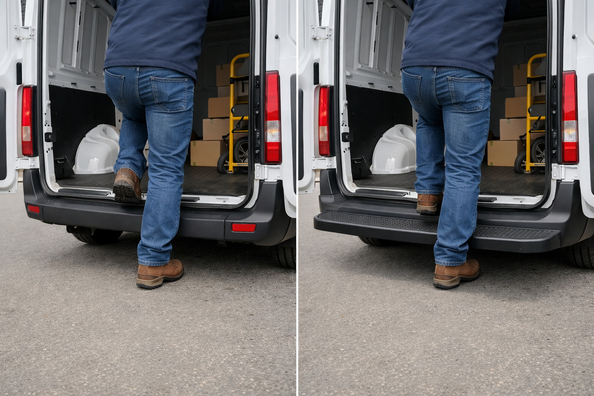

If the rear doors of a van are your work zone, a rear step is usually justified. It genuinely simplifies repeated access to the cargo area—especially in delivery, service work, a camper, or when tools and gear constantly ride in the back. But if the luggage area is opened only occasionally and the vehicle often runs with a trailer, a hitch bike rack, or strict departure-angle requirements, a step doesn’t always pay for itself.
The key to a solid choice isn’t the tube shape—it’s compatibility. In practice, everything is decided by the towbar, parking sensors, camera, mounting type, step width, behavior in mud and winter, and whether extra noise or play shows up after a season.
The question isn’t whether a step is convenient in general, but how often you actually step on it. For a van that gets opened from the rear 20 times a day, it’s an ergonomics tool. For a private vehicle with rare trunk access, it’s an option rather than a necessity.
Installation. Some solutions bolt on without drilling, others require modifications, and some only work with the factory towbar. In certain configurations, even the engine type and exhaust shape make the difference.
Noise. The quietest are usually simple fixed designs without hinges. Folding and sliding solutions are more convenient in some scenarios, but more sensitive to play, latch wear, and imperfect installation.
Service life. Aluminum handles moisture and road chemicals better, but it’s not only the base material that matters—the bracket quality does too. Steel is often strong and more affordable, but the coating on the lower edge needs monitoring.
Practicality. Not only width matters, but also platform depth, anti-slip surface, compatibility with sensors, camera, towbar, and what you carry in the back.
Price. The market is wide: from simple solutions at roughly $190 to premium builds around $850. The price difference isn’t just the material—it’s also vehicle integration, width, stiffness, mounting, and extra features.
| Option | Strengths | Weaknesses | Who it’s for |
|---|---|---|---|
| Simple fixed bolt-on step | Inexpensive, light, often no drilling, usually quiet | Narrow footing, less functionality, not always compatible with all towbar configurations | Anyone who needs basic access on a limited budget |
| Wide full-width aluminum | Comfortable with both feet, good grip in wet weather, lower chance of slipping | May interfere with the camera, sensors, or hitch; sometimes requires separate brackets | Camper vans, service vans, regular loading |
| Commercial folding step | Deep step, high load capacity, can be mounted left, right, or center | Heavy, bulky, hinges and latches need attention, may get noisy over time | Work vans with intensive daily use |
| Sliding step | Lower step height, doesn’t stick out permanently, convenient for frequent entry | More complex design, more moving parts, more expensive to maintain | Those who prioritize comfort and a clean look |
| Premium full-width with integration | Wide footing, sensor compatibility in certain versions, sometimes includes recovery points | Highest price, tightly tied to a specific towbar and vehicle generation | Those who know their exact configuration and use the rear often |
DD Tuning expert comment: most often people don’t get the step type wrong—they get compatibility wrong. They buy a wide model and then find out it interferes with the towbar, sensors, or a bike platform. Before ordering, you need to check the vehicle year, hitch type, whether there’s a camera, and whether you really need full-width access rather than just one step for your foot.
This is the most rational starting point. These models are often quick to install, sometimes without drilling, weigh little, and don’t create extra hassle. For occasional or moderate-intensity access to the rear doors, it’s enough.
The downside is that the footing is usually compact. If you climb in often with boxes or work in slippery weather, a narrow step is no longer that comfortable.
The strong side of this option is real working area. In typical solutions it provides about 1.37–1.40 m of usable width, and the ribbed surface holds footwear better in rain, mud, and ice. On a van where someone is constantly working at the rear, the difference is felt immediately.
The weak spot is adjacent equipment. Wide steps are the ones that most often conflict with the camera, sensors, or towbar, so you can’t choose them based on photos alone.
This is an option for heavy use: a deeper platform, high allowable weight, and multiple mounting positions. It’s convenient when someone enters and exits the van many times throughout the day.
But it’s heavier than other types and mechanically more complex. If quietness, minimal weight, and simplicity matter to you, it’s not the first candidate.
This is a niche but very comfortable solution. It doesn’t protrude constantly, gives a lower step height, and affects rear geometry less. For a family or converted van, it can sometimes be more logical than a massive external design.
The downside is obvious: more moving parts means more dependence on cleanliness, maintenance, and installation quality.
This is the choice for those who want maximum convenience without random compromises. In this class there are models up to 1.70 m wide, with compatibility for the factory hitch, sensors, and even recovery points. This is where stiffness, full-width access, and overall integration are handled best.
But the extra cost only makes sense if you truly use the rear constantly. If access is occasional, the benefit difference between a mid-range and premium option quickly shrinks.
For delivery, installation crews, and mobile workshops, a wide full-width or a commercial folding step wins. In those cases, what matters isn’t looks but the convenience of dozens of repeats per day.
For a camper or travel van, a wide aluminum or a quality integrated system makes sense: they’re comfortable to stand on, sit on, and reach gear deep inside. For occasional private use, a simple fixed model is enough.
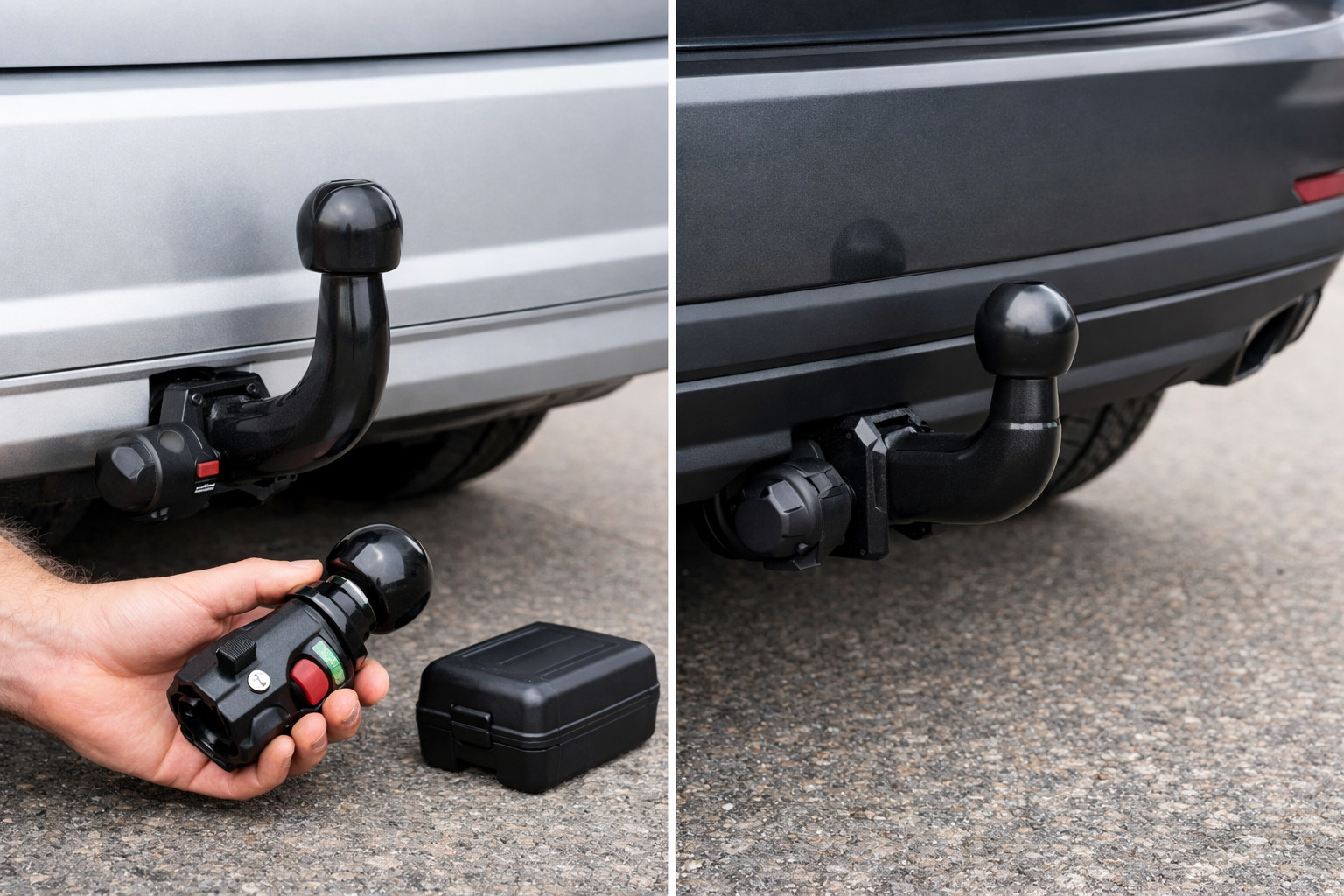
If the van tows a trailer or carries a hitch-mounted bike rack, you should start not with the step but with compatibility. In this scenario, many expensive options are eliminated first.
| Scenario | Best choice | Why |
|---|---|---|
| Daily delivery, service, tools | Wide full-width or commercial folding | Less fatigue, better footing, easier repeated entry through the rear doors |
| Camper or travel van | Wide aluminum | Comfortable full-width access, works better with dirty and wet footwear |
| Occasional trunk access | Simple fixed bolt-on | Basic convenience without a big overpay |
| Frequent towing or hitch bike rack | Only a compatible fixed or integrated solution after configuration check | Here the main risk isn’t comfort but a conflict with the towbar and attached equipment |
| Maximum comfort and a clean look | Sliding or premium integrated | Fewer compromises in access, geometry, and daily use |
A more expensive step is justified not when you just want “better,” but when a cheaper one truly doesn’t solve the task. That’s frequent rear access, the need to stand with your whole foot, work in slippery conditions, a strict requirement for compatibility with sensors or a towbar, and the desire not to lose rear-end functionality.
If you already understand that a basic option isn’t enough, it’s worth looking at rear steps, separately evaluating automatic steps for scenarios with a lower step height, and checking towing considerations in the material about the towbar in advance.
From a customer’s experience: the owner of a work van initially wanted the cheapest compact step because it seemed the main thing was simply having a place to put your foot. After уточнення it turned out the rear doors are opened dozens of times a day, and in winter the vehicle often works in mud. In the end, he chose a wider model with a proper anti-slip surface and was happy specifically because of less fatigue and a more stable step—not because of the looks.
In real-world use, a rear step for a van isn’t needed by everyone. It works best where the rear doors are a constant access point rather than a backup entry to the cargo area. For occasional use, a simple fixed solution is enough—or there’s no point in installing one at all.
The smartest approach is this: first check compatibility with the towbar, sensors, camera, and your usage scenario, and only then decide whether it’s worth paying extra for width, integration, or a sliding mechanism. The material is based on real selection experience, practical know-how, and real usage scenarios—not on choosing “by the picture.”
| ✔ | A rear step really simplifies repeated access to the cargo area, especially if the rear doors are used as a work zone. It is useful for delivery, service, campers, and vans carrying tools or equipment in the back. |
| ✔ | Simple fixed bolt-on models are often quick to install, sometimes without drilling, and usually work quietly. For infrequent or moderate cargo access, this is a practical basic solution. |
| ✔ | Wide full-width aluminum steps provide comfortable support for the whole foot and grip footwear better in rain, mud, and ice. This noticeably reduces inconvenience during frequent getting in and out of the van. |
| ✔ | Fold-out commercial models are well suited for intensive daily use, as they have a deeper platform and a high load capacity. They can be mounted on the left, right, or center, which is convenient for different tasks. |
| ✔ | Sliding and premium integrated solutions interfere less with the rear geometry and do not stick out all the time. This is convenient if a neat look and comfort without unnecessary compromises are important. |
| ✘ | A step is not always appropriate if the rear doors are opened rarely or the van often works with a trailer or bike rack. In such cases, it may not pay off or may create unnecessary restrictions. |
| ✘ | The biggest risk is incompatibility with a tow hitch, parking sensors, a camera, or a specific mounting type. Wide models especially often conflict with attached equipment. |
| ✘ | Fold-out, retractable, and other complex designs have more moving parts, so over time play, noise, and the need for maintenance may appear. This is not the best option if quietness and simplicity are needed. |
| ✘ | More expensive systems make sense only with frequent use; otherwise, the extra cost does not bring a noticeable practical benefit. For occasional access, a premium solution is often excessive. |
Shipping to EU
Wholesale and retail
Own warehouse
Опис продукту
Подарунки не надаються при оформленні покупки у кредит під 0,01% або при покупці частинами.