21.03.2026
346
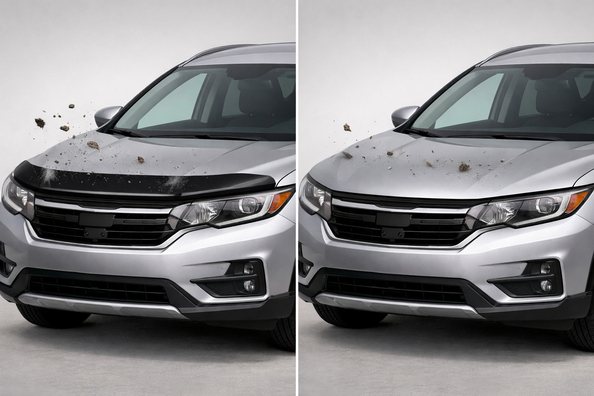

The key question here isn’t whether a hood deflector “works” in general, but whether you need it for your specific driving style. If your car spends most of its time in the city—where quietness, easy maintenance, and a clean-looking front end matter—it’s often smarter to drive without one. But if you regularly do highway miles, rural roads, deal with bugs, salt, small stones, and constant washes after long trips, a deflector can deliver noticeable practical benefits.
Most often, the healthiest compromise is a low-profile, vehicle-specific option. Taller deflectors really can lift the airflow more aggressively, but they also more often bring noise, vibrations, harder upkeep, and grime under the edge. No option provides complete protection from chips or large stones.
You’re essentially choosing between three scenarios: keep the hood without a deflector, install a low-profile vehicle-specific deflector, or choose a taller, more pronounced option. The difference isn’t only about looks. It’s about how much benefit you get on the highway—and what it costs you day to day: noise, maintenance, the risk of dust building up under the edge, and installation requirements.
Without a deflector, the car stays quieter and easier to maintain. A low-profile deflector usually suits those who want to slightly shield the hood’s leading edge and reduce the number of insects on the lower part of the windshield without a drastic change to the car’s appearance. A tall option is more aimed at highway driving, but it’s also the one that most often shows side effects.
There are five real criteria. Installation: ideally the deflector is vehicle-specific, fits without drilling, and uses quality tape or OEM mounting points. The more precise the fit, the lower the chances of play, rubbing, or misalignment. Noise: the taller and more aggressive the profile, the higher the chance of whistling, hood vibration, or simply a changed feel at speed.
Service life depends not only on the material, but also on whether abrasive dirt collects under the edge. Even good acrylic or polycarbonate won’t help if the part is installed on a dirty surface or isn’t cleaned. Practicality means how much benefit you actually get: fewer bugs, a bit fewer small impacts to the hood’s leading edge—but it’s not “armor” for the front end. Price isn’t just the product cost, but also the time spent on upkeep, checking mounts, and potential consequences of a poor installation.
| Option | Strengths | Weaknesses | Who it’s for |
|---|---|---|---|
| No deflector | No extra noise, easier washing, clean hood look, zero cost | The hood’s leading edge has no additional protection; more insects and small debris on the highway | Those who drive mostly in the city and don’t want extra maintenance |
| Low-profile vehicle-specific deflector | Neat look, moderate protection for the hood edge, lower chance of noise, usually easier installation | The effect isn’t dramatic; the area under the edge needs periodic cleaning | Those who often drive on the highway but don’t want a bulky accessory |
| Tall deflector | Can redirect airflow upward more actively; benefits at speed are more noticeable | Higher risk of whistling, vibrations, dirt under the edge; more demanding installation and upkeep | Those who drive a lot on high-speed roads or mixed highway routes |
DD Tuning expert comment: the most common mistake is buying the tallest deflector based on “the bigger, the better” and not considering where the car actually drives. If the vehicle spends 80% of its time in the city, this accessory often brings more noise and maintenance than benefit. The second typical misstep is installing it on a hood that isn’t perfectly cleaned, or choosing a non-vehicle-specific product with a mediocre fit.
This isn’t “saving on small things,” but a perfectly normal choice for a city car. You don’t get extra aerodynamic surprises, you don’t check mounts, you don’t worry about brush car washes being off-limits for the accessory, and you don’t collect dust under the edge. If your highway/city mileage is small, the difference in real-world benefit may be minimal.
The downside is obvious: the hood’s leading edge takes everything that flies into it. Bugs, road grime, and small impacts aren’t being pushed upward. So for frequent long-distance trips, this option loses out.
This is the most rational option for most people. It doesn’t promise miracles, but it delivers a practical plus: part of the airflow goes higher, the hood gets fewer small marks, and the lower windshield area may get dirty more slowly. At the same time, the car’s appearance isn’t disrupted as much as it is with a tall “visor” shape.
The key here is the vehicle-specific fit. If the deflector sits precisely, doesn’t pull on the edge, doesn’t wobble, and doesn’t press into the paint through trapped dirt, the chance of side effects is lower. But even a good low-profile option needs care: wash the area beneath it periodically and remember it doesn’t like abrasive treatment.
It’s chosen for the strongest effect at speed. On the highway, it really can lift small debris and insects higher above the trajectory of the hood and the lower windshield area. That’s why this format is more popular with those who drive a lot between cities.
But it also comes with the highest chance of compromises. A taller profile interferes more with airflow, so on some cars you may get whistling, trembling, or the sensation of an extra aerodynamic add-on. You also can’t rule out an impact on washer spray or wiper performance, especially if the deflector shape isn’t a good match for a specific body.
In short: city driving almost always points to skipping a deflector or choosing a low-profile vehicle-specific option. Long highway trips—especially during bug season and on roads with small stones—make a deflector more justifiable. But even then, it’s better to start not with the tallest solution, but with the most precisely matched one.
If preserving the car’s appearance matters more to you than maximum airflow deflection, the low profile wins. If the main goal is less grime and fewer small impacts on long trips, then a deflector makes sense. If you’re not ready to regularly check the mounts, clean the edge underneath it, and tolerate possible noise, it’s better to install nothing.
| Scenario | Best choice | Why |
|---|---|---|
| Daily city driving, short trips | No deflector | Less noise, easier to wash the car, the deflector’s benefit will be small |
| City plus regular highway | Low-profile vehicle-specific deflector | Real practical effect without overly rough changes to the car’s looks and behavior |
| Frequent intercity trips, lots of bugs, small stones | Low-profile or tall vehicle-specific, depending on noise sensitivity | At speed the difference is more noticeable, but a tall profile is only worth it if you’re ready for trade-offs |
| Poor roads, rural areas, dirt and salt | Vehicle-specific deflector | It makes sense to add coverage for the hood’s leading edge, where loads are higher |
| Maximum OEM-like appearance is important | No deflector or a low option | A tall deflector visually dominates and doesn’t suit everyone |
| No desire for separate upkeep and mount checks | No deflector | Any deflector requires at least minimal attention after installation |
Paying extra is justified when the car really sees a lot of highway driving, gravel, salt, and long high-speed runs. In that case, a cheap universal option almost never beats a precisely fitted vehicle-specific hood deflector. If your main goal isn’t bugs but preserving the paint on the front edge, sometimes it’s more logical to look toward paint protection film. And for those who often drive on muddy roads, a sensible addition can be mud flaps to reduce overall abrasive load on the body.
So a pricier solution makes sense not when you want “maximum accessories,” but when there’s a specific task: highway driving, protecting the hood edge, fewer bugs to wash off after every trip, or better paint protection. In other cases, paying more often doesn’t bring proportional benefit.
From a customer’s experience: a common scenario is when a crossover owner looked for a way to reduce the number of bugs on the windshield and small marks on the hood’s leading edge after regular interregional trips. After comparing options, he skipped the tall version and chose a low-profile vehicle-specific deflector because he didn’t want extra noise. As a result, he got noticeably less dirt in the lower windshield area and was happy that the car kept a neat appearance.
A hood deflector genuinely isn’t necessary for everyone. If your driving is mostly in the city, with short routes and a requirement for quietness and easy maintenance, it’s often better without it. If you have highways, bugs, small stones, and constant load on the hood’s leading edge, the smartest option is a low-profile vehicle-specific deflector—while a tall one should be chosen only if you knowingly accept possible side effects.
The material is based on real selection experience, hands-on practice, and real use cases—so the takeaway is simple. Buy a deflector not “just in case,” but for your specific driving conditions, and only considering fitment, installation, noise, maintenance, and whether it actually benefits you on your routes.
| ✔ | On the highway, a deflector can reduce the amount of insects and small debris hitting the lower part of the windshield and the front edge of the hood. For frequent intercity trips, this gives a noticeable practical effect. |
| ✔ | A low-profile model-specific version usually offers a compromise between utility and comfort: it is less noticeable from the outside, less likely to create noise, and easier to install. For most scenarios, it looks like the most rational choice. |
| ✔ | A properly selected deflector can partially protect the front edge of the hood from minor impacts and dirt. This is especially relevant on roads with salt, dust, and small stones. |
| ✔ | If the car often drives on highways or mixed routes, the benefit of the deflector becomes more noticeable in real-world conditions. In this mode, it can reduce how often the front end needs washing after trips. |
| ✘ | A deflector does not provide full protection against chips and large stones, so it should not be seen as a replacement for more serious protection. It only partially changes the airflow and reduces some of the minor impact. |
| ✘ | High-profile models more often add noise, whistling, and vibrations, especially at speed. On some cars, they can also change the feel of the washer system or windshield wipers. |
| ✘ | Any deflector requires care: dust and dirt collect under the edge, and after installation it is advisable to periodically check the fasteners. This adds maintenance compared with a car without this accessory. |
| ✘ | Universal or poorly fitted models can rub the paint, have play, or be installed unevenly. Problems most often arise precisely because of a poor fit and low-quality installation. |
Shipping to EU
Wholesale and retail
Own warehouse
Опис продукту
Подарунки не надаються при оформленні покупки у кредит під 0,01% або при покупці частинами.