
19.02.2026
166
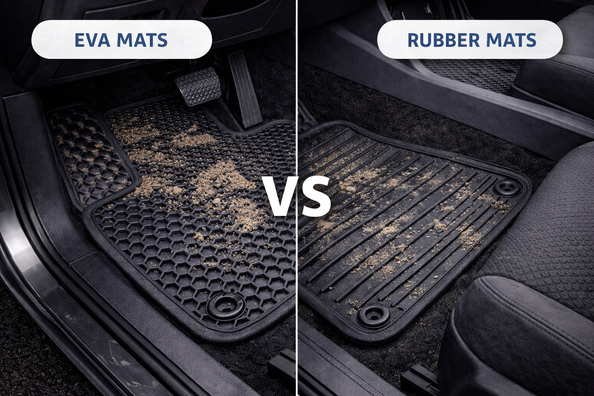
Executive summary. In the “EVA vs rubber vs carpet” comparison, there isn’t one “best” option for everyone: the choice depends on your use case, the season, and how much time you’re willing to spend on maintenance. EVA floor mats more often win where there’s a lot of water/snow and it’s important that dirt doesn’t get tracked around the cabin. Rubber is the easiest for everyday washing and works well for mud and “work” vehicles. Carpet is about comfort and looks, but in winter and the shoulder seasons it requires discipline with drying.
Below is a practical “car mats comparison” by criteria, plus ready-to-use tips on what to choose if you’re deciding “EVA or rubber mats”, “carpet or EVA”, or looking for which mats are best for winter. At the end there’s an ordering guide so the set is compatible with your model and mounts securely.
The question “what’s better” almost always breaks against real life. Some drivers mostly move around the city and get into the car with relatively dry shoes; others carry kids/pets every day; others live in a private sector and constantly deal with dirt from unpaved roads. In these scenarios, priorities differ: somewhere side walls and water retention matter, somewhere it’s washing speed, somewhere it’s comfort and quietness.
So instead of an abstract “EVA vs rubber” argument, it’s more useful to ask 5–7 right questions: will you have a lot of meltwater, how often do you clean the interior, are you sensitive to odors, do you need a “premium” look, and are there factory mounting points. If you’re considering EVA floor mats specifically, you’ll see below when they deliver the most practical value.
For readability, let’s define what exactly we’re comparing. EVA is ethylene-vinyl acetate (EVA), an elastic polymer; in car mats the most common format is a cellular texture (diamond/honeycomb) that captures water, sand, and fine dirt in “pockets.” Rubber is a solid material with ribbing/channels, aimed at fast washing. Carpet (textile) is a fibrous surface on a backing—comfortable, but more demanding about drying after it gets wet.
The criteria that actually determine the choice:
A practical nuance: in real use, the “material” often loses or wins because of the shape. Even the best rubber won’t save you if there are no side walls and water runs under the mat. Likewise, EVA won’t deliver the expected effect if the cells are shallow, the edges curl, or the set doesn’t follow the contour. So look at patterns for your specific model and at how well the areas near the sills, the center tunnel, and the dead pedal are protected.
If you want a deeper look at the construction and the “cell” principle, see what EVA mats are and how they work—it helps you evaluate not only the material, but also how the geometry and side walls are implemented.
Below is the main table. It summarizes typical properties, but the final result depends on the manufacturer: thickness, density, side-wall height, pattern accuracy, and correct mounting (especially in the driver’s area).
| Criterion | EVA | Rubber | Carpet |
|---|---|---|---|
| Water/dirt in the shoulder seasons | Cells retain moisture and fine dirt below the sole | Keeps water on the surface; channels and side walls matter | Fibers get wet; drying is required |
| Ability to “not spread” dirt | High if the texture is deep and there are side walls | Medium: dirt stays on the surface, but it’s easy to rinse off | Low in wet season: dirt gets rubbed into the pile |
| Maintenance | Usually shake out/rinse; sometimes flush the cells | Easiest: water + brush, dries quickly | Vacuum + sometimes shampoo/washing |
| Drying | Faster than carpet; you need to drain water from the cells | Almost hassle-free: doesn’t absorb water | Slower: the backing can hold moisture |
| Odor risk from moisture | Lower if you drain/dry regularly | Low: water doesn’t penetrate the structure | Higher when wet and poorly dried |
| “New product” smell | More often moderate; depends on formulation | Can be stronger in budget compounds | Usually neutral (possible glue smell) |
| Comfort and appearance | Springy, “technical” design | Practical, but less “interior-like” | Most comfortable and best aesthetically |
| Winter: snow and de-icers | Strong scenario: cells capture slush | Strong scenario: easy to wash, doesn’t absorb water | Weak scenario: wet pile dries slowly |
| Summer: dust/sand | Holds sand well, but you need to rinse the texture | Very practical: rinse and done | Dust clogs it; vacuuming needed |
| Slipping and mounting | Proper mounting is required; otherwise risk of shifting | Usually holds well, but anchors still matter | Backing helps, but you shouldn’t skip anchors |
| Wear | Good with quality edging and density | Good; cheap options can age faster | Can get “matted” at the driver’s heel |
| Price/value | Mid/higher; best value in wet scenarios | Low–mid; often the best “for the maintenance” | Low–high; you pay for comfort and looks |
Why are EVA or rubber usually recommended for winter? In the cold season there’s a lot of salty moisture and fine abrasive (sand/salt) on shoes. So materials that keep the slush within the mat and are easier to wash bring more practical benefit. Carpet loses not because it’s “bad,” but because textiles can retain moisture longer—and fast drying is what matters here.
As for a “chemical” smell: it’s possible with any type (rubber, EVA, carpet backing), because polymers and adhesive compounds can release volatile components. Intensity and duration depend on formulation and process. If you’re sensitive to odors, a simple routine helps: rinse/wipe the mats, dry them, let them air out, and ventilate the cabin more often during the first trips.
And one last important point: regardless of material, the driver’s mat must be secured and must not interfere with the pedals. Also avoid “double” solutions where one mat is placed on top of another: this can compromise mounting and increase the risk of shifting in the pedal area.
A quick tip in one place—the “scenario → type” table. Remember: if two types “fit,” the difference is often made by side walls, patterns, and mounting.
| Use scenario | Best type | Why | Compromise |
|---|---|---|---|
| City/highway, minimal dirt | Carpet | Comfort, looks “factory” | For winter, a second set (EVA/rubber) can make sense |
| City with frequent rain/outdoor parking | EVA | Cells retain water/sand; less “mud” on top | You need to rinse the cells periodically |
| Family, kids, frequent crumbs/spills | Rubber | Fastest “remove and wash” | EVA retains fine dirt better, but cells are less convenient to wash |
| Taxi/delivery, high traffic | Rubber | Minimum maintenance time, consistent practicality | EVA can be an alternative if dirt containment matters more |
| Winter: wet snow, slush, de-icers | EVA or rubber | Handle water better, easier to wash | Carpet—only with regular drying |
| Private house/dirt roads/mud | Rubber | Easiest to wash after “heavy” dirt | EVA may require longer rinsing of the texture |
| Neat interior, aesthetics matter | Carpet | Maximum comfort and “premium” feel | Rubber/EVA—as a seasonal set for wet periods |
If your conditions are mostly dry, carpet is a logical choice for comfort. If the city is often wet, EVA may be more practical: it better “organizes” sand and water in the texture and gives a cleaner-surface feeling between cleanings.
For a family, cleaning speed matters. Rubber and EVA are usually easier because they can be washed with water, whereas carpet more often needs vacuuming/shampoo and mandatory drying.
In taxi use, rubber most often wins: minimal steps, quick washing, minimal risk of leaving moisture in the material. EVA can be an alternative if it’s important that fine dirt isn’t tracked around by passengers’ feet.
To the question “which mats are best for winter,” the most honest answer is: the ones that keep salty moisture within the mat and don’t create a drying problem. EVA and rubber are strong here; carpet is demanding. More on the topic: EVA mats in winter: de-icers and snow.
When there’s a lot of dirt and it’s “heavy,” rubber is usually the most convenient: rinse and you’re done. For EVA, it’s important that you’re willing to rinse the texture—otherwise some dirt will remain in the cells.
EVA floor mats are the most rational when your main pain point is moisture and fine abrasive (sand/salt) that in the shoulder seasons and winter quickly spreads through the cabin. The cellular structure works like a trap: moisture and dirt settle into the recesses, so the top surface often looks cleaner between cleanings.
For EVA to truly work “better,” pay attention to three things: precise patterns for your model, side walls (especially near the dead pedal), and mounting. An unsecured mat can shift and interfere with the pedals—this applies to any material, but quality fit is what separates a well-thought-out set from a universal one.
A typical expectation mistake: EVA doesn’t “make dirt disappear by itself.” The cells only localize it, and you still need to periodically shake out or rinse the mat. If you fill it “to the edges” with water and don’t drain it for a long time, the effect decreases. That’s why wet season = short but regular cleaning cycles.
For maintenance, EVA is usually convenient if you’re okay with a simple routine: shake out/rinse and properly drain water from the cells. Practical tips—how to wash and care for EVA mats.
Material is only half the success. The other half is compatibility, mounting, and the shape in the driver’s area. Here’s a short ordering algorithm.
After receiving the set, do a simple check: install the driver’s mat, secure it, press the pedals fully, and make sure nothing catches and the mat doesn’t shift. This is a basic requirement for safe use.
EVA is a strong choice for the wet season when it’s important to retain water/sand and clean the interior less often; rubber is the easiest for mud and quick washing; carpet is best for comfort and aesthetics, but demanding about drying in the wet season. Choose not the “material,” but the scenario—and always check mounting and compatibility in the driver’s area.
Shipping to EU
Wholesale and retail
Own warehouse
Опис продукту
Подарунки не надаються при оформленні покупки у кредит під 0,01% або при покупці частинами.