09.04.2021
6696
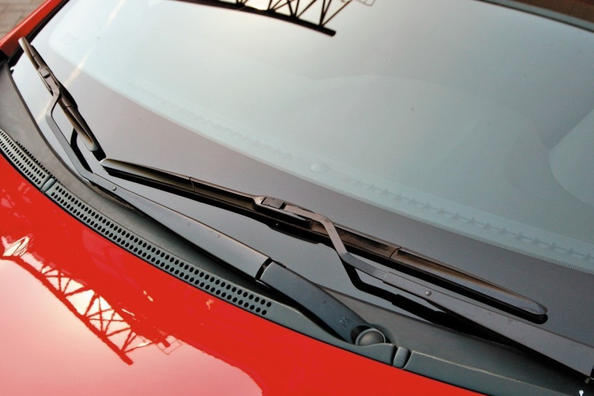
Wiper blades are a small thing you only remember when, in the rain on the highway, streaks start appearing on the windshield—and in winter the wiper turns into an icy stick. Stores offer three main types: frame, frameless (flat), and hybrid. They press the rubber against the glass differently, behave differently at speed and in frost, and attach to the wiper arm differently. Let’s break down how they differ, which wipers are better in winter, and how to choose the right blades for your car.
Contents
The key difference is not the appearance, but how the blade presses against the glass and whether it has open areas where snow and ice can build up.
A frame blade consists of a rubber strip and a metal frame with a system of linkages. The wiper arm pushes on the center of the frame, and the linkages transfer that force to the rubber at several points. This design is well proven, simple, and inexpensive, and on some models you can replace only the rubber insert without throwing away the entire frame.
The weak points also come from the design. Pressure is applied through separate points, so on windshields with strong curvature the rubber makes less even contact. The open frame catches the oncoming airflow, and at high speed the blade holds the glass worse. In winter the joints and linkages get packed with snow and freeze—more on that below.
In a frameless (flat) blade, instead of a frame there is a spring steel strip with a pre-set curve. When the wiper arm presses the blade down, the strip straightens and evenly presses the rubber along the entire length. On top there is usually an aerodynamic spoiler: at speed the airflow does not lift the blade off—it presses it to the glass. That is why flat blades are quieter and clean more consistently on the highway.
A common myth is that frameless wipers “fit only a specific car model.” In reality, most flat blades are sold as universal—with an adapter for the most common “hook” mount, or with a set of adapters for different wiper arms. There are also vehicle-specific blades: they are made for cars with a non-standard mount where a universal adapter will not fit. The blade really is non-serviceable—you replace it as a whole—but it also works without joint play, because it simply has no joints.
A hybrid combines both approaches: inside is a metal frame with linkages, like on a classic blade; outside is a one-piece streamlined housing, like on a flat blade. The frame distributes pressure evenly, while the housing protects the joints from snow and dirt and reduces blade lift from airflow at speed. Hybrid blades are often sold with several adapters for different arm types.
| Parameter | Frame | Frameless | Hybrid |
|---|---|---|---|
| How the rubber is pressed | through several points of the frame | along the entire length by a spring strip | through a frame hidden in the housing |
| Behavior at speed | may lift off the glass | the spoiler presses the blade down | the housing reduces blade lift |
| Snow and ice | joints and linkages freeze | no exposed joints | joints are covered by the housing |
| Noise | higher | lower | lower |
| Serviceability | on some models only the rubber insert is replaced | the whole blade is replaced | the whole blade is replaced |
| Mounting | mostly “hook” | universal adapter or vehicle-specific | set of adapters |
In winter, the problem with frame blades is the exposed joints. Wet snow packs between the linkages, freezes, and the frame loses mobility: the blade becomes stiff, contacts the glass only partially, and leaves wide streaks. For these conditions there are special winter frame blades—in them the frame is enclosed in a rubber cover that prevents slush from freezing in the joints.
With frameless blades there is nowhere for ice to pack in, so in freezing temperatures they keep their pressure longer. But the claim that flat blades “do not freeze” is an exaggeration: any blade can stick to the glass by the rubber if the car sat overnight under snow. Hybrids in this respect are closer to flat blades—their joints are covered by the housing.
A few rules that help protect wipers in winter regardless of type:
Wipers are selected by two parameters — length and mounting type. Universal blades are not tied to a brand, so the car model name by itself does not guarantee anything.
The most reliable method is to measure the old blades with a tape measure from end to end. On most cars the front blades are different: the driver’s side is longer, the passenger side is shorter. If you install two of the same length, they may hit each other or the windshield seal. The rear wiper has its own size and often its own mount, so measure it separately.
To avoid mistakes, take a photo of the point where the blade attaches to the arm and measure both blades—then choosing will take just a few minutes. Universal blades with a “hook” mount and hybrids with a set of adapters are collected in the universal wipers section, and the full range is in the wiper blades category. Note: universal blades are sold individually, so for the front you usually need two.
Rubber ages from sun, frost, road chemicals, and dust, so most blades have to be replaced every 6–12 months. Many drivers do it before winter, when a weak blade is most likely to let you down. Signs it is time to replace:
Not every squeak means replacement: sometimes the culprit is dirty glass, dried wax, or a bent wiper arm. What to check first is in the article why wipers squeak. Regularly wiping the rubber with a damp cloth and keeping the glass clean helps extend blade life: sand under the blade works like sandpaper.
Whatever the design, it wipes cleanly only when the length and mounting match, and the rubber is fresh. So start not with choosing the type, but with measuring your old blades.
We deliver with Nova Poshta across Ukraine; orders from 15,000 ₴ are delivered free of charge by our own transport.
Shipping to EU
Wholesale and retail
Own warehouse
Опис продукту
Подарунки не надаються при оформленні покупки у кредит під 0,01% або при покупці частинами.