 Author: Radomskyi Maksym Vasyliovych
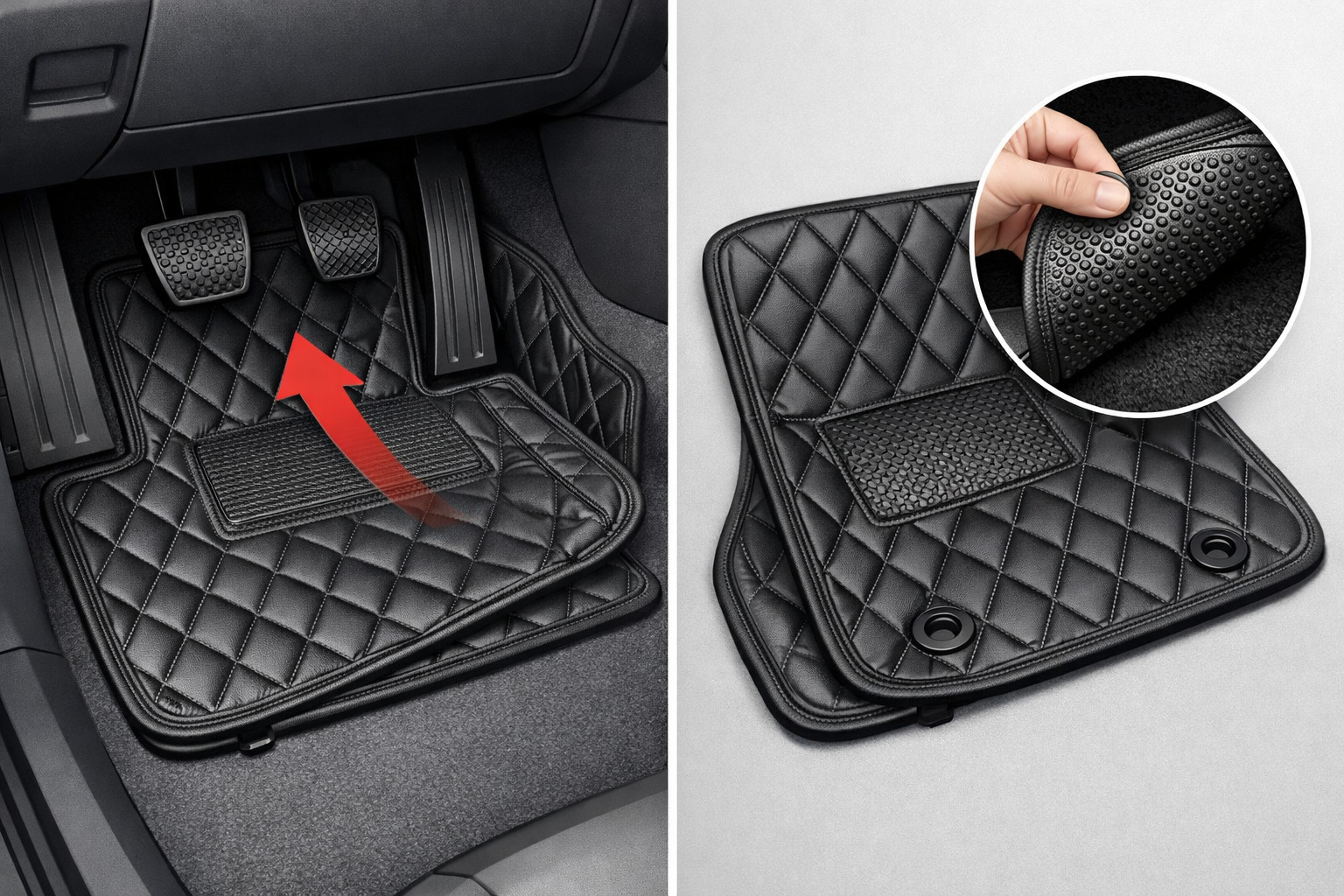
Eco-leather mats don’t automatically slip, but the material alone doesn’t guarantee safety either. What matters most isn’t the top surface, but the accuracy of the cut, OEM mounting points, the quality of the backing, and what the mat is lying on inside the cabin.
It’s important to separate two different issues here: when your foot slips on an overly smooth surface after poor finishing, and when the mat itself shifts across the floor. The second scenario is more dangerous, especially in the driver’s area, where the mat can move toward the pedals.
Why this problem happens
Eco-leather often looks dense and “premium,” so buyers expect the mat to fit properly right away. But if the set is universal, the edges don’t match the floor shape, and the holes for retainers are missing or don’t line up, the mat starts “living its own life” in the cabin: it curls, slides forward, or bunches up in waves.
The biggest risk is in the driver’s seat. There, the mat is constantly loaded by the heel, leg movement, and moisture from shoes. If the floor is smooth, the carpet pile is worn, and there’s no mechanical retention, even a decent anti-slip backing works only partially.
Main causes
- Inaccurate cut or a universal size instead of a vehicle-specific set.
- No OEM fixation or incompatibility with the factory retainers.
- Moisture, worn carpet pile, or a smooth vinyl floor under the mat.
- Incorrect installation: the mat is placed on top of another one, shifted, or positioned incorrectly.
- Poor cleaning or treatment that makes the surface or backing more slippery.
The point is simple: in most cases, it’s not “eco-leather as a material” that slips, but a poorly secured set in a specific cabin and under specific operating conditions.
How to understand what’s causing it in your case
- Check whether the car has factory mounting points and whether the mat actually sits on them. If not, that’s the first suspect.
- Make sure the mat lies flat across the entire area. Any wave, a fold near the tunnel, or a gap by the seat means the template doesn’t match.
- Press each pedal fully with the engine off. If the mat edge comes even close to the pedals, the issue must be fixed before driving.
- Remove the mat and inspect the floor. Wet carpet pile, sand, chemical residue, or smooth plastic under the backing drastically reduce grip.
- Recall what changed recently: interior washing, rearranging, replacing mats, applying shine/dressing. If everything was fine before, the cause is often there.
DD Tuning expert comment: the most common mistake is judging a mat only by photos and material, not by compatibility with a specific car model. Another typical story is when the driver places a new mat on top of the old one or doesn’t check the retainer holes after cleaning. If the set sat with waves from the start, Velcro rarely saves it for long.
Symptoms, causes, and what to do (table)
| Symptom | Likely cause | What to do |
|---|---|---|
| The mat creeps forward toward the pedals | No mechanical retention or an inaccurate cut | Use only a vehicle-specific set; check compatibility with factory retainers |
| The edge curls near the tunnel or sill | Universal sizing or deformation after incorrect installation | Remove and reinstall; if the shape doesn’t match, replace the set |
| The mat slips after rain or washing | Wet floor, sand, slippery backing | Dry the floor, clean the backing, and recheck the fit |
| Your foot slips on top, but the mat itself hardly moves | A glossy or slippery product residue on the surface | Remove the treatment; wipe with a neutral cleaner without a shine effect |
| It sits fine for the passenger, but slides for the driver | Constant heel load, weak heel-pad area, no fixation | Assess the driver’s mat separately; if worn or too soft in shape—replace it |
What actually helps
- A vehicle-specific set for the exact make, year, and cabin type—not something that “almost fits.”
- Mounting to OEM points if your car’s design provides them.
- A dry, clean floor before installation, especially in the driver’s area.
- Checking full pedal travel immediately after installation and again after interior cleaning.
- An honest choice for your use case: eco-leather is fine for city driving, but for постоян mud, sand, and wet shoes, a different surface is more practical.
If a mat is cut correctly, secured properly, and lies on a normal floor, it shouldn’t slide under your feet. These three conditions deliver the result—not a loud “anti-slip” label.
What hardly works or only helps briefly
- Velcro as the only retention method in the driver’s area.
- Trying to “pin” the problem down with a second mat on top or underneath.
- Randomly trimming a universal set when the floor geometry already doesn’t match.
- Glossy care products that make the surface slippery.
- Ignoring a small shift thinking it will “still do for now.”
Auxiliary solutions can be useful only as an add-on. If the shape isn’t right or the OEM mounting is missing, a short-lived effect isn’t worth the risk near the pedals.
When accessories or replacing elements makes sense
If a city driving routine suits you, you want to keep the cabin neat, and your car has factory mounting points, take a look at vehicle-specific eco-leather mats. If you’re unsure because of seasonality and slush, it’s useful to first read the comparison with honeycomb mats.
Replacement is needed not only when the mat is torn. If it doesn’t sit on the retainers from the start, forms waves, or consistently shifts in the driver’s area, it’s better to spend the money on a different type of covering. For a work vehicle, frequent trips in dirt, and wet shoes, it’s often more logical to switch straight to rubber mats rather than fighting a bad set.
Solutions: when they work and when it’s not worth spending money (table)
| Solution | When it works | When it’s not worth spending money |
|---|---|---|
| Vehicle-specific set with holes for OEM retainers | When the car has factory retention points and the template is accurate | When you buy an approximate size without checking compatibility |
| Cleaning and drying the floor before installation | When the mat started slipping after rain, winter, or interior cleaning | When the problem is constant due to the mat’s incorrect shape |
| Velcro or an additional anti-slip underlay | As a supplementary measure on passenger sides or together with OEM mounting | As the only retention method near the pedals |
| Correct reinstallation | When the mat shifted after removal, washing, or service work | When the edges don’t match the floor even when the mat is at rest |
| Switching to rubber or another more practical material | When the car is driven daily in slush, dirt, or with wet shoes | When the only issue is that the new mat hasn’t been installed properly yet |
From a customer’s experience: someone wanted an eco-leather set for a tidy-looking interior but first bought a universal kit without compatible retainers. On the passenger side it was tolerable, but the driver’s mat crept forward after every trip. After switching to a vehicle-specific set, the problem disappeared without extra underlays or DIY fixes.
Conclusion
Eco-leather mats can be a normal and safe option, but only under three conditions: an accurate template, proper fixation, and an appropriate usage pattern. If even one of these conditions fails, the problem is almost certainly not a “slippery material,” but fitment and design.
So before buying, you should check not only the look, but compatibility with your cabin, the presence of OEM mounting points, and how the car is actually used. This material is based on real selection experience, installation practice, and real usage scenarios—not on photos from a product card.
How it works
- Check compatibility with your vehicle Choose a model-specific set, not a universal one, for a specific make, year, and interior type. It is important that the mat has an exact fit and matches the factory mounting points.
- Inspect the factory mounts and the base Before buying or installing, make sure there are working retention points in the cabin and that the mat actually fits onto them. If the floor is wet, dirty, or covered with slippery plastic, retention will be weaker.
- Install the mat correctly Lay it flat, without waves, folds, or overlap on the old mat. After installation, check that the edge does not reach the pedals and that it does not shift in the driver area.
- Check the cause of slipping after use If the mat started shifting after rain, washing, or cleaning the interior, remove it, dry the floor, and clean the base. If your foot slips on top, remove shiny or slippery care products.
- Assess whether the material needs to be replaced If the mat does not match the shape of the floor from the start, ripples, or consistently moves toward the pedals, auxiliary solutions will not have a lasting effect. In that case, it is better to switch to a model-specific set or, for difficult conditions, to a more practical material, such as rubber.
Pros and cons
EVA floor mats can be safe if they have an exact template, factory fixation, and fit the interior properly. In other words, the material itself is not the issue when the set is matched to a specific car.
A model-specific set holds to the cabin better than a universal size. This reduces the risk of edge curling, ripples, and shifting toward the pedals.
On a dry and clean floor, the mat usually sits more stably. This is especially noticeable after rain, cleaning the interior, or before reinstalling it.
If the mat starts moving because of an improper fit, the problem can often be found and fixed without replacement: check the fasteners, placement, and floor condition. This is more practical than replacing the set right away.
Universal mats often do not follow the floor shape and may shift or bunch up. In the driver’s area, this already creates a risk of getting close to the pedals.
If there are no factory mounts or they do not match, the anti-slip backing only helps partially. In that case, the mat may remain unstable even with a normal outer surface.
After moisture, dirt, sand, or poor cleaning, the mat starts slipping much more easily. On a smooth vinyl floor or worn carpet, the problem becomes even worse.
Glossy care products can make the surface slippery, and hook-and-loop or backing does not solve the problem for long. If the shape does not fit, temporary solutions near the pedals are dangerous.