14.08.2026
111
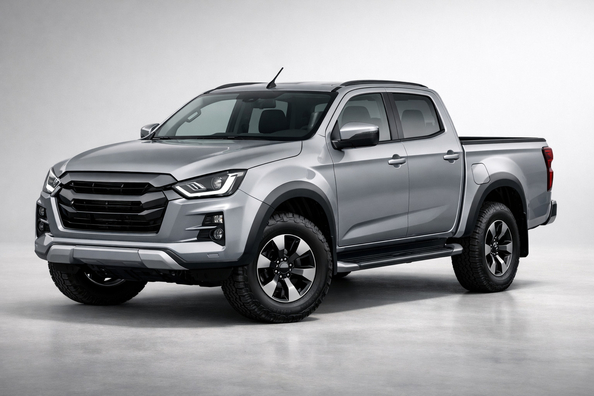
Isuzu D-Max is a body-on-frame mid-size pickup where the priority isn’t ride softness but payload work, towing, and trips to places where a passenger car gives up. The new generation has become noticeably more civil in the cabin and in safety, but the essence hasn’t changed: it’s a vehicle for those who actually use the bed, 4WD, and ground clearance—not just want a high seating position.
There’s an important nuance with the D-Max: trims, engines, and even output depend heavily on the market. So before buying or choosing accessories, it’s worth looking not only at the model name, but also at the generation, cab type, drivetrain, and the exact engine.
In its class, the D-Max sits alongside the Toyota Hilux, Ford Ranger, Mitsubishi L200, and Nissan Navara, but it traditionally bets on durability and straightforward work logic. It’s not a crossover with an open bed—it’s a real pickup: when it’s loaded or pulling a trailer, its purpose is instantly clear.
The model suits builders, farmers, service crews, hunters, anglers, and anyone who travels with a trailer or lots of gear. If your main use case is city driving, parking garages, short daily trips, and expectations of car-like smoothness, the D-Max may feel too stiff and bulky.
The D-Max has evolved from a purely utilitarian work pickup into a much more mature vehicle that no longer intimidates with its interior or lack of electronics. But the differences between generations are significant, so you shouldn’t lump them into one image.
| Generation | Years produced | What fundamentally changed |
|---|---|---|
| First | 2002-2011 | Simple work-focused design, emphasis on durability, minimal comfort. |
| Second | 2011-2019 | Better cabin, more modern diesels, more versions for private use. |
| Third | from 2019 | Newer frame and body, a much bigger leap in safety, electronics, and everyday comfort. |
The launch timing of the new generation varied by country: it appeared earlier in some places and later in others. For the used market, that means a simple rule: the year on the papers doesn’t always precisely tell you which generation you’re looking at, so it’s better to verify the body, engine, and interior.
The D-Max lineup is almost entirely diesel. This is where market specifics matter, because the same model in different countries could have different tuning or a different base engine.
| Engine | Where it’s found | Power | Practical character |
|---|---|---|---|
| 2.5 diesel | First and second generation | 136-163 hp | The basic workhorse option on older D-Max models—simpler in feel and louder in operation. |
| 3.0 diesel | Various generations, including certain markets of the current model | 163-190 hp | A better torque reserve for payload and trailers—especially appealing if you rarely drive empty. |
| 1.9 diesel | Late second and current third generation | 150-163 hp | The most common modern D-Max engine; calmer, but more economical in everyday use. |
For the new generation, a 6-speed manual or 6-speed automatic is typical. Most 4WD versions use part-time 4WD with a low range, which means strong traction on dirt and in mud, but not the car-like all-weather versatility of full-time AWD on dry asphalt.
The D-Max is built on a frame, with independent front suspension and a solid rear axle on leaf springs. For hauling, that’s the right layout; for empty driving, it’s a compromise: without load, the rear end is noticeably stiffer than in a crossover.
| Parameter | Current D-Max with double cab |
|---|---|
| Length | about 5265-5280 mm |
| Width | 1870 mm |
| Height | approximately 1790-1810 mm |
| Wheelbase | 3125 mm |
| Ground clearance | about 235-240 mm |
| Wading depth | up to 800 mm |
| Bed size | approximately 1495 x 1530 x 490 mm |
| Bed volume | about 1.1 m³ |
| Payload | up to 1 t depending on version |
| Braked trailer weight | up to 3.5 t depending on market |
A pickup doesn’t have a “trunk” in the passenger-car sense, so you need to look at the bed geometry. For travel and work, what matters isn’t liters under a parcel shelf, but bed length, side height, the ability to secure the cargo, and loading convenience.
The new generation made a big step forward: materials are nicer, the infotainment is more up to date, and ergonomics are clearer for everyday driving. But it’s still a pickup: the seating position is high, the second row in a double cab is more upright, and noise insulation depends on tires, load, and road surface more than in a typical passenger car.
In safety terms, the current D-Max is much more serious than older generations. Depending on trim and market, it may include automatic braking, lane keeping, blind-spot monitoring, adaptive cruise, and other electronic assistants. For those who drive far and often, this isn’t a minor detail—it’s real driver fatigue taken off your shoulders.
In the city, the D-Max takes getting used to: the long wheelbase, large turning circle, and tall body quickly remind you it’s work equipment, not a compact family car. But on the highway, broken roads, in fields, or on a job site, it starts playing by its own rules and feels much more at home.
For the owner, two things matter. First: an empty pickup rides harsher than a loaded one. Second: an open bed doesn’t solve storage by itself—tools, suitcases, and gear need to be covered or unloaded regularly. That’s why D-Max accessories are often bought not for looks, but out of practical necessity.
| Specification | Value |
|---|---|
| Body type | body-on-frame pickup |
| Drive | rear-wheel or 4WD, depending on version |
| Transmission | 6-speed manual or 6-speed automatic |
| Engines | 2.5 diesel; 3.0 diesel; 1.9 diesel |
| Power | 136-190 hp depending on engine and market |
| Ground clearance | about 235-240 mm |
| Bed | about 1.1 m³ |
| Wading depth | up to 800 mm |
| Towing | up to 3.5 t depending on trim and market |
| Pros | What it gives the owner | Cons | What it means in practice |
|---|---|---|---|
| Frame, low range, high ground clearance | You can go where a passenger car would already feel like a risk, and not worry about doing real work. | Stiff rear suspension without load | With an empty bed, the ride can feel choppy over small bumps. |
| Diesel torque and strong towing capability | Easier to pull a trailer, carry building materials, a boat, or equipment. | Large dimensions | Parking and tight yards aren’t its favorite discipline. |
| A cargo bed instead of a regular trunk | Easy to carry dirty, large, and awkward items. | The bed needs add-ons | Without a canopy, roll cover, or liner, everyday practicality is lower than it seems. |
| The latest generation is safer and more convenient | Less of a purely utilitarian feel on long trips. | It doesn’t replace a crossover for comfort | If you buy it only for city and family use, some advantages simply won’t show. |
The main mistake with the D-Max is simple: buying it as a fashionable alternative to a large crossover. It performs best where you need to carry, tow, go beyond asphalt, and not be afraid of dirty work.
Tuning for the D-Max makes sense when it solves a specific task. If the bed constantly carries tools, work boxes, suitcases, or camping gear, the first step is usually to enclose the bed. Side steps, protection, and exterior styling come next—once the use case is clear.
If the vehicle often drives on dirt roads, it makes sense next to look at mud flaps, floor mats, skid plates, and side steps. But the right sequence is almost always the same: first close off the bed and make everyday life convenient, and only then add everything else.
| Practical pros | Practical cons |
|---|---|
| Handles heavy work, trailers, and broken roads well. | In the city and in parking lots it demands more attention and space. |
| The bed lets you carry large, dirty, and bulky items. | An open bed requires accessories to protect cargo. |
| Diesel engines deliver noticeable low-end pull. | Empty driving can feel stiff. |
| The current generation already offers a decent level of comfort and safety. | For purely family trips, a crossover is often more convenient. |
Choosing accessories for the D-Max is best started from how the vehicle is used day to day. If you need cargo protection and a neat look, consider solutions like a canopy or roll covers; and if you need a quick clarification about the generation itself and its specifics, the review of the updated D-Max will come in handy.
In its new generation, the Isuzu D-Max has become more mature, safer, and nicer to live with day to day, but it hasn’t lost its work-focused character. It’s a strong choice for those who truly use a pickup as intended: carrying loads, towing, driving bad roads, and wanting simple utilitarian logic without unnecessary show. If, however, you need a vehicle mainly for city use, family comfort, and short trips without cargo, a crossover will often be the more rational option.
| ✔ | The ladder-frame construction, low-range gear, and high ground clearance make the D-Max suitable for heavy work and trips where a passenger car would no longer cope. This is especially useful on broken roads, in the field, or on a construction site. |
| ✔ | The diesel engines deliver good low-end torque, which is convenient for towing a trailer, carrying materials, and driving with a load. For those who often drive loaded, this is a practical advantage. |
| ✔ | The cargo bed allows you to transport large, dirty, and awkward items without being tied to a regular trunk. For work use, this is much more convenient than a passenger-car format. |
| ✔ | The current generation has become noticeably better in terms of cabin, ergonomics, and safety equipment. Because of this, the vehicle feels less purely utilitarian on long trips. |
| ✔ | The all-wheel-drive versions with selectable drive and low-range gear are well suited for dirt, mud, and difficult surfaces. This provides an extra margin of capability where a regular city car quickly gives up. |
| ✘ | Without a load, the rear leaf-spring suspension is noticeably stiff, so the empty D-Max can shake over small bumps. In everyday driving, this is more noticeable than in a crossover. |
| ✘ | The large dimensions and long wheelbase make parking, maneuvering in narrow yards, and driving in tight city streets more difficult. You have to get used to that. |
| ✘ | The open cargo bed does not, by itself, protect the load from rain, dust, or unauthorized access. To use the vehicle conveniently, you often have to buy a canopy, rolling cover, or other accessories right away. |
| ✘ | The D-Max does not replace a crossover in terms of comfort, especially if the main use is city and family trips. In such a scenario, its advantages simply do not fully come into play. |
Shipping to EU
Wholesale and retail
Own warehouse
Опис продукту
Подарунки не надаються при оформленні покупки у кредит під 0,01% або при покупці частинами.