
29.06.2026
287
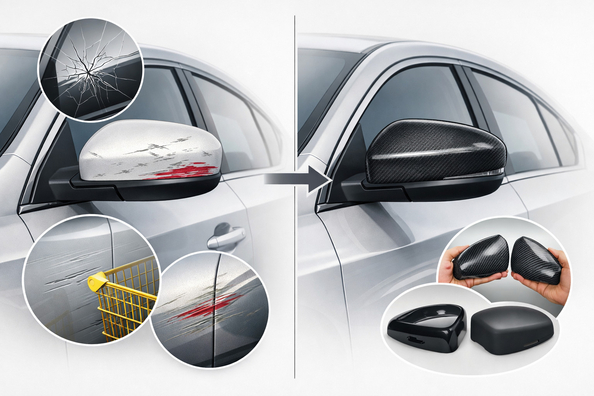

Exterior mirrors get scratched first not because the plastic is weak, but because they often stick out beyond the door line and are the first to touch a wall, a post, a neighboring car, or the brushes at a car wash. The main mistake is simple: any mark on the cover is treated as a reason to replace the entire mirror, even though in practice you first need to tell paint transfer from a deep scratch, a crack, or an impact to the hinge.
Covers can indeed protect the mirror, but only when the base is intact, the shape is chosen correctly, and the issue is purely cosmetic. If there is play, a cracked cover, broken clips, or the mirror has started to vibrate, the accessory no longer fixes the cause and only masks it for a short time.
The mirror must provide visibility to the rear and to the side, so by design it is often the most protruding point on the side. In tight parking, the driver ориентates by the doors and fender, but the first contact happens right on the mirror cover. That’s why even a light touch leaves either paint transfer or a scratch in the most visible spot.
The second reason is that the mirror consists of several different zones: the glossy cover, the lower textured plastic, the glass, the turn signal repeater, the folding hinge. The same contact has different consequences: on gloss you often get residue or a fine line, on textured plastic you get light scuffs, and an impact near the base can already cause play and vibration.
First wash the mirror and wipe it dry. Then inspect the cover under angled light: it makes it easier to see whether it’s residue on top or the top layer has already been cut through. If the mark is colored and partially wipes off with a microfiber cloth, it’s often paint transfer rather than actual damage to the cover.
Next, check the material. On a glossy cover, a light mark can sometimes be removed with cleaning, while on the lower textured plastic polishing is almost useless and often only ruins the look. If the scratch catches your fingernail, there is a crack along the edge, or you can see deformation, it’s no longer a surface defect.
Also check the mechanics: folding action, even gaps, no play, and no vibration while driving. If after an impact the mirror started folding more tightly, changed angle, developed a misalignment, or the turn signal repeater or heating stopped working properly, the cause is no longer the scratch but damage to the assembly.
DD Tuning expert comment: The most common mistake is choosing covers only by model year and not verifying the cover shape, the turn signal repeater, and whether the blind-spot monitoring system is present. The second typical mistake is sticking the accessory onto an already cracked or loose cover. If there is play or misalignment, you first need to fix the mechanical problem, not mask it with a cover.
| Symptom | Likely cause | What to do |
|---|---|---|
| Colored mark without texture on the glossy cover | Paint transfer or surface residue after light contact | Wash, gently clean, re-check under light |
| The scratch can be felt with a fingernail, but the mirror has no play | Damaged top layer of the cover or the plastic itself | Consider replacing the cover or adding protection after restoring the base |
| Light scuffs on the lower matte plastic | Abrasive rubbing on a textured surface | Do not polish; assess whether replacing the lower part makes sense or leave it as is |
| Crack along the edge, uneven gap, cover sits crooked | Broken clips or deformation after an impact | Remove and replace the cover instead of hiding the defect with an overlay |
| The mirror vibrates or folds with effort | Impact in the hinge area or internal mechanism | Diagnose the assembly; repair or replace the mirror as a complete unit if needed |
| Issues with the glass, heating, or repeater | Damage to a specific element or wiring | Replace the glass or electrical component; check connectors |
The best approach is preventive protection while the cover is still intact. If the mirror is glossy and crack-free, protective polyurethane film works well: it’s almost invisible and takes the minor scuffs from parking and washing. The downside is that installation on the mirror’s curved shape is more difficult than on flat panels.
The second effective solution is precisely fitted model-specific covers or replacing the outer cover. This makes sense when the mirror mechanism is intact and only the outer shell is damaged. Here the cover acts as a consumable outer layer: minor contact hits it instead of the painted cover.
And the third thing—without which no accessory will save you—is the habit of folding mirrors in truly tight spots, not wiping dirty surfaces dry, and not scraping ice. If the mirror constantly takes abrasive load, even a good cover or film will wear through over time.
Cheap universal stickers and covers rarely fit the mirror’s complex shape properly. The edges start lifting, bubbles form inside, and after heat or washing the piece begins to peel off.
It’s also a bad idea to polish textured matte plastic or try to fill a crack with cosmetic products. Likewise, you shouldn’t stick a cover over a housing with broken clips: it won’t restore the fit or remove the play.
If you have a Volkswagen Jetta and the mirror cover is intact but you want protection from repeated minor contacts, it makes sense to look at model-specific mirror covers for Jetta. For a specific option for this model there are carbon mirror covers 2011–2018, but before ordering you should verify not only the year, but also the cover shape and the mirror equipment.
If you want the same exterior look across several body elements, you can also check other carbon covers for Jetta. But it’s important to understand the limit: accessories make sense for a cosmetic defect or as prevention, while for a crack, misalignment, broken mounts, issues with the glass, or the mechanism you need to replace the specific part or the entire assembly.
| Solution | When it works | When it’s not worth spending money |
|---|---|---|
| Gentle cleaning after contact | Only paint transfer or light residue on the glossy cover | There is a deep groove, a crack, or plastic damage |
| Protective polyurethane film | The cover is intact; you need subtle daily protection from minor scuffs | The base is already cracked, the surface is too complex for poor-quality installation, or you need to hide a deep defect |
| Model-specific cover | The mechanism is fine; you need to cover a worn cover or create an outer protective layer | The shape doesn’t match the trim, there is misalignment, broken clips, or play |
| Replacing the outer cover | Only the shell is damaged and the mirror works normally | The impact reached the hinge, folding mechanism, or electrics |
| Replacing the glass or a separate element | The glass is cracked, heating or the repeater doesn’t work, but the housing is intact | The housing itself or the mirror mount is damaged |
| Repairing or replacing the mirror as a complete unit | There is play, vibration, misalignment, or consequences of an impact to the base | The issue is only a light scuff on the cover |
From a customer’s experience: After contact with a concrete column, the owner first looked for a universal film because he was sure the mirror would need to be replaced entirely. After inspection it turned out the hinge was intact, and the cover had paint transfer and one deeper scratch. As a result, he skipped replacing the whole assembly, chose model-specific covers, and got a good appearance without unnecessary costs.
Mirrors get scratched first because of their geometry: they protrude to the side and take contact before the body does. So the right logic is: first determine what exactly was affected—residue, the glossy cover, textured plastic, the glass, or the hinge—then choose cleaning, film, a cover, or part replacement. Covers do make sense as prevention and as protection for an intact cover against repeated minor touches, but they don’t fix cracks, play, or misalignment. This material is based on real selection experience, practical work, and real usage scenarios—not on one-size-fits-all advice without inspecting the part.
Shipping to EU
Wholesale and retail
Own warehouse
Опис продукту
Подарунки не надаються при оформленні покупки у кредит під 0,01% або при покупці частинами.