


































































 Author: Radomskyi Maksym Vasyliovych
You don’t need to remove a hood deflector for the winter: vehicle-specific polycarbonate “bug shields” are designed for year-round driving, and edge-mounted fasteners aren’t afraid of frost. The real winter risks are different—ice and snow that people try to knock off with a scraper, sand mixed with salt under the clips that wears through the paint on the hood edge, and pressure washing at point-blank range. Below is how to deal with all that, and in which cases it’s still worth removing the deflector.
Contents
- Do you need to remove a hood deflector for the winter
- What happens to polycarbonate in freezing weather
- How to remove ice and snow from under a “bug shield”
- Why salt and sand under the clips are dangerous
- How to wash a car with a deflector using a pressure washer
- What you must not use to wash or defrost a deflector
- When it’s still worth removing the deflector
Do you need to remove a hood deflector for the winter
No—if it sits tight and the paint underneath is intact. Most vehicle-specific deflectors in the catalog are made of polycarbonate; they mount with clamps on the hood edge or with screws in factory locations—no glue and no drilling. That means there’s nothing to “unstick” in winter, and taking the part off and putting it back on each time only adds unnecessary wear to the clips and the paint beneath them.
What’s worth doing is removing the deflector once before the season, washing the hood edge, and reinstalling it. Over the summer, sand and dust build up under the clips, and in winter—mixed with salt—they work like sandpaper. A step-by-step guide is below in the section “How to inspect a hood deflector before winter.”
What happens to polycarbonate in freezing weather
Polycarbonate is an impact-resistant plastic, and it’s not in danger of cracking on the hood just from frost. But in the cold it becomes more sensitive to cuts and scratches: in a study published in the Journal of Applied Polymer Science, notched polycarbonate samples at −40 °C partly failed in a brittle manner, whereas at room temperature the same plastic stretches rather than chips. The practical takeaway is simple: in freezing weather, a deflector does not tolerate a sharp удар to one point—by a scraper, the edge of a brush, or a lump of ice that someone forcefully knocks off.
Second is thermal shock. ADAC advises against going to a car wash in winter at temperatures below −10 °C: warm water on a deeply chilled vehicle can damage the clear coat, rubber, and plastic parts. For a deflector, this means: don’t pour hot water from a bucket onto frozen plastic, and don’t put it under a hot-water jet immediately after being out in the мороз.
How to remove ice and snow from under a “bug shield”
Snow that packs into the gap between the deflector and the hood isn’t harmful by itself: it melts as soon as the engine warms the hood, and the water drains through the same gap. The problem starts when people try to knock it out with a scraper or a brush with a hard plastic edge.
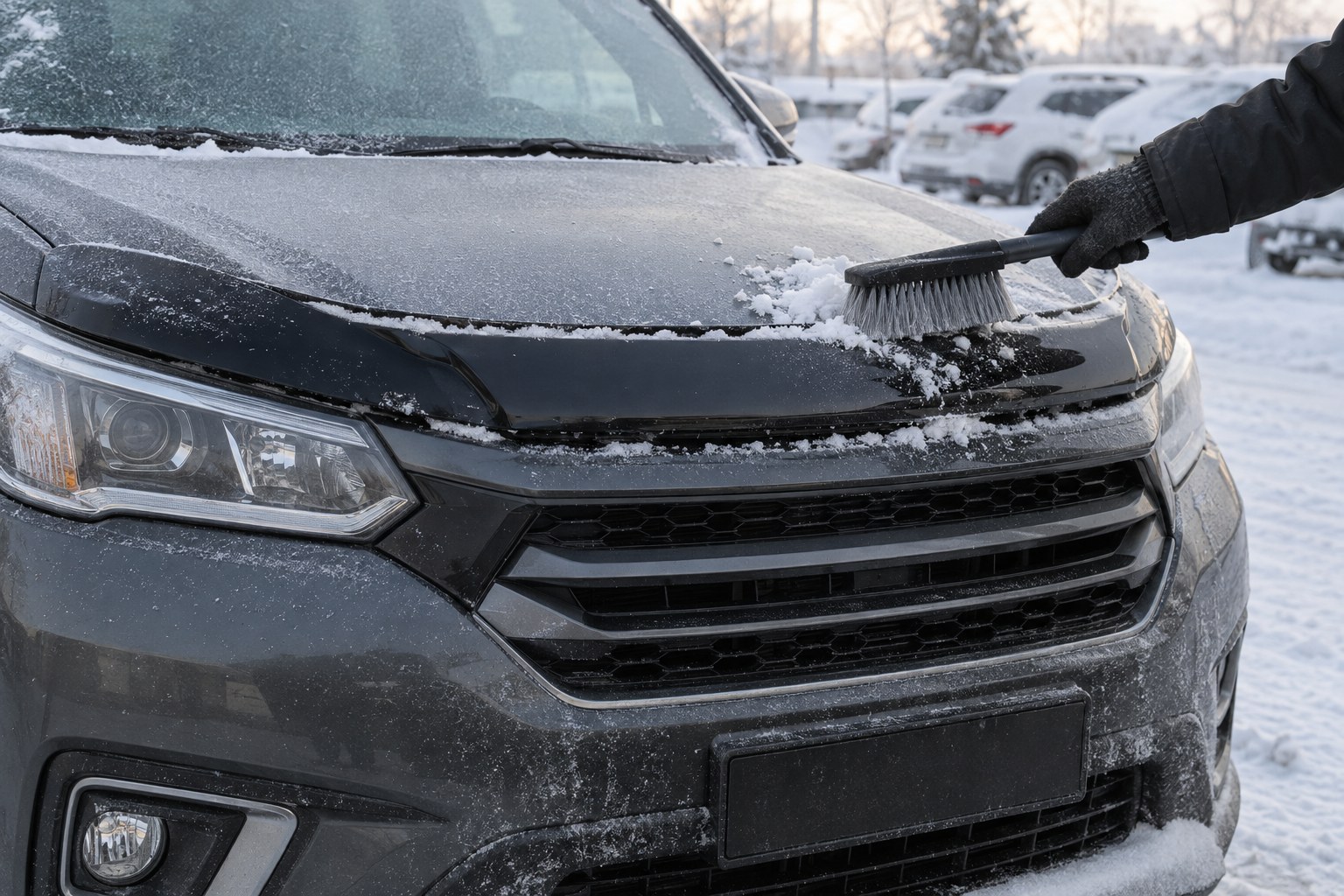
- Sweep loose snow away with a soft brush in the direction from the windshield toward the bumper, without hooking the deflector’s edge.
- Do not scrape ice off the deflector itself: start the engine and let the hood warm up—the ice will come off on its own.
- Do not pry up the deflector to knock ice out from underneath: that bends the clips, and the part starts to vibrate on the highway.
- If the hood is frozen along the edge, open it after warming up, not by yanking the edge near the deflector.
Why salt and sand under the clips are dangerous
Each clip has a pad that keeps metal from contacting the paint. But fine sand still gets into the gap, and with vibration the clip and sand gradually wear through the clear coat on the hood edge. ADAC explains that road salt corrodes the body only where the paint is already damaged—and that very scuffed spot under the clip becomes the place where corrosion starts along the edge. So it’s more important not to wash the deflector every day, but to ensure there’s no sand under the clips and that metal isn’t touching intact paint.
Signs it’s time to remove and check the mounting: the deflector has started knocking or whistling at speed, the gap near a clip has disappeared, or you can see a gray salt deposit under the edge. For noise and vibration in detail, see the article “A hood deflector makes noise or vibrates: what to check”.
How to wash a car with a deflector using a pressure washer
Touchless washing won’t harm the deflector if you keep your distance. Car manufacturers advise in their manuals to move the high-pressure washer nozzle smoothly and not to bring it right up to the surface. ADAC emphasizes thorough pre-rinsing: salt and грубый dirt, if rubbed in with a sponge or the wash brushes, scratch like sandpaper.
| Situation | What to do | What not to do |
|---|---|---|
| Touchless wash | Don’t bring the nozzle right up close; sweep the jet along the deflector | Don’t blast the jet at point-blank range into the gap under the deflector and into the clips |
| Washing below −10 °C | Postpone the wash, or wash in a warm bay after the vehicle has thawed | Pour hot water onto frozen plastic |
| Hand wash | First rinse off sand with water, then use a soft sponge and car shampoo | Rub salty dirt with a dry cloth |
| Ice on the deflector | Warm up the engine and wait for the ice to release | Scraper, brush edge, prying |
| After washing | Wipe the gap and the hood edge dry | Immediately leave the car in the мороз while it’s still wet |
A brush автомат car wash is a separate вопрос: a tightly secured vehicle-specific deflector usually won’t get torn off, but if the clips have loosened, the brush can catch it. Before using such a wash, tug the deflector by hand: if it moves around, tighten the mounting first.
What you must not use to wash or defrost a deflector
Polycarbonate is resistant to water and обычный car shampoo, but not to all chemicals. In chemical resistance charts for polycarbonate (including for brands Lexan and Makrolon), substances it’s not resistant to include alkalis (caustic sodium and potassium), ammonia, amines, methanol, acetone, and chlorinated solvents. In practice this means:
- do not apply concentrated alkaline “touchless” химия to the deflector and do not let it dry on the plastic—use only a working dilution and rinse it off;
- do not scrub off insects and tar with acetone, solvent, or products containing ammonia;
- do not defrost the deflector with some неизвестный windshield fluid: methanol is harmful to polycarbonate (in the EU, retail sale of windshield washer fluids with methanol from 0.6% is banned by Regulation (EU) 2018/589).
For insects and road film, warm (not hot) water, car shampoo, and a soft microfiber are enough.
When it’s still worth removing the deflector
There are three situations when removing the deflector for the winter makes sense: the paint under the clips is already worn through (first it needs touch-up paint or protection film, otherwise salt will find bare metal); the mounting has loosened or some of the clips are missing; there is a film on the hood and dirt packs under its edge. In other cases, the deflector will спокойно make it through winter in place.
If you don’t have a deflector yet, choose it by the exact generation and year: on Kia Sportage, Hyundai Tucson, or Toyota RAV4, hoods differ between generations, and a part from another generation won’t fit tightly. Vehicle-specific deflectors are collected in the “Hood deflectors” section, for example for Kia Sportage 2021+ or Toyota RAV4 2019+. For how window deflectors behave in winter, see the article “Do window deflectors ice up in winter, and do you need to remove them for the winter”, and the catalog itself is in the “Window deflectors” section. And remember the limits of what a “bug shield” can do: why it doesn’t save you from all chips on the hood.
We deliver with Nova Poshta throughout Ukraine.
How to Inspect a Hood Deflector Before Winter
- Remove the deflector Open the hood and unscrew or unclip the fasteners according to the instructions for your deflector, without prying up the plastic with a metal tool.
- Wash the hood edge Rinse sand and dust off the edge and from under the clip areas with water, then wash with car shampoo and wipe dry.
- Inspect the paint under the clips Look for spots worn through to primer or metal. Before winter, such areas should be touched up or covered with protective film.
- Check the clips and pads Replace bent clips and worn rubber pads: they are what maintain the gap and keep the metal from touching the paint.
- Wash the deflector itself With warm water, car shampoo, and a soft microfiber cloth, without acetone, solvents, or ammonia-based products.
- Reinstall the deflector Secure it evenly, with the same gap along the entire length, and check by hand that the part does not move. After the first highway drive, inspect the fasteners again.