 Author: Radomskyi Maksym Vasyliovych
Cargo in a roof basket slides not necessarily because the basket itself is bad, but because on potholes you get upward impacts, forward jolts, and lateral shift at the same time. If there’s little friction under the load and no firm downward clamping from above, items start to slip even when the basket sides seem high enough.
In most cases, the problem is solved not by a single net, but by the right securing scheme: increase friction underneath, apply forceful clamping with straps, avoid overloading the setup, and check tension on the road. Below is how to quickly identify the cause in your specific case and what actually works in practice.
Why this problem happens
On a smooth road, cargo can sit calmly in the basket, but on potholes it briefly loses some of its downward pressure to the floor, bounces, and then shifts. The higher the speed, the higher the center of gravity, and the slicker the surface of bags, boxes, or jerry cans, the faster the movement starts.
An open basket doesn’t clamp the load by itself. Its sides only limit large travel, but they don’t replace proper tie-down. That’s why the same item can ride fine in the city and start “walking” already on the first broken section or washboard/gravel road.
Main causes
- Low friction under the load. A smooth basket floor, plastic containers, soft travel bags, and polyethylene wrapping slide easily.
- Insufficient clamping from above. A soft net holds the volume, but often doesn’t press a heavy load down.
- Incorrect weight distribution. Heavy items are placed high, far from the center, or there’s free play between them.
- Too few proper tie-down points. The strap runs on an awkward path, pulls the load sideways, or only “covers” it from above.
- The issue isn’t the load, but the base. Basket play, weak mounting to crossbars, overloading, or a poor base amplify oscillations.
How to understand the cause in your case
- With the car stationary, push the load hard forward and sideways by hand. If it slides before the straps actually start holding, the issue is friction and clamping.
- Rock not only the items, but the basket itself. If the whole assembly moves relative to the roof or crossbars, start with the base—not a new net.
- Look at the strap direction. If they run almost horizontally, they resist shifting but clamp the load to the floor weakly.
- After the first rough section, stop and check tension. If it has noticeably loosened, elastic elements or slick packaging have already lost the fight.
- Evaluate the load against the lowest allowable limit of the roof, crossbars, and basket. Overloading can’t be fixed with one more bungee.
DD Tuning expert comment: The most common mistake is relying on a single net where you need firm clamping with straps. A net is great for gathering small items into one bundle, but it doesn’t press heavy cargo down tightly enough. The second typical mistake is tying to soft bag handles or to packaging, instead of to the cargo itself or a rigid container.
Symptoms, causes, and what to do (table)
| Symptom | Likely cause | What to do |
|---|---|---|
| The load creeps forward under braking | Weak clamping from above; straps aren’t pushing down | Reroute the straps so they actually clamp the load to the floor; add a non-slip layer |
| Items slide sideways in turns | Empty space between items; weight shifted toward the edge | Pack the load tighter; place heavy items closer to the center; add a transverse strap |
| On potholes everything bounces | High center of gravity, too much speed, or overloading | Lower the mass; reduce weight; drive slower over rough surfaces |
| After a short drive the straps loosen | Elastic net, bungee cords, or slick packaging | Switch to rigid ratchet/tie-down straps; periodically re-tighten on the road |
| The whole basket moves together with the load | Play in the basket mount or a problematic base | Check the mounting to the crossbars and base compatibility, rather than masking the problem with a new net |
What actually helps
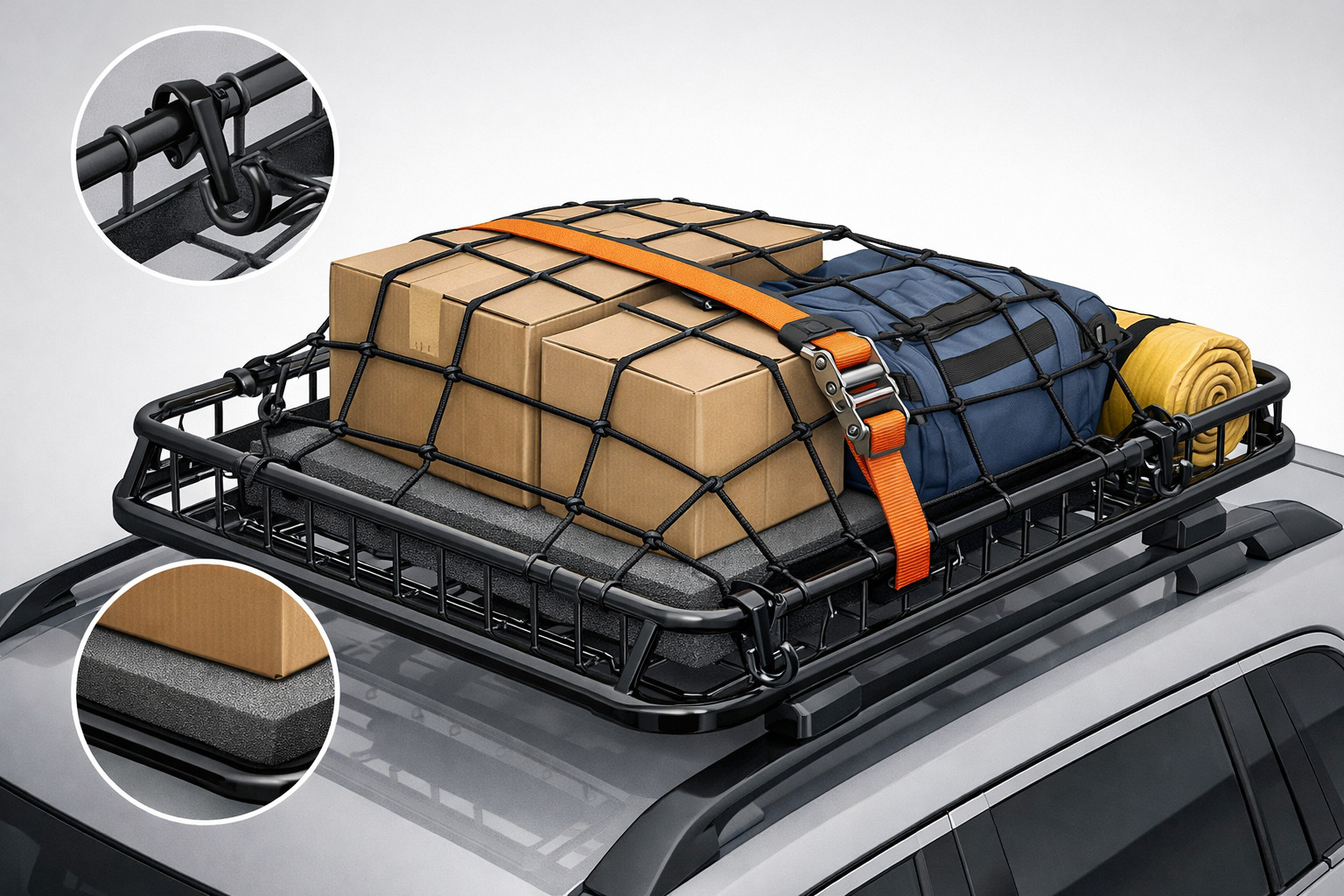
- A non-slip mat under the load. The easiest way to increase friction and eliminate initial movement.
- Two tie-down straps with firm tension. For heavier items, they work better than a single soft net because they provide forceful clamping.
- Use the net only as a second layer. It’s useful for small items so nothing pops out, but it doesn’t replace straps.
- Low, tight packing. Heavy items go down and closer to the center, with no large free play between them.
- Check tension on the road and reduce speed over rough sections. On long trips, securing gradually loosens—especially on broken roads.
One more practical point: the combined working load rating of the straps must cover the weight of the cargo. If the strap itself or its buckle is weak, it won’t become reliable just by tightening harder.
What almost doesn’t work or only helps briefly
A single elastic net without straps almost always loses with heavy, slick, or awkwardly shaped cargo. Bungee cords are also weak for serious weight: they’re convenient, but they don’t provide stable clamping and they lose stiffness over time.
Trying to “wrap everything tighter” doesn’t help much either if the packaging itself is soft or slippery. Attaching to bag handles, thin covers, or film often creates the illusion of securing rather than real retention. It’s also worth remembering seasonality: heat and sun make nets and rubber elements age faster.
When accessories or replacing elements makes sense
If your basket has too few tie-down points, an inconvenient rail, or nowhere to route straps properly, it’s logical to consider a different roof basket. What matters isn’t only area, but whether you can reliably clamp the load, not just cover it from above.
When the problem starts with a shaky base, check not the net but the foundation: a compatible roof rack for rails or another rigid support brings more benefit than yet another set of hooks. And if you regularly carry small, slippery, or soft items, it’s more practical to switch to a roof box, because an open basket is less convenient for that scenario.
Solutions: when they work and when not to spend money (table)
| Solution | When it works | When it’s not worth spending money |
|---|---|---|
| Non-slip mat | Smooth bags, boxes, jerry cans; a flat basket floor | If there’s no proper clamping from above with straps |
| Two tie-down straps with firm tension | Heavy or dense cargo that needs to be clamped down | If the cargo is small and loose without a container or box |
| Net on top | For light items and as additional securing over straps | When it’s used to replace straps for heavy cargo |
| Additional tie-down points or a stiffer base | Long, non-standard items; too few places for correct strap routing | If the issue is only a slippery floor and a mat solves it cheaper |
| Switching to a roof box | Regular trips with small, soft, or weather-sensitive luggage | If you rarely carry large dirty items that are easier to toss into an open basket |
From a customer’s experience: at first they carried travel bags and plastic boxes in the basket under one elastic net, and after potholes the load shifted forward every time. After laying a non-slip mat and using two straps with firm tension, the movement disappeared, and the net stayed only for small items on top. As a result, they didn’t replace the whole setup—only fixed the weak point in the securing.
Conclusion
If cargo in a roof basket slides on potholes, in most cases there isn’t just one cause: too little friction underneath, weak clamping from above, poor weight distribution, or play in the base itself. The most stable setup is “a non-slip layer plus rigid straps,” with the net remaining an auxiliary element for light and small items.
If the cargo is small, slippery, or you constantly drive on bad roads, it’s not always worth squeezing the maximum out of an open basket—sometimes it’s smarter to change the transport format itself. The material is based on real selection experience, practical work, and real use scenarios—not generic advice without reference to the design and driving conditions.
How it works
- Check Why the Load Is Shifting With the vehicle parked, push the load forward and sideways, and also shake the basket itself. If the items are slipping, the issue is friction and clamping force; if the entire basket moves, start with the mounting and the base.
- Reduce Slipping From Below Place an anti-slip mat or another layer with higher friction under the load. This is especially useful for smooth bags, boxes, and jerry cans on a flat basket floor.
- Apply Firm Top Pressure Use two tensioned tie-down straps so they do more than just cover the load and actually press it down to the bottom. For heavy items, rigid straps work more reliably than a single soft net or rubber bungee cords.
- Pack the Load Tightly and Low Place heavy items closer to the center and lower down, with no empty gaps between them. The higher the center of gravity and the more free movement there is, the easier it is for the load to shift over bumps and in turns.
- Check Tension and Load on the Road After the first rough section, stop and check whether the straps have loosened. Do not exceed the permitted roof, crossbar, and basket load, because overloading cannot be compensated for by adding another tie-down.
- Change the Transport Setup If Needed If the basket has too few attachment points or the load is constantly slippery and small, consider a more rigid base or a roof box. A net can remain only an additional layer for small items, but it does not replace straps for heavy loads.