09.08.2026
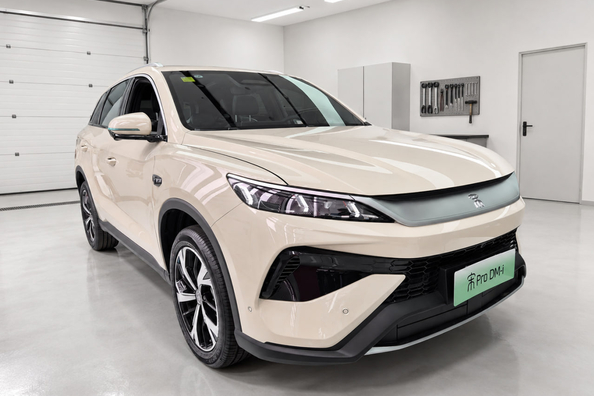

BYD Song Pro 2027 should be considered without confusion in the numbers: the confirmed combined driving range of this model today is up to 1001/1030 km under NEDC or 982/1011 km under WLTC depending on the version, while the 1105 km figure found in verified materials belongs to Song Plus, not Song Pro. For Brazil’s 2027 line, a flex update of the hybrid system is confirmed, but the final technical sheet for this local version has not yet been published.
In essence, it’s a family-oriented plug-in hybrid with front-wheel drive, five seats, and a large trunk. It suits those who charge regularly and want quieter, cheaper day-to-day city use, but it won’t suit anyone expecting sporty handling, compact dimensions, or all-wheel drive.
Song Pro occupies a practical niche between compact hybrids and larger family crossovers. In BYD’s lineup it sits below Song Plus, yet it doesn’t look like a “budget simplification”: a 520 L trunk, a 5-seat cabin, and solid pulling power make it a true daily family workhorse.
The model’s strength is the combination of electric drive for short routes and a gasoline reserve for long trips. Its weakness is that the format is big for the city: a length of 4738 mm already requires getting used to parking, and the chassis character is tuned more for calm comfort than for excitement.
In the materials verified for this publication, the current export version of Song Pro appears in technical sheets for 2025–2026, while for Brazil a 2027 line is announced with local production in Camaçari and flex adaptation for gasoline and ethanol. In other words, 2027 should currently be seen not as a guaranteed new generation with completely different hardware, but as an evolution of the existing model.
It’s also important that publications about 2027 mention updated styling, a new interior, and a larger central screen, but these details have not yet been confirmed by the final local technical sheet. So it’s best to rely firmly on the already published parameters of the current Song Pro.
The current Song Pro is a plug-in hybrid with a 1.5 L gasoline engine rated at 98 hp and 122 N·m, plus an electric motor rated at 197 hp and 300 N·m. Combined output depends on the version: 223 hp for GL or 235 hp for GS, while combined torque is 400 N·m in both cases. Drive is front-only, and the transmission is DHT30.
For the “Super DM-i Flex” topic, the key point is this: flex adaptation for Brazil is confirmed, but the exact final figures for the Brazilian Song Pro 2027 are still awaiting the official sheet. Therefore, below are the numbers that can already be considered real for the current model.
| Parameter | GL | GS |
|---|---|---|
| Powertrain | Plug-in hybrid | Plug-in hybrid |
| ICE | 1.5 L, 98 hp, 122 N·m | 1.5 L, 98 hp, 122 N·m |
| Electric motor | 197 hp, 300 N·m | 197 hp, 300 N·m |
| Combined output | 223 hp | 235 hp |
| Combined torque | 400 N·m | 400 N·m |
| Battery | 12.96 kWh | 18.3 kWh |
| Electric range | 71 km NEDC / 52 km WLTC | 110 km NEDC / 81 km WLTC |
| Total range | 1001 km NEDC / 982 km WLTC | 1030 km NEDC / 1011 km WLTC |
| 0–100 km/h acceleration | 8.3 s | 7.9 s |
| Top speed | 170 km/h | 170 km/h |
By size, Song Pro is no longer compact: 4738 × 1860 × 1710 mm, wheelbase 2712 mm, ground clearance 182 mm. This provides good second-row space and a composed ride on rough asphalt, but in tight courtyards and underground garages you’ll have to get used to the body length.
The trunk is 520 L, and with the second row folded the volume increases to 1339 L. For the owner, that means a stroller, suitcases, groceries, or boxes fit without constantly playing Tetris. The 5.8 m turning radius is normal for the class, and the 225/60 R18 tires are more about comfort than sharp steering response.
| Metric | Value |
|---|---|
| Length | 4738 mm |
| Width | 1860 mm |
| Height | 1710 mm |
| Wheelbase | 2712 mm |
| Ground clearance | 182 mm |
| Trunk | 520 L |
| Trunk with the second row folded | 1339 L |
| Turning radius | 5.8 m |
Inside, the focus is on quietness, a soft suspension, and everyday convenience. For this model, it’s not about decorative effects but practical things: dual-zone climate control, a 360° camera, a digital NFC key, a power tailgate, and the ability to power external devices via VTOL.
The nuance is that equipment differs noticeably by version. The base GL is simpler in driver-assistance systems, while GS has a much more complete package such as adaptive cruise control, lane keeping, automatic braking, and blind-spot monitoring. If the car is meant for highway use, GS looks like the more logical choice.
In daily use, Song Pro makes the most sense when it’s charged. AC charging up to 6.6 kW makes it possible to top up the battery regularly without complex infrastructure, and the official WLTC consumption of 5.7 L/100 km for a hybrid of this size looks reasonable. On short routes, the main benefit comes from the electric side, not the gasoline engine on its own.
If you drive without charging, it’s still a torquey and comfortable crossover, but part of the PHEV’s point simply disappears. Add the typical real-life nuances: a big rear end in parking, a soft steering response at speed, and not-too-sporty stability in abrupt maneuvers.
From an owner’s perspective, Song Pro wins with practicality and quietness, not emotions. It’s at its best as a family city or suburban vehicle, where trunk space, ride comfort, and the ability to cover part of the route on electricity matter.
| Pros | Cons |
|---|---|
| Spacious 5-seat cabin and 520 L trunk | Dimensions aren’t the most convenient for tight courtyards and garages |
| Torquey hybrid: up to 235 hp and 400 N·m | Front-wheel drive and a non-sporty chassis character |
| Real urban benefit if you charge regularly | Without charging, the PHEV’s economic advantage is noticeably smaller |
| A solid set of everyday features: 360° camera, VTOL, NFC | GL’s safety systems are noticeably simpler than GS |
| Soft, comfortable ride on bad roads | At speed there’s body roll and not very expressive steering feedback |
For Song Pro, the point isn’t power tuning, but protecting the cabin and cargo area. The factory hybrid system is already strong enough for daily driving, so the first things to cover are what actually wear out: the floor, the trunk, and the edge of the rear bumper.
If you look broader, accessories that preserve durability and cleanliness work better for this model than decorative elements. This is one of those cases where a properly selected useful set is more valuable than trying to turn a soft family PHEV into something sporty.
BYD Song Pro 2027 looks like a strong option for families and daily routes if you need a roomy cabin, a large trunk, and straightforward hybrid logic without being tied solely to a charging station. But it’s important not to repeat the marketing mistake with the 1105 km figure: for Song Pro it isn’t confirmed, and the final parameters of the Brazilian flex version for 2027 are still awaiting the official technical sheet.
If you evaluate the already known Song Pro without the noise around the new release, it’s not about thrills but about sensible everyday efficiency. The material is based on real selection experience, practice, and real-world use scenarios, so the main conclusion is simple: the model is worth attention for those who will use its hybrid part every day, rather than just carrying an extra battery around.
| ✔ | The spacious 5-seat cabin and 520 l trunk make the Song Pro convenient for family use and everyday trips. With the second row folded, the volume increases to 1339 l, so it’s easy to carry large items in the car. |
| ✔ | The hybrid system delivers strong performance: up to 235 hp and 400 Nm, and 0–100 km/h takes 7.9–8.3 s depending on the version. That is more than enough for normal city and suburban driving. |
| ✔ | It has real value in everyday use as a PHEV: on short routes, the car can run on electric power, and AC charging up to 6.6 kW does not require complex infrastructure. This is convenient for those who can regularly plug in the car at home or at work. |
| ✔ | The suspension is tuned for comfort, and the 182 mm ground clearance helps handle poor roads more calmly. For everyday use, this is more practical than a stiff sporty setup. |
| ✔ | Higher trims include useful equipment for daily life: a 360° camera, NFC key, power tailgate and VTOL. This makes parking, access to the car and small everyday tasks easier. |
| ✘ | The Song Pro is fairly large: its 4738 mm length makes it harder to maneuver in tight courtyards, garages and underground parking lots. For city use, it is not the most convenient format. |
| ✘ | The model has only front-wheel drive and a calm chassis character, so sporty handling should not be expected. At speed, body roll and not very clear steering feedback are mentioned. |
| ✘ | The economic advantage of a PHEV is noticeable only when the car is charged regularly. If you drive without recharging, much of the hybrid concept’s appeal is lost. |
| ✘ | The base GL version is noticeably simpler in safety equipment than the GS. If the car will often be driven on the highway, this may make you look at the more expensive trim. |
Shipping to EU
Wholesale and retail
Own warehouse
Опис продукту
Подарунки не надаються при оформленні покупки у кредит під 0,01% або при покупці частинами.