
































































 Author: Radomskyi Maksym Vasyliovych
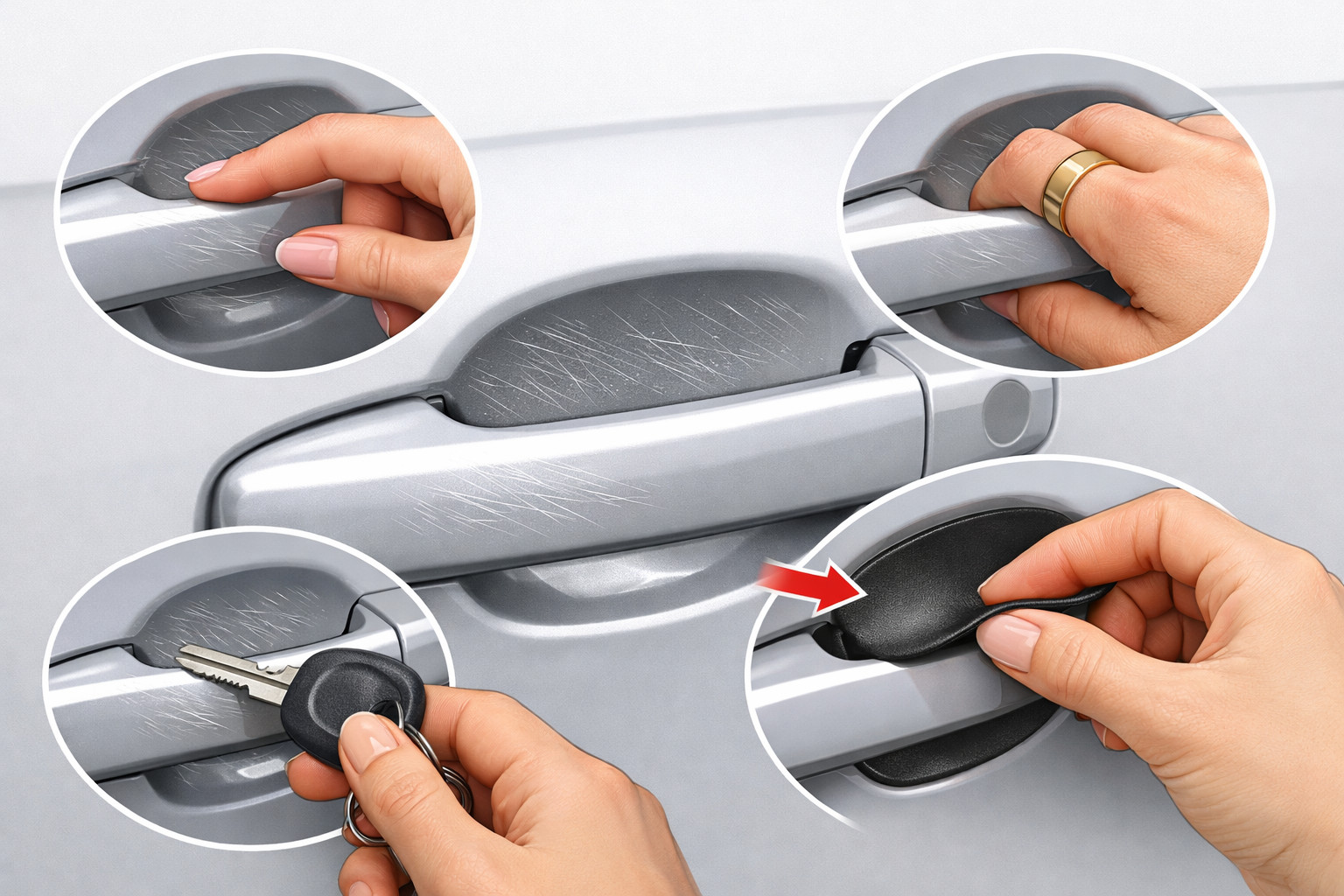
Scratches under the door handle almost always appear not because of the weather, but due to everyday mechanical contact: nails, rings, keys, dirt on your hand or on the surface constantly rub the clear coat in the same spot. If the marks are light, they can sometimes be reduced with polishing; if the scratch has already gone through the clear coat, a transparent film won’t remove it—it will only stop new defects from appearing.
The practical approach here is simple: first distinguish a surface micro-mesh from deep marks, then decide what exactly to do—polish, reapply protection, or install a cover. What works best is not masking with any chemistry, but a barrier in the contact zone: transparent PPF or properly selected door-handle cup protection.
Why this problem happens
The area under the handle constantly takes the hit, because the palm goes into the recess at an angle, and the clear coat there acts as a contact point. On a dark body color it’s more noticeable: even a fine micro-mesh immediately creates a dull spot, although the damage may be shallow.
The situation often gets worse in winter and during the dirty season not because of the cold itself, but because the contact is harsher: gloves, sand, salt, and frequent door opening with items in your hand. Another nuance is handle geometry: the more complex the recess, the harder it is to install universal protection neatly, and the faster the area picks up new marks.
Main causes
- Nails scratch the clear coat at the moment your fingers go into the handle cup.
- Rings, keys, and key fobs hit the same area during everyday opening.
- Sand, salt, and dirt work like an abrasive if you don’t rinse them off and just rub with a cloth.
- Unlucky geometry or a gripping habit concentrates wear on one door or on the rear handles.
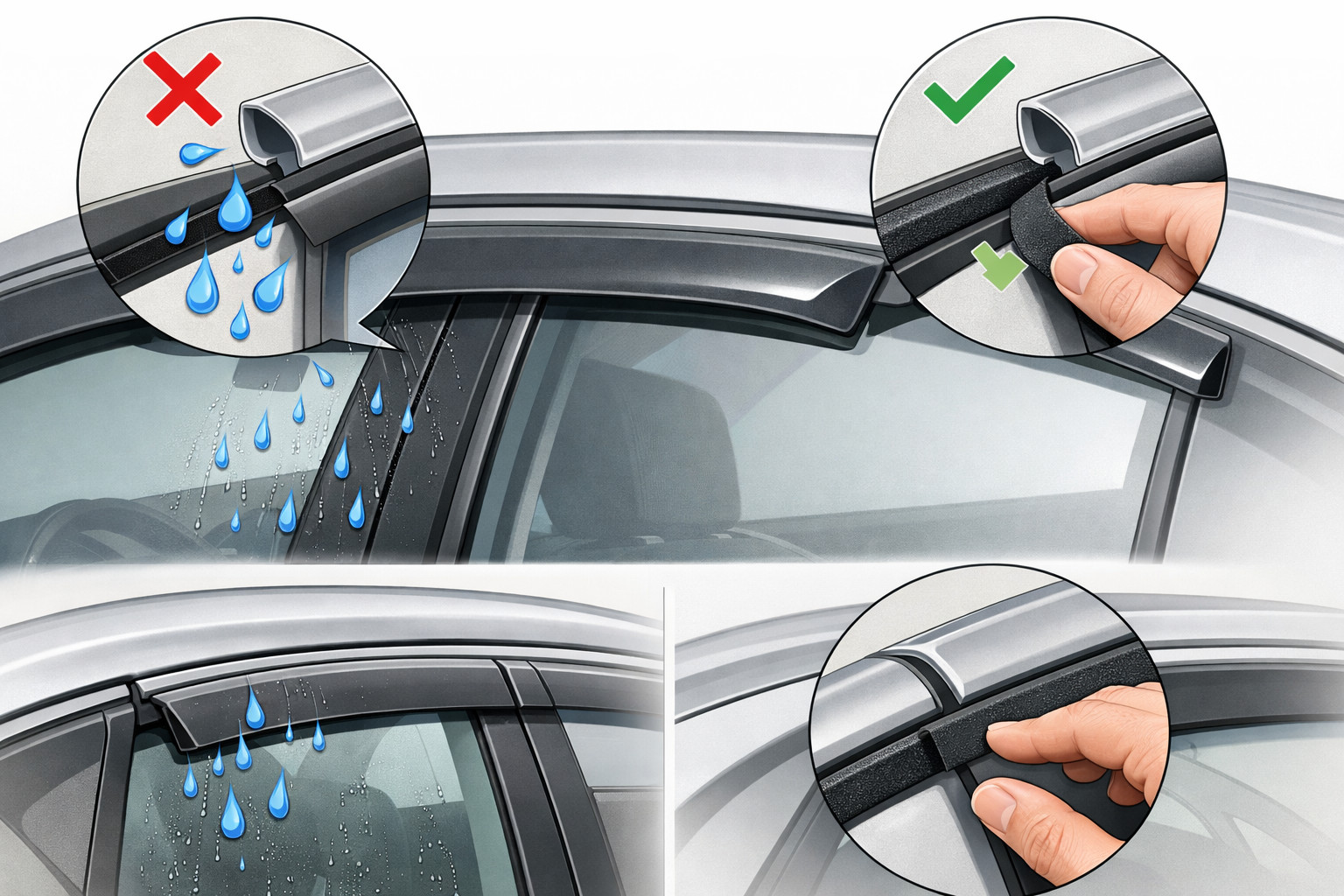
- Old or cheap film can ruin the look itself: it collects dirt along the edges, turns cloudy, bubbles, and visually resembles scratched paint.
How to understand what the cause is in your case
First wash and dry the area, and before polishing or applying new protection—degrease it. Then look at the surface under side lighting: if you see an even fine micro-mesh only in the recess, it’s a typical trace of repeated contact; if there are 1–2 pronounced grooves, most likely there was a hit from a key or ring.
Compare all doors. If the issue is noticeable only on the driver’s door, the reason is almost always a usage habit; if the rear handles suffer more, the shape of the recess is often to blame. If there’s already clear protection on the surface, check the edges: a dark outline, dirt, hazing, or bubbles mean the problem is no longer the paint, but the old film.
Also assess the depth. Light marks are visible after washing only under light—this is a candidate for gentle polishing. If a scratch is deep and high-contrast, it’s not worth chasing it with abrasives: you’ll remove more clear coat, and the defect still won’t fully disappear.
DD Tuning expert comment: the most common mistake is applying universal film to a dirty or cold surface and then being surprised by lifting edges. The second typical mistake is trying to hide a deep groove with transparent material: it really does make fine micro-mesh less noticeable, but a cut through to the clear coat doesn’t vanish. If the cup shape is complex, it’s better to choose a pre-cut solution for the area right away or have the protection installed by a professional.
Symptoms, causes, and what to do (table)
| Symptom | Likely cause | What to do |
|---|---|---|
| Fine dull micro-mesh visible only under light | Constant rubbing from nails or rings | Light polishing, then transparent protection |
| A single deep scratch or several long lines | Key, metal key fob, a hard hit from a ring | Don’t remove too much clear coat by polishing; protect the area, and if needed do a local repair |
| Dirty line along the edge of the transparent element | Old or poorly installed film | Remove and replace the protection, clean the surface before new installation |
| Bubbles, haze, messy appearance | Cheap film, incorrect installation, complex handle geometry | Install higher-quality protection or a vehicle-specific solution |
| One door is worn more | A particular user’s habit | Change your grip and cover the exact problem zone with film |
| Rear handles suffer more than front | Awkward recess shape | Avoid universal cutouts, look for more precisely matched protection |
What actually helps
Gentle polishing makes sense only for light marks in the clear coat. It removes the consequence, not the cause, so without subsequent protection the micro-mesh returns quickly.
Transparent PPF is the most practical solution for prevention. It’s almost invisible, takes the contact on itself, and on some films minor marks on the film become less noticeable over time from heat. It’s important to understand the limit: self-healing applies to the film, not to an old scratch in the clear coat underneath.
Proper installation is critical. Apply it to a clean, degreased surface at a temperature not lower than 15°C; if it’s colder, both the body panel and the material need to be warmed. If the old film has already ruined the appearance, it’s better to remove it carefully, without jerking, and only then install the new one.
Normal care also matters: for cleaning, regular car shampoo is enough. Aggressive abrasives, hard compounds, and dyed products quickly damage the top layer of the protection.
What almost doesn’t work or helps only briefly
Nano and ceramic coatings on their own do not stop impacts from nails, keys, and rings. They can make washing easier, but they don’t replace a physical barrier.
Constant re-polishing is a bad strategy. If you rub the same area every time marks appear, you don’t solve the problem and gradually reduce the clear coat reserve.
Cheap universal film on complex handles often looks worse than minor scratches without it: the edges are visible, dirt gets underneath, and the shape doesn’t lay down well. Likewise, you shouldn’t apply protection in the cold or on a surface with wax or dirt residue.
Transparent protection over a deep groove is not masking in the full sense. It will stop new scratches, but the old deep defect will remain visible.
When accessories or replacing elements makes sense
Accessories are appropriate when you need not only to protect but also to quickly tidy up the appearance without painting. If marks are already on the handle itself or you want a tougher outer layer, it’s worth looking at door handle covers, with one caveat: they don’t always cover the recess under the handle.
If you take a systematic approach to body protection, it makes sense to look beyond just one problem spot. For an overall approach, it’s useful to consider paint protection film for cars, and for nearby constant-contact areas—sill protection film. This makes sense when scratches appear not only under the handle but also in entry/exit areas.
Replacing an element is rarely needed. It usually comes up when the handle or decorative trim is worn by itself, not just marked in the handle-cup area.
Solutions: when it works and when it’s not worth spending money (table)
| Solution | When it works | When it’s not worth spending money |
|---|---|---|
| Light polishing | There’s only a surface micro-mesh without deep cuts | The scratch is already deep and high-contrast |
| Transparent PPF | You need prevention and to soften the look of minor marks | You want to completely hide an old deep scratch |
| Vehicle-specific handle-cup protection | Complex recess shape, universal film doesn’t lay well | You need to cover damage outside its coverage area |
| Door handle covers | The handle itself is worn or you need a different outer layer | Scratches are only inside the cup and the cover doesn’t close it |
| Nano or ceramic coating | You want easier maintenance as an add-on to protection | You expect to stop mechanical scratches without film |
| Local repainting | The clear coat is already breached and appearance is critical | The defect is minor and can be addressed with polishing and protection |
From a customer’s experience: on a black car, the owner wanted to completely remove the white micro-mesh under the driver’s handle and initially considered ceramic coating. After proper washing, it became clear that most marks were superficial; they were refreshed gently, and then covered with transparent protection on top. One deeper mark remained, but it stopped standing out sharply. In the end, the person got not “magic disappearance,” but a real solution: the area looks neat and doesn’t keep getting scratched.
Conclusion
Quick scratches under the door handle are almost always repeated mechanical contact, not some mysterious clear-coat problem. The right sequence is: wash, assess depth, remove only light marks, and then install physical protection that takes the friction on itself. Transparent film works best for prevention, vehicle-specific protection or covers help when shape and appearance matter, while aggressive polishing and “magic” coatings without a barrier usually only delay the problem from coming back. This material is based on real experience in selection, installation practice, and real usage scenarios—not theory without contact with real cars.
How it works
- Wash and inspect the area under the handle First, clean and dry the surface, and degrease it before assessing it. Look at it under side lighting: a fine, even network usually means surface wear, while one or two distinct grooves indicate a deeper strike from a key or ring.
- Separate light marks from deep ones If you can only see dullness or fine scratches, you can try to remove them with gentle polishing. If the scratch is sharp and has gone through the clear coat, do not remove extra material — polishing will not fully hide such a defect.
- Choose a protection method for your issue For prevention and masking minor marks, clear PPF works best. If the cup shape is complex or universal film does not fit well, it is better to choose a model-specific protector or another more precisely matched solution.
- Apply the protection correctly It should be applied to a clean, degreased surface at a temperature of at least 15°C; in cold conditions, the body and the material should be warmed up. If the old film is already turning cloudy, has dirt along the edges, or bubbles, it is better to remove it carefully and replace it rather than apply new film over the old one.
- Keep the area in good condition For care, a regular car shampoo is enough. Do not use aggressive abrasives, harsh polishes, or products with dyes, and consider nano or ceramic coatings only as an addition, not a replacement for a physical barrier.