22.03.2026
301
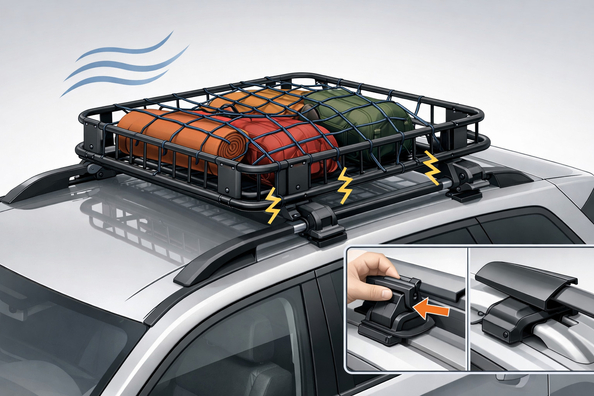
A roof basket is noisy for more than one reason. Usually it’s either aerodynamic roar from the airflow, or mechanical rattling caused by play in the mounts, crossbars, or the basket itself. If you don’t separate these two scenarios, it’s easy to waste money on a fairing when you simply need to remove play—or the other way around.
The fastest route to a quieter roof is this: check the fasteners and rubber parts, figure out exactly when the sound appears, and only then decide whether you need a fairing, different crossbars, or to remove the basket when you’re not traveling.
A basket adds lots of tubes, edges, and gaps to the roof. At speed, air hits the front of the structure, passes between the tubes, breaks off the edges, and creates a whistle or hum. On many cars this becomes noticeable from 50–60 km/h and then increases almost in proportion to speed.
The second part of the problem is vibration. If the mounts are tightened unevenly, the rubber pads are worn, or the OEM crossbars have play, the basket starts ticking or rattling at the joints, over asphalt ripples, and in crosswinds. In winter, ice, snow, and dirt often make things worse: they can imitate a “failure” even though the cause is simple.
If your kit specifies a tightening torque, follow it exactly. Values differ by fastener: small joints may have one set of numbers, while M6 or M8 bolts have completely different ones. Over-tightening doesn’t cure noise, and sometimes it only finishes off plastic parts and threads.
| Symptom | Likely cause | What to do |
|---|---|---|
| Hum starts at 50–60 km/h and grows with speed | Turbulence at the front edge of the basket or the crossbars | Check the height and fit of the fairing, the condition of rubber inserts, and the basket’s position on the roof |
| Ticking or rattling at joints and over bumps | Play in the mounts, worn pads, weak crossbar end caps | Re-tighten fasteners per the instructions, inspect pads, replace cracked or damaged parts |
| Noise appears only with cargo | The load changes the airflow or loosens the base | Move the load lower and closer to the center, check the straps, try a short drive without it |
| In winter there’s noise, in dry warm weather it almost disappears | Ice, snow, water, or dirt in gaps and on crossbars | Clean and dry all joints completely, check that rubber isn’t moving in the channels |
| After installing a fairing the noise changed but didn’t disappear | The fairing is a poor match in width/height, or the noise source isn’t the fairing | Check whether the fairing actually redirects airflow over the basket; if not, adjust its position or look for play |
| Noise depends strongly on crosswinds | Roof, basket, and crossbar geometry characteristics | Try a different crossbar position within the allowed range; if it doesn’t help, consider a different crossbar type or a removable setup |
First step — re-tighten and control play. After installation, it’s worth checking the fasteners again after a short trip, and then periodically. This often eliminates rattling before it becomes constant.
Second step — work on rubber parts and fitment. If inserts in the crossbar channels have shifted, pads are compressed, or the basket sits unevenly, noise appears even with a good base. Aligning and replacing small parts helps more than you might think.
Third step — a properly chosen fairing. It truly reduces hum when airflow is the actual problem. But it must match the specific “roof — crossbars — basket” combination in width and height. A poor fit can create new turbulence.
Fourth step — change the configuration. Sometimes it’s enough to slightly shift the basket or crossbars within the allowed range to eliminate resonance. If the base itself is noisy, switching to aero-profile crossbars helps.
Fifth step — remove the basket when you don’t need it. This is the most reliable way to get a quiet cabin back. If the basket rides on the roof every day “just in case,” you’re constantly paying in noise for something that isn’t doing any work at that moment.
Rope, rubber bungee ties, foam, electrical tape, or random sleeves on tubes sometimes dampen whistling a bit, but it’s rarely a stable solution. On one car you’ll get an effect, on another you won’t, and after rain or frost it all comes back.
It’s almost always pointless to simply crank the bolts tighter without understanding the cause. If the play comes from cracked plastic, a weak OEM crossbar, or unlucky geometry, over-tightening only masks the issue for a short time.
Likewise, don’t expect a fairing alone to remove any noise. It helps little against purely mechanical rattling and isn’t a cure-all for crosswinds.
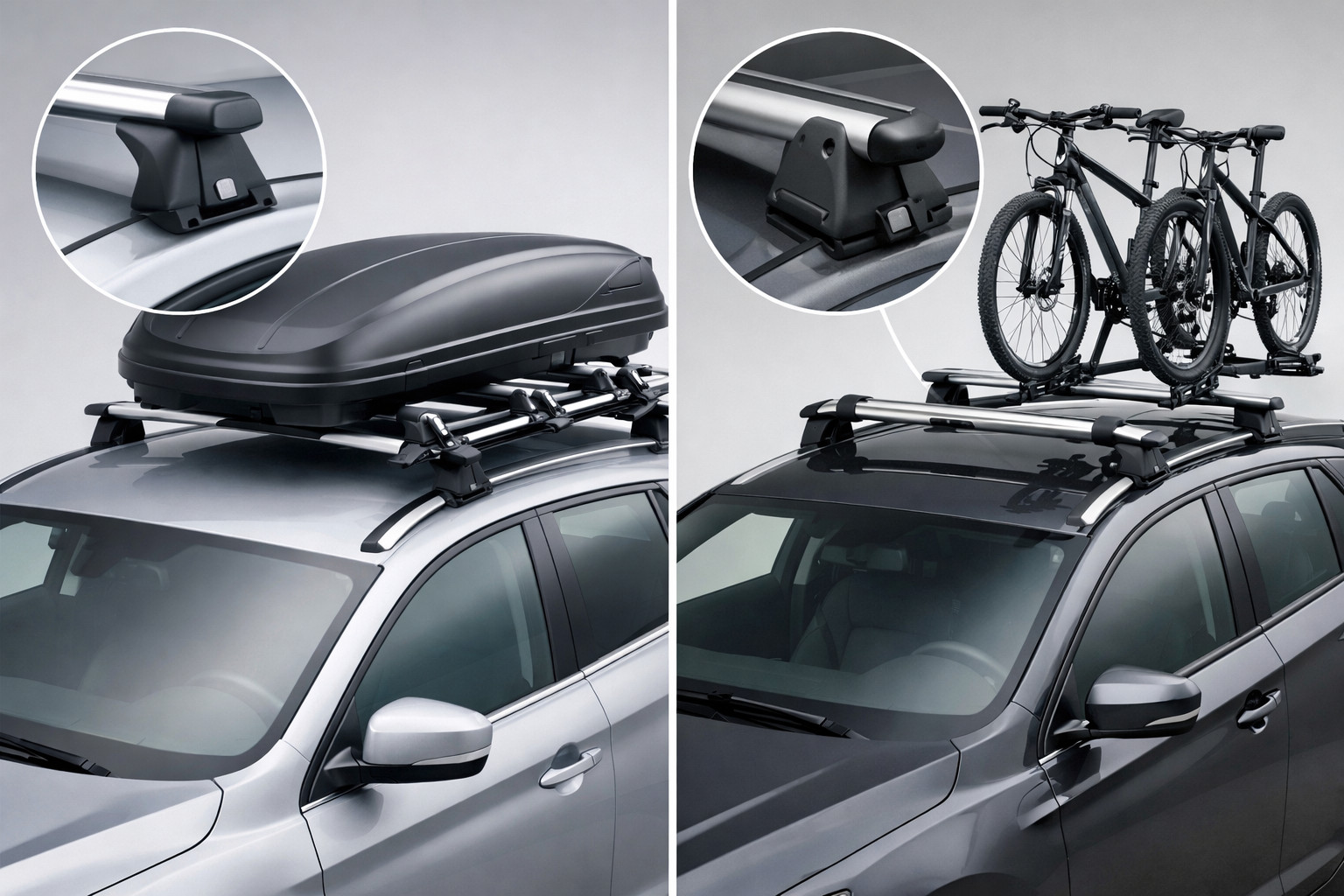
If the basket is installed correctly, nothing is loose, but there’s a steady hum on the highway, then it makes sense to choose a roof basket together with a compatible fairing. Here, the accessory really solves the problem rather than covering it up.
If the noise comes from the crossbars themselves, their plastic ends, or an overly soft OEM base, you need to look at the entire configuration. When choosing car roof baskets, it’s worth assessing not only size but also mounting rigidity and the type of crossbars.
When you only need the basket for trips, the most rational scenario is a removable installation. In this mode, roof baskets don’t hang on the roof every day, which means they don’t create constant noise and extra drag.
A separate case is vehicle-specific dampers, bumpers, or updated mounts for a particular car. If there’s already a known technical solution for vibration for your vehicle, that’s a more logical spend than universal “anti-noise” small add-ons.
| Solution | When it works | When not worth spending money |
|---|---|---|
| Re-tighten fasteners per the instructions | After installation, the first trip, when ticking appears, or when there’s minor play | If brackets are cracked, pads are worn, or the base is damaged |
| Remove ice/dirt/water and check rubber inserts | When the noise is seasonal or appears after bad weather | If the sound is stable in any weather and there’s obvious mechanical play |
| Install or adjust a fairing | When there’s steady aerodynamic hum at speed | When the basket rattles over bumps or the noise comes from weak crossbars |
| Change the basket or crossbar position | When noise depends on speed, roof position, or crosswinds | When the mounting is rigidly fixed and the instructions don’t allow any repositioning |
| Switch to aero-profile or stiffer crossbars | When the base itself is noisy, there’s play in OEM parts, or the crossbars whistle without cargo | When the basket is used rarely and it’s cheaper to simply remove it between trips |
| Remove the basket when not traveling | Always works if you don’t need the basket daily | Not suitable only when the basket must be installed permanently for work reasons |
First, determine the type of noise: hum at speed is mostly aerodynamics, rattling over uneven surfaces is play. After that, check the fasteners, rubber parts, and the condition of the crossbars—and only then buy accessories.
Most often, three things work: correct re-tightening and eliminating play, a properly selected fairing, and switching to a quieter base or removing the basket when it isn’t needed. Don’t try to “treat” noise with random wraparounds and don’t exceed the limits set by your system’s manufacturer: for many kits, the upper speed limit is close to 130 km/h.
| ✔ | The article clearly separates two types of noise: aerodynamic hum and mechanical rattling. This helps avoid wasting money on an unnecessary wind deflector if the problem is play, or vice versa. |
| ✔ | There is a specific diagnostic algorithm: checking the mounts, inspecting the rubber elements, testing with an empty basket, and monitoring the noise at different speeds. This allows you to quickly narrow down the cause without unnecessary experiments. |
| ✔ | It describes practical actions that can really reduce noise: retightening, aligning the rubber inserts, and setting the basket and crossbars correctly. Each step is tied to a specific symptom. |
| ✔ | There is a warning against overtightening the bolts, which can damage the plastic and threads. This is useful because it suggests not to “push harder,” but to follow the instructions. |
| ✔ | The material separately explains when it makes sense to remove the basket when not traveling. For those who do not use it every day, this is an easy way to eliminate constant noise and drag. |
| ✘ | If the source of the noise is poor roof geometry or the crossbars themselves, simple cheap solutions may not work. In that case, you will have to change the configuration or even the mounting base. |
| ✘ | A wind deflector does not solve the problem universally: it only helps with aerodynamic hum. If the noise is mechanical, it will be of little use. |
| ✘ | Some solutions require regular inspection after installation rather than a one-time setup. The fasteners need to be tightened again and the joints checked roughly every 1000 km. |
| ✘ | Some noise elimination options come down to removing the basket between trips, meaning the problem is not structurally solved. If the basket is needed all the time, this solution is not suitable. |
Shipping to EU
Wholesale and retail
Own warehouse
Опис продукту
Подарунки не надаються при оформленні покупки у кредит під 0,01% або при покупці частинами.