13.07.2026
218
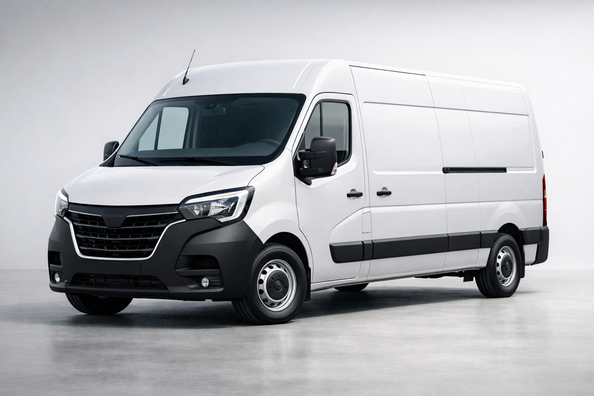
The Renault Master after the 2019 facelift is a big work van for those who need space, body options, and solid pulling power under load. Its strength isn’t about emotions, but about the fact that the same model can cover delivery work, a service crew, a workshop conversion, or a base for a camper.
Before buying, it’s important to understand one simple thing: the Master is good where the vehicle actually works. If you need a quiet, car-like van without diesel emissions-related nuances, you have to choose very carefully based on the exact version and condition.
After the 2019 update, the Master stayed in the large commercial van segment, where it’s typically compared with the Ford Transit, Mercedes-Benz Sprinter, Volkswagen Crafter, and Fiat Ducato. Its main argument is an exceptionally wide range of configurations: different lengths, heights, front- or rear-wheel drive, and for specific tasks even off-road conversions.
This model suits businesses where usable volume, easy access to the cargo bay, and predictable performance under load matter. It makes less sense for those who mostly drive empty around the city, park in tight courtyards, and don’t use its key advantage—a large body.
The Renault Master line has existed since 1980, but for this topic the relevant one on the used market is the third generation. The 2019 facelift wasn’t a new model, but a deep update of a familiar design: the front end, interior, some electronics, and the engine lineup were revised.
The updated Master premiered in spring 2019, and European sales started in September of the same year. An important practical point: the cargo bay itself wasn’t redesigned, so compatibility with many conversions and work setups remained.
| Parameter | Data |
|---|---|
| Generation | Third generation, 2019 facelift |
| Premiere and sales start | Shown in April 2019, on sale in Europe from September 2019 |
| Production years | Current third generation, updated in 2019 |
| Market positioning | Large commercial van for business, transport, and conversions |
For the facelifted Master, the key engine became the 2.3-liter diesel in several power outputs. Depending on the market, body, and purpose, you’ll find versions with 135, 145, 150, or 180 hp. The higher-output versions pull a loaded van noticeably better, but sound harsher.
The base gearbox was a 6-speed manual; an improved 6-speed automated manual transmission was also offered. In some markets, other automation options appeared later, but the 2019 facelift should primarily be associated with these 6-speed solutions. In terms of drive, the Master comes in front- or rear-wheel drive; rear-wheel drive is the more logical choice for heavy work, while 4x4 existed as a separate conversion configuration rather than a universal option for all versions.
| Component | Versions and specifics |
|---|---|
| Engine | 2.3 L diesel: 135, 145, 150, or 180 hp depending on market and body |
| Transmission | 6-speed manual or 6-speed automated manual |
| Drive | Front or rear; 4x4 as a separate conversion |
| Pulling power under load | The higher-output versions handle a full load noticeably more easily |
One of the main reasons to look at the Master specifically is the range of body styles. For front-wheel-drive versions, length is 5075–6225 mm, height is 2310–2815 mm, and cargo volume is from 8.0 to 14.8 m³. In rear-wheel-drive versions, volume reaches up to 17.0 m³, which is a very serious space reserve for transport and conversions.
Practical numbers matter more here than brochure appeal: internal bay width is 1765 mm, between wheel arches is 1380 mm, internal height is 1700–2144 mm, and the loading sill is about 542–564 mm. Ground clearance, depending on version, is 169–182 mm. On the move, an empty Master can sway and lean noticeably, but under load the chassis feels more settled and makes more sense.
| Parameter | Range / value |
|---|---|
| Body length | 5075–6225 mm |
| Height | 2310–2815 mm |
| Width with mirrors | 2470 mm |
| Usable bay length | 2583–3733 mm |
| Internal width / between arches | 1765 mm / 1380 mm |
| Internal height | 1700–2144 mm |
| Cargo volume | 8.0–14.8 m³ in front-wheel drive, up to 17.0 m³ in rear-wheel drive |
| Ground clearance | 169–182 mm |
| Loading sill height | 542–564 mm |
| Trunk / cargo bay volume | 8.0–17.0 m³ depending on body and drive |
After the facelift, the cabin became more modern in a work-focused way: more useful storage spaces, a large 7.6 L glovebox, a better-organized driver’s area, and in some trims the center seat turns into a table. For courier work, service calls, and long-distance routes, this isn’t a minor detail—it’s daily convenience.
The interior materials are hardwearing, which is logical for a commercial vehicle. On safety, the facelift brought features that really make sense on a big van: automatic emergency braking, crosswind assist, blind-spot monitoring, permanent rear view, and front and rear parking assistance.
In daily work, the Master wins with space and versatility, but it needs the right use case. For regular highway runs, intercity deliveries, and work under load, it fits better than for short city hops without warm-up and constant stop-start driving.
In real life, fuel consumption is usually higher than the nice brochure figures: for most versions it’s worth aiming at 8.6–9.7 L/100 km, while long versions can use around 13.5 L/100 km. Also, on used vehicles you should check the condition of the AdBlue system, the diesel particulate filter, the EGR valve, NOx sensors, and the operation of the start-stop system—because this is where hidden costs often appear.
There’s no single universal recipe with the Master: a great vehicle for an installer and a poor one for short urban mileage can be the same van in different conditions. That’s why it’s better to assess the pros and cons not in the abstract, but from the owner’s perspective.
| Aspect | Pros | Cons |
|---|---|---|
| Body and capacity | Very wide choice of bodies, large volume, convenient bay width and a low loading sill | Large dimensions make maneuvering and parking in the city harder |
| Engines | The 2.3-liter diesel pulls well under load, especially in higher-output versions | The 180 hp option sounds harsher, and consumption depends heavily on length and weight |
| Chassis | Under load the vehicle drives more composed and logical than when empty | Without load there is sway and noticeable body roll |
| Cabin | Lots of storage, a comfortable working position, practical layout | Hard plastics and an overall utilitarian cabin feel |
| Operation | Well suited for business, conversions, and heavy daily work | AdBlue, DPF, EGR valve, and emissions sensors may require costly intervention |
In short, the Master’s strength is in the right task-oriented configuration. Its weakness is that a mistake in body length, drive type, or operating pattern is felt every day—and costs more than with a smaller van.
For the Renault Master, tuning makes sense when it solves practical tasks: protects the body in the loading area, keeps the cabin cleaner, and reduces small everyday wear. Before choosing, it’s useful to compare your use case once again with the Renault Master review so you don’t buy accessories for a different body configuration.
If you’re choosing a vehicle for conversion or working with cargo, it’s also worth checking out rear bumper protectors and car mats: these are the items that pay for themselves quickly in a service van.
If the van works in deliveries or on construction call-outs, these kinds of accessories pay back faster than decorative elements. With the Master, what works best isn’t “style for style’s sake,” but protecting the areas that take daily wear.
The Renault Master after the 2019 facelift is a strong option for a business that needs a large van with a wide range of bodies, drivetrains, and working configurations. It’s worth buying for a specific task: deliveries, installation work, conversions, intercity transport, or carrying demanding loads.
It won’t suit everyone equally well: for short empty city trips, quiet driving, and minimal attention to diesel emissions systems, there are simpler scenarios. This material is based on a practical review and real use cases, so the key takeaway is simple: the Master is good when its body, drivetrain, and operating mode match your daily task.
| ✔ | A very wide choice of body styles, lengths, and heights makes it possible to match the Master to a specific job instead of taking a ‘one-size-fits-all’ van. For business use, this is practical, as the model can be easily adapted for deliveries, service work, or conversions. |
| ✔ | The 2.3-liter diesel works well under load, especially in the higher-output 180 hp versions. This is important for a loaded van, where what matters is not speed but steady pulling power. |
| ✔ | The large cargo volume and practical load bay geometry make it easier to transport bulky items. The low loading sill also helps in daily work when cargo has to be loaded and unloaded often. |
| ✔ | After the facelift, the cabin became more practical: there are more storage compartments, a large glovebox, and a better-organized driver’s workplace. For a service van, this really makes everyday use easier. |
| ✔ | The facelift added useful safety systems, including automatic emergency braking, blind-spot monitoring, and crosswind assist. For a large commercial van, this matters more than cosmetic updates. |
| ✘ | The Master’s dimensions make maneuvering and parking in the city more difficult, especially in tight courtyards and on short routes. If the van often drives empty, its size can be more of a drawback than an advantage. |
| ✘ | When empty, the van noticeably rocks and leans, while it shows better stability under load. This means that for light urban use it is not tuned in the most comfortable way. |
| ✘ | The cabin is utilitarian: the materials are hard, with no car-like feel. For a commercial vehicle this is logical, but those expecting more comfort may find the interior too plain. |
| ✘ | On used examples, it is important to carefully check AdBlue, the particulate filter, EGR, emission sensors, and start-stop. These are the components that can lead to unexpected expenses if the vehicle was used in an unfavorable way or has high mileage. |
Shipping to EU
Wholesale and retail
Own warehouse
Опис продукту
Подарунки не надаються при оформленні покупки у кредит під 0,01% або при покупці частинами.