28.06.2026
252
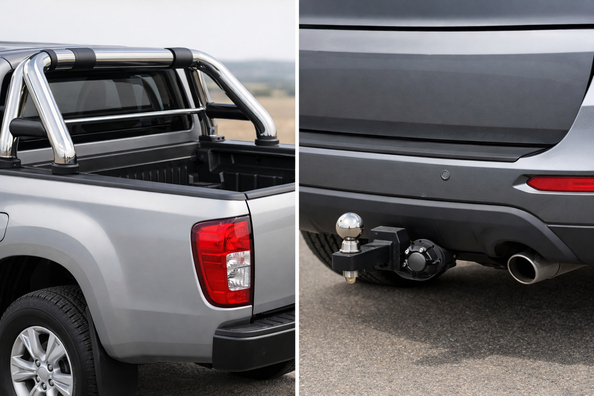
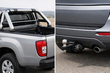
If you need a trailer, a bike rack, or a cargo basket, a towbar will almost always be more useful. A rear bar wins in another way: it works better as rear-end protection, a mounting point for additional lighting, or an element for a daily work vehicle body, but it doesn’t replace a towing setup.
The main confusion is that the name “rear bar” is used for both bumper protection for vans and SUVs and for a bed bar on a pickup. That’s why you should choose not by looks but by scenario: what you carry, whether you tow, whether quiet cruising on the highway matters, and whether the design conflicts with a tonneau cover or doors.
A towbar gives the vehicle a new function: to pull a trailer or carry a hitch-mounted accessory in the receiver. For a van, pickup, or large SUV, it’s often the most practical upgrade because it works both for everyday life and for work.
A rear bar is useful when the priority is different: protect the bed edge or bumper, get a rigid mounting point for additional equipment, or avoid towing altogether. In short, a towbar is about load and function; a bar is about protection, packaging, and convenience on a specific body style.
| Option | Strengths | Weaknesses | Who it suits |
|---|---|---|---|
| Towbar | Real towing capability, works with trailers and hitch-mounted accessories, clear load classes, ability to improve heavy-trailer stability | You need to watch the vehicle limits, tongue load, wiring, and play in the receiver | Those who tow a trailer, carry bikes, a generator, a cargo basket, or want versatility |
| Rear bar | Protects the rear end, can provide a place for lights or mounting points, often installs in factory locations | Doesn’t replace a towing setup, can be noisy at speed, may conflict with a bed cover or doors | Those who need body protection, work use, or a specific pickup/van layout |
DD Tuning expert comment: the most common mistake is buying a bar “just in case,” when in fact a person needs a towbar for a bike carrier or trailer. The second typical story is buying a towbar without checking the body version and the allowable load for your exact vehicle. If the vehicle works every day, always check not only mounting compatibility, but also what will happen with noise, doors, bed cover, and wiring after installation.
For a van, pickup, and large SUV, a towbar is almost always more functional. The most common receiver format is 50.8 × 50.8 mm, and heavier vehicles may use 63.5 × 63.5 mm and 76.2 × 76.2 mm. Even at the class level the difference is huge: a notional Class III, IV, or V means different limits for trailer weight and tongue load, so choosing “by metal thickness” makes no sense.
The towbar’s strength isn’t only towing. If the trailer is heavy, weight distribution and sway control systems genuinely improve how the vehicle behaves on the highway. But there are nuances: the limit is set by the vehicle itself, not only the hitch; different versions of the same van can have very noticeable differences in towing capability. Wiring also matters: a 7-pin connector isn’t “just any plug,” it’s a specific standard for trailer equipment.
A rear bar makes sense where you need not towing, but protection or packaging. On a pickup, it can be a bed bar with space for lighting or cargo tie-down points. On a van or SUV, it can be rear bumper protection or protection for the lower edge that regularly suffers during loading or tight maneuvers.
The weak point of a bar is its narrow specialization. It doesn’t take on the role of a towbar and isn’t designed for heavy towing loads. Also, in real use, bars more often raise issues with noise, minor rattles, and compatibility with a bed cover. If installation is vehicle-specific and uses factory points, that’s a plus; if you have to modify it or live with blocked access, the benefit quickly drops.
For a work van, a towbar wins when the vehicle at least occasionally pulls a trailer, platform, or additional load. But if the van is constantly doing deliveries in a dense city and the rear often hits curbs, ramps, or bollards, a rear bar can be more useful than a towing setup that’s never used.
For a pickup, it depends on the bed. If the main scenario is a trailer, ATV, boat, or bike carrier, choose a towbar. If the bed is a work setup with frequent top loads, you need tie-down points or additional lighting, then a good bar is also justified. For an SUV, the rule is simple: if you need to tow something or carry a platform on the back—towbar; if you only need protection and rear-end ruggedness—look at a bar.
| Scenario | Best choice | Why |
|---|---|---|
| Trailer for equipment, a boat, or building materials | Towbar | You need clear load limits, correct wiring, and predictable behavior under tow |
| Bike carrier or rear cargo basket | Towbar | This is the direct purpose of the receiver, but you must check the allowed accessory type and tongue load |
| City delivery van with frequent loading at ramps | Rear bar | Protecting the lower section and bumper is more beneficial if a trailer isn’t used |
| Pickup with a tonneau cover or roller shutter | Depends on compatibility; more often a towbar | A bar can conflict with the cover, while a towbar doesn’t take up bed space and doesn’t block access |
| SUV for travel and camping | Towbar | More scenarios: trailer, platform, basket, additional gear |
| Vehicle where only rear-end protection matters | Rear bar | If you don’t plan to tow, there’s no point overpaying for a towing setup |
A more expensive towbar makes sense if you tow regularly, operate near the maximum allowed loads, or want a vehicle-specific install without compromises. Then not only the hitch matters, but also the anti-corrosion coating, correct wiring, extra margin in the class rating, and the ability to properly eliminate play. If you want to clarify your needs first, it’s worth checking the material about the towbar.
A more expensive rear bar is justified when you need factory brackets, proper rigidity, compatibility with a bed cover, or locations for additional lighting. For pickups, it’s also useful to understand how a simple bar differs from a roll bar: it looks similar, but the difference in convenience and purpose is noticeable.
From customer experience: a pickup owner first looked for a bar “to be universal,” but it turned out he needed a bike carrier and a weekend equipment trailer. In the end, he installed a towbar with a proper load class and got exactly the function he was spending money for. A different scenario was a delivery van: there, a rear bar proved itself as protection for the body edge, because there was no towing in the job at all.
For a van, pickup, or SUV, a towbar is more useful in most cases because it solves a transport task: trailer, platform, basket, equipment in the receiver. A rear bar makes sense when the main priority is rear-end protection, a work-focused body layout, or a place for additional equipment—not towing.
The best choice here isn’t “what looks stronger,” but what actually works for your scenario without extra noise, installation conflicts, or overpaying for an unnecessary function. This conclusion is based on real selection experience, hands-on practice, and real-world use cases—not on decorative differences in a product card.
| ✔ | Tow bar provides real utility for towing and rear transport: a trailer, bike rack, cargo basket, or other mounted equipment. For a van, pickup, or SUV, it is the most practical option if the vehicle is actually hauling or carrying something. |
| ✔ | A tow bar has clear load classes and predictable behavior under load. For a heavy trailer, this matters because load-distribution and sway-control systems really improve handling. |
| ✔ | A rear bar is useful as protection for the rear of the vehicle. It can cover the bumper or the lower edge of the body, which is especially relevant for work vans, cargo vans, and pickups in everyday use. |
| ✔ | A rear bar can provide additional mounting points or a place for lights. For a pickup, this is convenient when work equipment for the cargo bed is needed and towing is not the priority. |
| ✔ | A tow bar does not take up the top of the body and usually interferes less with a bed cover or tonneau cover. This makes it a more universal solution for pickups and vehicles where access to the cargo space is important. |
| ✘ | A rear bar does not replace a tow bar and is not designed for heavy towing loads. If you need a trailer or bike platform, it practically does not solve this task. |
| ✘ | With a tow bar, you need to consider not only the hitch itself, but also the wiring, the permissible vertical load, and compatibility with a specific vehicle version. Without this, it is easy to buy something that technically fits but does not work properly. |
| ✘ | A rear bar can create compatibility problems: blocking doors, the tailgate, a step, sensors, or a roller cover. In other words, its usefulness depends heavily on the specific body and installation. |
| ✘ | Both options can be noisy, but the reasons are different: with a tow bar it is play in the insert, with a rear bar it is aerodynamics or poor mounting. In practice, this quickly becomes annoying if the installation is not checked in advance. |
Shipping to EU
Wholesale and retail
Own warehouse
Опис продукту
Подарунки не надаються при оформленні покупки у кредит під 0,01% або при покупці частинами.