16.07.2026
225
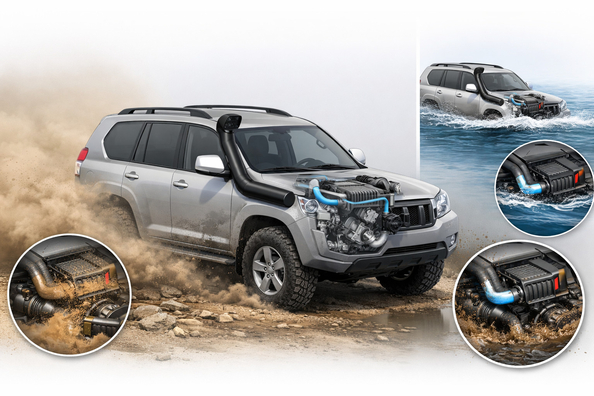

In short: a snorkel helps in real life, but not on its own. It raises the air intake point higher, so it better protects the intake from splashes, rain, snow, and some dust. But if the airbox, joints, or seals aren’t airtight, water and dust will get into the system sooner than the air reaches the snorkel head.
A snorkel is most useful not in the city, but in specific scenarios: driving in a convoy on dry dirt roads, long dusty routes, frequent water crossings, wet forest tracks, and deep puddles. In everyday driving, the effect often comes down to a slightly bigger safety margin against splashes and, sometimes, a bit of extra noise.
The factory intake on many vehicles is located low: in the fender, near the wheel arch, or behind the grille—where there’s plenty of dust, water mist, and dirt. On dirt roads, the densest dust cloud is right there, and at a ford or in a deep puddle, splashes hit that area first.
A snorkel solves only one part of the task: it moves the air intake higher. The mistake starts when people expect full waterproofing of the entire vehicle from it. If breathers, wiring, the air filter box, or drains aren’t prepared for water, one pipe won’t make the vehicle “amphibious.”
Remove the airbox lid and look not only at the filter, but also at the sealing surface, the airbox joints, and the tube after the filter. Dust before the filter is normal. If there are dust traces after the filter or at the joints, the problem is almost certainly a lack of sealing—not the snorkel concept itself.
A practical method is to quickly check the system for air being sucked in: block the snorkel head inlet with a tight film, then carefully listen at the joints and watch whether thin film or aerosol gets pulled into any leaky spots. This helps find weak points without risky experiments of pouring water.
After a water obstacle, open the airbox and check for moisture inside. If the design includes a one-way drain, you shouldn’t plug it blindly—first you need to understand exactly how it works in your system.
DD Tuning expert comment: a common mistake is installing a snorkel and not checking the airbox, joints, and filter seating. The second mistake is expecting a big dust effect without a pre-filter, even though the main gain in a convoy comes from it. Before the first serious trip, it’s worth doing a dry leak check and separately inspecting the system after water.
| Symptom | Likely cause | What to do |
|---|---|---|
| The filter clogs with dust very quickly when driving in a convoy | Low factory intake or snorkel without a pre-filter | Raise the intake, add a cyclone pre-filter, check airbox sealing |
| After a water crossing there is moisture in the airbox | Leaky joints, installation error, or incorrect water-crossing technique | Reseal the tract, check the drain, change water-crossing technique |
| Dust is present after the air filter | Poor filter sealing or air leaks at joints | Replace seals, check filter seating, go through all connections |
| Noise appeared after installation | A characteristic of the head or pre-filter | Assess whether the noise is acceptable; for fast highway trips, a standard head without a cyclone can sometimes be more appropriate |
| There’s almost no difference | City use, little dust, no water crossings | Don’t expect miracles: in such conditions a snorkel often doesn’t provide noticeable benefit |
For water, the best setup is a combination of three things: a raised intake, an airtight tract, and proper driving technique. That’s why a snorkel does a good job of holding back splashes and provides a safety margin at a ford—but only if the system isn’t drawing air through weak points lower down.
For dust, the most noticeable result is in a convoy, when the factory low intake works right in the thick cloud. Raising the air intake even by half a meter can move it above the dirtiest zone. If the route is truly long and dry, the best effect usually comes not from a simple head, but from a cyclone pre-filter that separates a significant portion of dust before it reaches the main filter.
Regular post-trip inspection also truly helps: the airbox, drain, joints, and any dust traces after the filter. This is simpler and cheaper than later searching for the cause of hydrolock or accelerated filter wear.
The “installed a tube and forgot about it” approach almost doesn’t work. Without sealing, a snorkel can look convincing but effectively leave the old paths open for water and dust.
A standard head also helps little in very dusty conditions if the expectation is an almost clean filter after a full day in a convoy. In these scenarios, without a pre-filter the benefit is often noticeably smaller.
You shouldn’t treat a snorkel as a replacement for preparing the vehicle for serious water. It doesn’t protect axle breathers, the transmission, connectors, and other units. And for daily highway use, an expensive cyclone pre-filter is sometimes unnecessary: it can be noisy, require maintenance, and be inconvenient in dense brush or at high speed.
If you truly drive through fords, deep puddles, slushy snow, or in dusty convoys, it makes sense to look at snorkels as a practical intake protection item. If you’re unsure about shape, mounting, or the use scenario, it’s worth first reviewing how to choose a snorkel. And when you need to quickly understand the real limits of the benefit without myths, a short explanation what a snorkel is for will help.
Replacing components is logical in three cases: when the old filter already leaks at the seal, when the head doesn’t match the route conditions, and when dust or moisture is visible in the airbox after installation. Then you first eliminate the leak, and only after that decide whether you need a pre-filter or a different head.
| Solution | When it works | When it’s not worth spending money |
|---|---|---|
| Vehicle-specific snorkel | Frequent water crossings, wet forest, dusty routes, convoy driving | Mostly city use with no water and no dust |
| Cyclone pre-filter | Long dry routes, sand, dust, lots of driving behind other vehicles | Daily fast highway driving where quietness matters more and there’s no real dust problem |
| Sealing all joints and the airbox | Always, if a snorkel is being installed already or there’s suspected air leakage | Don’t save money on this: without sealing, the rest of the spending loses its point |
| Replacing the filter seal or the airbox itself | Dust after the filter, misaligned seating, old seals | If the issue is only inflated expectations from city driving |
| Additional vehicle prep for water | Real fords, expeditions, regular contact with water | If the task is limited to protection from rain, splashes, and occasional puddles |
From a customer’s experience: the person wanted a snorkel not for “looks,” but because of constant convoy trips on dry forest roads and occasional water crossings. After installation, the biggest difference came not from the tube itself, but from airtight installation and the right head for dust. As a result, the filter lasted longer, and after water outings they stopped finding the airbox damp.
A snorkel really works against water, splashes, and dust—but only within its scope. For water, intake sealing, the condition of the airbox, and water-crossing technique are critical; for dust, the biggest effect appears in a convoy and on long dry routes, especially with a pre-filter. If the vehicle is mostly used in the city, the expense may be unjustified. This material is based on real selection experience, hands-on practice, and real usage scenarios—not the myth that one part solves everything.
| ✔ | It raises the air intake point higher, so it better protects the intake from splashes, rain, snow, and some dust. In real fording and when driving through wet forest, this provides a noticeable safety margin. |
| ✔ | It works best in specific off-road scenarios: in convoy on dry dirt roads, on dusty routes, and during frequent water crossings. In such conditions, the effect of a snorkel is much more practical than in the city. |
| ✔ | With proper intake sealing, it helps reduce the risk of dust and moisture entering the system. The author emphasizes that the biggest difference comes from the sealed installation itself, not just the pipe. |
| ✔ | Combined with a cyclone pre-filter, it can noticeably keep the filter clean longer on long dry routes. This is especially useful when the vehicle is driving in dust behind other cars. |
| ✔ | After installation and after water trips, it is easier to monitor the condition of the intake: the box, joints, drain, and signs of moisture. Such an inspection allows you to spot a leak in time before serious problems arise. |
| ✘ | A snorkel by itself does not make a vehicle waterproof. If there are unsealed joints, issues with the box or drainage, water and dust will still get into the system. |
| ✘ | In city driving and on highways without dusty conditions, the benefit is often barely noticeable. In such scenarios, a snorkel may only provide a bit more splash protection or a little noise. |
| ✘ | A standard snorkel head does not always handle fine dust in a convoy well. Without a pre-filter, you should not expect the filter to stay clean after a full day on a dry route. |
| ✘ | After installation, noise may appear, especially if the head or pre-filter used does not suit the driving mode. For fast highway trips, this sometimes becomes a downside rather than an advantage. |
Shipping to EU
Wholesale and retail
Own warehouse
Опис продукту
Подарунки не надаються при оформленні покупки у кредит під 0,01% або при покупці частинами.