
































































 Author: Radomskyi Maksym Vasyliovych
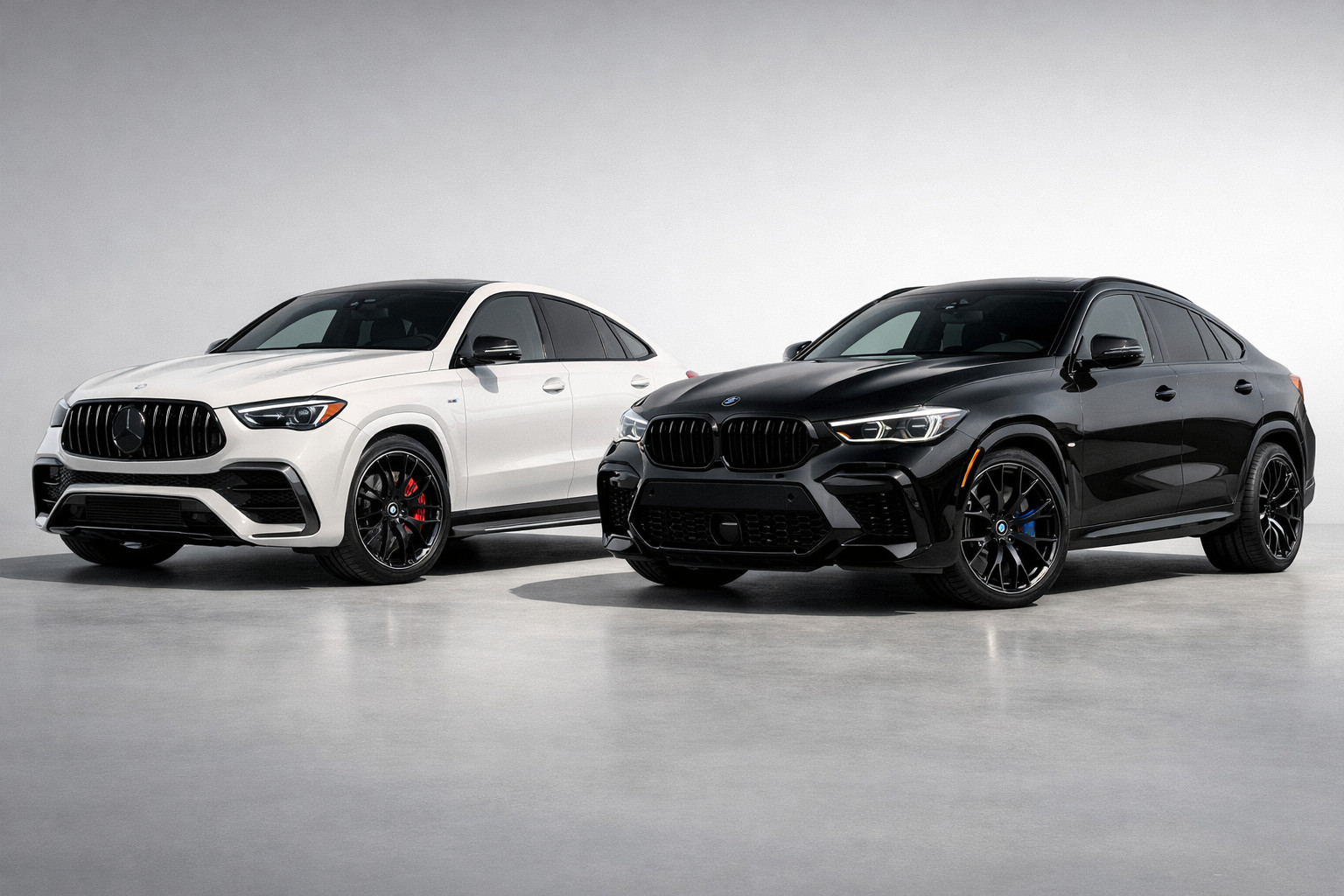
Mercedes-AMG GLE 63 S Coupe and BMW X6 M Competition solve the same task in different ways: deliver a coupe-SUV format with a V8, all-wheel drive, and sports-car-level acceleration. In short, Mercedes is stronger in everyday comfort, smooth power delivery, and daily versatility, while BMW shines in chassis feel, sharper responses, and its potential for visual and technical upgrades.
To choose between them, it’s not enough to look only at the brochure numbers of 603 and 617 hp. Both cars are very fast, very heavy, and expensive to run, so what really matters isn’t the acceleration figures but the character: how the car drives day to day, how it handles bad roads, what it offers inside, and whether tuning is worth the investment.
The model and its place in the market
This is the top end of large performance-focused coupe-SUVs. Formally, they compete not only with each other but also with the Porsche Cayenne Coupe and Audi RS Q8, yet the GLE Coupe vs X6 pairing offers a clear choice logic: Mercedes wins with a comfortable grand-tourer character, BMW with a more hardcore sporty attitude.
Mercedes-AMG GLE 63 S Coupe is a better fit for someone who wants a fast family car without constantly fighting the suspension and ergonomics. BMW X6 M Competition tends to appeal more to drivers who value sharp steering response, a tighter chassis, and a broader field for further modifications. If your priority is maximum space, calm fuel consumption, and good rear visibility, neither option is the best.
Generation and model history
Mercedes-Benz launched the GLE Coupe in 2015 as a separate coupe-styled branch of its large SUV. The first was the C292 body, and in 2019 the current C167 generation arrived, which is the one the Mercedes-AMG GLE 63 S Coupe belongs to. In this generation the model became more technically mature: more chassis electronics, mild-hybrid assistance, and a clearer split between comfort and performance.
BMW X6 is the older concept: the first E71 generation appeared in 2008, followed by the F16 in 2014 and the current G06 in 2019. The X6 M Competition version is part of this modern lineup too, although the M variant is often referred to internally as F96. An important practical point: on BMW’s official pages the model year can differ from the actual year of a specific car for sale, so on the used market it’s worth cross-checking the VIN and equipment separately.
Engines and transmissions
In current versions, both cars have a twin-turbo V8 and a 48-volt mild-hybrid system. In the Mercedes-AMG, it’s a 4.0-liter engine of 3982 cm³ with 603 hp and 850 N·m paired with a 9-speed AMG SPEEDSHIFT TCT gearbox and AMG Performance 4MATIC+ all-wheel drive. In the BMW X6 M Competition, it’s a 4.4-liter V8 of 4395 cm³ with 617 hp and 750 N·m, an 8-speed automatic, and an M-tuned all-wheel-drive system.
By factory numbers, both are nearly equal off the line: 3.7 s to 0–97 km/h is claimed. But the way they deliver power is different. The Mercedes feels torquier and calmer in mid-range driving, while the BMW is more edgy, with a sharper response and a more pronounced sporty bias. In both cases you’ll need high-octane gasoline, and city consumption for this class will be high even without aggressive driving.
Body, dimensions, and chassis
In format, these are close cars, but with different visual attitudes. The Mercedes is taller and looks more massive; the BMW looks lower and more tightly drawn in profile. The chassis philosophy is different too: the GLE 63 S Coupe leans more toward comfort, while the X6 M Competition focuses on tighter body control and a crisp, asphalt-first pace.
| Parameter | Mercedes-AMG GLE 63 S Coupe | BMW X6 M Competition |
|---|---|---|
| Current generation | C167, since 2019 | G06/F96, since 2019 |
| Engine | V8 4.0 biturbo, 3982 cm³ | V8 4.4 biturbo, 4395 cm³ |
| Power | 603 hp | 617 hp |
| Torque | 850 N·m | 750 N·m |
| Transmission | 9-speed | 8-speed |
| Drive | AMG Performance 4MATIC+ all-wheel drive | M-type all-wheel drive |
| 0–97 km/h acceleration | 3.7 s | 3.7 s |
| Length | 4961 mm | 4949 mm |
| Width | 2017 mm | 2019 mm |
| Height | 1720 mm | 1692 mm |
| Wheelbase | 2936 mm | 2973 mm |
| Ground clearance | 191 mm | 213 mm |
| Curb weight | 2530 kg | 2475 kg |
| Fuel tank | 85.0 L | 82.8 L |
| Trunk | 655 L, up to 1790 L with the rear row folded | 776 L, up to 1686 L |
| Towing | up to 3493 kg | no factory tow hitch |
For trunk space, it’s important to look at the measurement method: in the Mercedes the maximum volume with the second row folded is higher, but in daily use the BMW offers more usable space. Ground clearance shouldn’t be taken too literally either, because on cars with adaptive chassis and air suspension the figure depends on the mode and the measuring method.
Interior, comfort, and safety
Mercedes banks on the feel of an expensive, fast long-distance crossover. Strong points here include physical controls for key functions, a panoramic roof, multi-color ambient lighting, a good 360-degree camera, and systems like PRE-SAFE. That doesn’t mean the interface is perfect: touch-sensitive elements on the steering wheel aren’t for everyone, but overall the GLE is easier to live with day to day.
BMW counters with a more technocratic cabin featuring a curved display, a sportier vibe, and a snugger seating feel. Equipment is also high-end, including heating, ventilation, and available seat massage functions. But the X6 M architecture is more driver-oriented than passenger-relaxation focused, and the sloping roof and window line don’t help space or visibility.
Everyday use
In the city, the difference is felt more than in the acceleration numbers. The Mercedes rides softer over joints, behaves more calmly on rough asphalt, and suits those who often drive with family or a loaded trunk. The BMW, on the other hand, is stiffer, more sensitive to the surface, and less forgiving on bad roads, but on good asphalt it delivers more enjoyment at speed.
Fuel consumption differences are small, but they exist: in the combined cycle the Mercedes looks slightly more restrained, while in the city the BMW can be even more expensive to run day to day. A practical advantage of the GLE is official towing up to 3493 kg and useful off-road electronic modes, although neither of these cars is built for regular off-roading. If the car is bought as the only vehicle in a family, the Mercedes is the more versatile choice.
Strengths and weaknesses
| Model | Pros | Cons |
|---|---|---|
| Mercedes-AMG GLE 63 S Coupe | More comfortable chassis, torquey engine at low and mid revs, better suited to long trips, towing capability, clearer everyday ergonomics | Coupe-style roof eats into practicality, the high weight is noticeable, touch controls on the steering wheel aren’t for everyone, fuel consumption is high |
| BMW X6 M Competition | Sharper chassis, higher peak power, driver-focused feel, strong exterior presence, broader options for technical and visual tuning | Harsher ride on poor surfaces, worse rear visibility, less everyday versatility, no factory towing solution |
From an owner’s perspective the choice is straightforward: the Mercedes is less tiring and better at the daily-driver role, while the BMW hooks you more emotionally but more often demands perfect roads and greater tolerance for compromises. On the used market, for both it’s important to check service history and completed service campaigns, especially if the car isn’t bought new.
Tuning and accessories
This is where the difference between the models becomes very noticeable. The BMW X6 M Competition is more convenient as a project base: aero parts, sport brake solutions, suspension, and visual M accents all make sense for it. The Mercedes-AMG GLE 63 S Coupe also responds well to exterior upgrades, but its factory balance is so well judged that most owners typically stick to wheels, body kits, a diffuser, and practical accessories for the cabin and trunk.
Without unnecessary hype: with the Mercedes it makes sense not to ruin comfort with overly aggressive tuning. With the BMW, modifications feel more organic—the car itself asks for a more expressive look. It’s better to start not with the loudest exhaust, but with elements that genuinely change appearance and everyday usability.
What to check out for this model
- Rear diffusers for GLE Coupe C167 — a fitting option if you want to подчеркнути AMG-характер без втручання в техніку.
- Kidney grilles for BMW X6 G06 — a quick way to make the front end more aggressive and remove excessive restraint.
- Body kit sets for BMW X6 G06 — for those who want a cohesive visual package rather than installing random individual elements.
Conclusion
If you need a fast coupe-SUV for every day, with a softer character, better day-to-day logic, and real usefulness from towing, the stronger argument is Mercedes-AMG GLE 63 S Coupe. If the main priorities are a tighter chassis, sharper response, a more aggressive look, and more room for tuning, BMW X6 M Competition is the more logical choice. This material is based on real selection experience, practice, and real usage scenarios—not just dry catalog numbers: that’s why the difference in character matters more here than a few extra horsepower.
Pros and cons
Mercedes-AMG GLE 63 S Coupe is better suited for daily driving: the suspension handles joints more smoothly, and the car behaves more calmly on poor surfaces. This makes it less tiring in the city and on long trips.
The Mercedes has a more torquey engine character — stronger torque and smoother delivery at low and mid revs. As a result, the car feels more convenient and predictable in everyday driving.
BMW X6 M Competition is more driver-focused: it has a sharper chassis, quicker responses, and a more sporty feel on good asphalt. This adds emotion behind the wheel, not just in the spec sheet figures.
The Mercedes has practical advantages for everyday use: a larger usable trunk in daily driving mode and an official towing capacity of up to 3493 kg. For family use, this is a noticeable plus.
BMW is better suited for technical and visual tuning: body kits, aero parts, brakes, and suspension make sense for it. It is a more convenient base for a project if the owner wants to tailor the car to themselves.
Both models are very heavy and expensive to maintain, and fuel consumption remains high even without aggressive driving. In other words, this is not an option for those who expect reasonable running costs.
In the Mercedes, the coupe-style roof takes away some practicality, and the touch-sensitive steering wheel controls are not to everyone’s taste. This can be annoying in everyday use.
BMW X6 M Competition is harsher on bad roads and less forgiving on uneven surfaces. In the city and on broken asphalt, this is quickly noticeable.
The BMW has worse rear visibility and less everyday versatility, and there is no factory towing solution. For family use, these are significant limitations.