30.08.2026
60
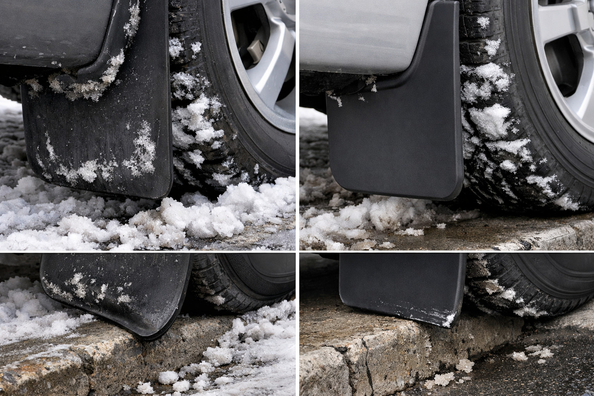
If the main question is what will survive winter, ice, slush, and an accidental brush with a curb, the advantage is usually on the side of flexible rubber or polyurethane mud flaps. If the car is driven mostly in the city, you need a neat OEM-style fit and there’s no constant contact with snow banks, it makes more sense to look toward plastic guards.
But the material name by itself doesn’t decide everything. In practice, three things matter more: how the mud flap behaves in мороз, how correctly it’s chosen for length and offset relative to the tire, and whether the installation creates extra load on the fasteners.
In essence, you’re not choosing between “rubber” and “plastic” as words in a description, but between a flexible and a rigid type of protection. A flexible mud flap absorbs an impact: it bends, catches snow or the edge of a curb, then returns to shape. A rigid one holds a cleaner shape and looks more restrained, but with a hard hit it more often cracks or pulls the mounting out.
That’s why in winter the difference is felt quickly. In the city it may be subtle, but on the highway, on gravel, with wide winter tires, or on a vehicle with a small lift, a flexible set usually turns out to be more practical. Plastic wins where conditions aren’t harsh and compactness plus a factory look matter most.
| Option | Strengths | Weaknesses | Who it’s for |
|---|---|---|---|
| Rubber or polyurethane | Handle snow, ice, gravel, and curb contact better; provide more real-world protection | May be noisy if too soft or too long; require careful selection for ground clearance | Those who drive a lot in winter, on highways, through yards with snow banks; SUV and pickup owners; cars with wide tires |
| Plastic or OEM thermoplastic | Neat fit, compact look, often easy installation into factory points | Worse at taking hard hits and мороз; more likely to crack or load the fasteners | Those who mostly drive in the city, don’t hop curbs, and want a clean, understated look |
DD Tuning expert comment: the most common mistake is choosing the longest mud flap “just in case” and not checking how it sits relative to the tire’s outer shoulder and the lower edge of the wheel arch. The second typical issue is overtightened mounting: a soft set starts to rub or make noise, while a rigid one after ice buildup acts like a lever and breaks a clip or the edge of the part.
Their main advantage is that they forgive the conditions that happen every day in winter: packed snow, an icy crust, parking up to a snow bank, an accidental touch of a curb. If the set is chosen correctly, it won’t break from a single contact—it simply works it off by bending.
The downside is that softness also has limits. If the mud flap is too long, too thin, or hangs too far behind the wheel, at speed it can fold back and make noise. On a lowered car or with limited clearance, excessive length also increases the chance of catching on the edge of a parking stop.
They’re chosen for compactness and for looking like a native part of the bodywork. In a calm city режим this is genuinely convenient: the mud flap is less noticeable, doesn’t wobble, usually installs into factory points, and doesn’t require lengthy fitting.
The weak spot is мороз and hard contact. When plastic becomes brittle, a hit against ice or a curb is no longer absorbed by bending. As a result, you either get a crack or the load transfers into the mounting point. Another nuance: an incorrect stand-off sometimes leads to paint rubbing in the contact area.
In practice, a lot depends on the shape, thickness, bracket stiffness, and fitment for your exact vehicle model. A good flexible set with правильной geometry works better than a random universal one, and compact OEM plastic can be perfectly sufficient if the car doesn’t see harsh winters and bad roads.
For daily winter driving, country trips, gravel, and wide tires, flexible mud flaps have the edge. They survive real impacts better and provide more coverage behind the wheel. This is especially noticeable on crossovers, minivans, pickups, and vehicles where the wheel throws a lot of грязь onto the rockers.
For calm city use, standard wheels, and normal ground clearance, plastic guards are often enough. They’re less eye-catching and don’t create the feeling of a “hanging apron” by the wheel. If the car is lowered, the choice should be made not by material but by compactness and exact clearance: a too-long soft set will be a bad fit there.
| Scenario | What to choose | Why |
|---|---|---|
| Winter, yards with snow banks, frequent parking up to curbs | Rubber or polyurethane | Bend on contact and handle icy slush and accidental impacts better |
| Calm city driving, a neat look matters | OEM-style plastic | Compact, less noticeable, often fit factory points well |
| Highway, gravel, lots of dirt on the rockers | Flexible vehicle-specific set with increased coverage | Catches water, salt, and stones better than a short OEM guard |
| Wide tires or wheels with more offset | Rubber or polyurethane, selected to match tire width | You need real coverage of the spray trajectory, not just a decorative piece |
| Lowered car | Short vehicle-specific set or compact OEM plastic | The key here is not catching road irregularities and parking edges |
| Commercial or very intensive use | More expensive flexible set with strong mounting | Higher upfront cost pays off through lower breakage and replacement risk |
Paying extra is justified when the mud flap works not as a decorative accessory but as a sacrificial защитa in tough conditions. This applies to wide tires, winter, highway and gravel driving, lifted vehicles, family minivans, and commercial transport. In these scenarios, a pricier set typically offers a better shape, more stable stiffness, cleaner installation, and a lower chance you’ll have to replace the part after the first season.
If you want to compare options by fitment and build type, it’s worth starting with the mud flaps category. For those who specifically need OEM geometry, it’s also useful to check original mud flaps. And if you’re unsure whether it’s worth paying more for a vehicle-specific solution, the article about when paying extra is justified will help.
From a customer’s experience: the owner of a crossover with wide winter tires was looking not for the prettiest, but for the most durable option for yards with snow banks and frequent curbside parking. At first he looked at short plastic guards, but in the end chose a flexible vehicle-specific set with the correct clearance. The result was simple: the rockers got less грязь, and after winter there was no need to replace cracked parts or fasteners.
In short, for snow, ice, curbs, and bad roads, flexible rubber or polyurethane mud flaps work more practically. Plastic ones make sense where a compact look, calm driving, and the absence of постоянных impact loads are key. But the final choice should always consider ground clearance, tire width, arch shape, and installation quality.
This conclusion is based not on a theory of a “best material overall,” but on real fitment experience, practice, and real-world usage scenarios. That’s why in most winter and mixed conditions, the winner isn’t the most rigid option, but the one that’s correctly chosen and can handle daily contact with the road.
| ✔ | Flexible rubber or polyurethane mud flaps handle snow, ice, glaze ice and occasional curb contact better. They bend on impact and usually do not break from a one-time hit. |
| ✔ | They are more practical for winter driving, highways, gravel, wide winter tires and cars with a greater wheel offset. In such conditions, they provide more real coverage and better catch water, salt and small stones. |
| ✔ | Plastic or OEM shields have a neater fit and a more compact look. In a calm city driving mode, they are less noticeable and often fit into the factory mounting points without complex adjustment. |
| ✔ | For cars with normal ground clearance and without harsh winter conditions, a plastic option can be perfectly sufficient. In such a scenario, it performs its function without unnecessary bulk near the wheel. |
| ✘ | Soft rubber mud flaps can be noisy if they are too long or set incorrectly. At speed, such a flap is bent by the air flow and starts to flap. |
| ✘ | On lowered cars or with low ground clearance, excessive length creates a risk of catching parking curbs or obstacles. In other words, “with a margin” often works against the owner here. |
| ✘ | Plastic handles strong impacts and frost worse: in a brittle state, it is more likely to crack or transfer the load to the mounts. There is also a risk of rubbing the paint if the offset is chosen poorly. |
| ✘ | A universal kit without checking the fit may turn out to be false economy. Without taking tire width, wheel offset and clearances into account, you will have to either adjust it or replace it. |
Shipping to EU
Wholesale and retail
Own warehouse
Опис продукту
Подарунки не надаються при оформленні покупки у кредит під 0,01% або при покупці частинами.