29.06.2026
152
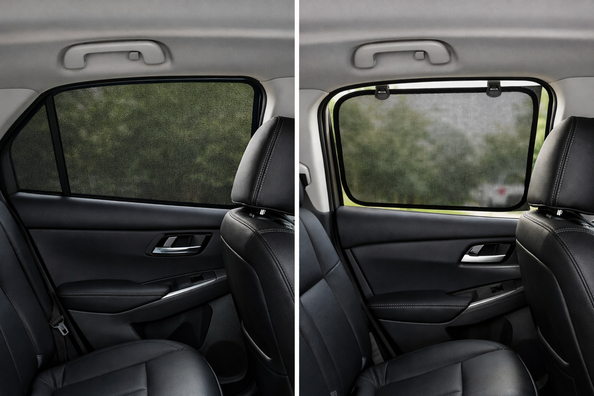
If the main thing is that the sunshade fits the interior tightly, doesn’t wobble while driving, and doesn’t leave big gaps around the edges, in most cases model-specific shades will be better. Universal ones have a different strong side: they’re easier and cheaper to buy, and they can also move from one car to another.
Here, it’s not so much the material itself that matters, but the fit, the mounting type, and the use case. For one family car and daily driving, the requirements are one thing; for occasional trips or several cars in the driveway, they’re completely different.
A model-specific sunshade is made for a particular make, model, body style, and often even the production year. That’s why it usually follows the window contour better, shifts less, and blocks light along the edges more effectively. If you want a quieter cabin, proper privacy, and stability on the highway, that’s a strong argument in its favor.
A universal sunshade isn’t tied to one vehicle. That’s a plus for those who don’t want to spend time selecting, or who are looking for a budget solution. But you almost always pay for that universality with compromises: somewhere it lacks height, somewhere width, and somewhere the mounting itself lets you down.
| Option | Strengths | Weaknesses | Who it’s for |
|---|---|---|---|
| Model-specific shades | More precise fit, fewer gaps, better stability while driving, usually less noise | Higher price, requires exact matching to the vehicle, possible small technical gaps near sensors or cameras | Those who install shades long-term on one car and want minimal compromises |
| Universal shades | Lower price, quick purchase, can be used on different cars, often easier to store | More often don’t match the window shape, may hold worse, sometimes make noise or slide down | Those who need a temporary or budget solution without being tied to one vehicle |
DD Tuning expert comment: Most often, people who look only at size or only at price make mistakes. If you don’t account for the window frame shape, mounting location, and whether you’ll be opening the window, even a decent shade can turn out inconvenient in a real car. For daily use, it’s better to immediately rule out solutions that rely only on weak suction cups.
Their main advantage is the fit. The frame or shape of the shade is adapted to the geometry of a specific window, so coverage is more complete and the shade moves around less in the opening. For rear side windows this is especially noticeable: fewer gaps in the corners, less direct sun for kids, and fewer chances that the accessory starts “living its own life” on a rough road.
As for installation, model-specific solutions also usually win—if they’re selected correctly. Depending on the design, they mount with clips, magnets, or into the window channel. On some kits, the shade can be left in place even when the window is partially opened, but this should be confirmed for the specific design rather than taken as a rule for all.
The downsides are real too. First, you need an exact match for the body and year. Second, not every model-specific shade delivers a completely zero gap: near a mirror, sensor, or camera there may sometimes be a technical offset. Third, it’s a more expensive solution, and a selection mistake costs more.
They’re bought for simplicity: choose a size, attach with suction cups, Velcro, or clips, and use it. For occasional trips, a second car, or situations where one shade needs to fit several vehicles, this is genuinely practical. They often fold compactly and don’t take up much space in the trunk.
But fit is the weakest point here. Glass in different cars differs not only in size, but also in shape, radius, and the angle of the frame. So a universal shade may match in width but not cover the height—or vice versa. This creates gaps and, with them, extra light and a worse visual result.
In terms of service life, universal options vary a lot. Most often, the mounting wears out before the fabric itself: suction cups hold worse on hot glass, and weak fixation leads to noise and slipping sooner. So a universal shade can work well as a temporary accessory, but is less often comfortable as a permanent everyday solution.
If you have one car, need shades all the time, and kids or pets often ride in the cabin, the model-specific option usually justifies its price. It covers the window better, irritates you less in daily use, and needs fewer small adjustments.
If you have multiple cars, need a shade occasionally, or your budget is strictly limited, a universal solution can be a reasonable compromise. Especially when the task is simple: reduce direct sun a bit during short trips, not achieve the most seamless integration into the interior.
On the highway, in heat, and on bad roads, the difference between these two approaches is felt more strongly. The more load on the mounts and the more often you use the shade, the more worthwhile a precise fit becomes.
| Scenario | What to choose | Why |
|---|---|---|
| One family car, shades for every day | Model-specific | Fit the opening better, fewer gaps, and less need for constant readjustment |
| Frequent highway trips | Model-specific | Hold more securely, make noise less often, and shift less at speed |
| Need to cover several different cars cheaply | Universal | One type is easier to move between cars, and the initial cost is lower |
| Rare use in the city | Universal | For short trips, the fit compromise is often not critical |
| Kids in the rear row, fuller shading matters | Model-specific | More tightly cover the window contour and block light along the edges better |
| Rental or work fleet | Universal | Easier to buy and manage one universal format than exact kits for each car |
Paying extra for model-specific shades makes sense when you’re buying them not as a seasonal experiment, but for permanent use. If you have one car, the sun hits regularly, kids ride in the cabin, and you care about quiet, a neat look, and proper fit without daily adjustments, the more expensive option usually turns out more practical.
It’s logical to start with sun protection shades as a base category, and to understand the compromises of budget solutions it’s useful to separately look at suction-cup shades and the article which shades actually work against the sun. If you only need a shade occasionally, for a second car, or for several cars at once, the extra cost isn’t always justified: a universal format in such a scenario often delivers more honestly for its price.
From a customer’s experience: we were looking for rear-door shades for a family car and first took a universal set because of the lower price. In reality, one shade didn’t cover the glass fully, and the suction cups had to be reattached from time to time. After switching to a model-specific set, we stuck with it because the edge gaps disappeared and there was no need to keep checking whether everything was holding.
If we answer briefly: for a better interior fit, model-specific shades almost always win. They follow the window shape more precisely, hold more stably, make less noise, and are better suited for daily driving. Universal ones are worth buying when budget, purchase speed, or the ability to use the accessory across different cars is the top priority.
The main thing is not to buy “by eye” and not to lump different designs into one category. This conclusion is based not on marketing promises, but on real selection experience, practice, and real use cases—where fit tightness and everyday convenience matter more than a nice description on the packaging.
| ✔ | Model-specific curtains are usually a better match for the shape of the particular window, so they fit more snugly into the opening and leave fewer gaps around the edges. This is especially noticeable when it is important to cover the rear side windows as much as possible. |
| ✔ | They stay more secure while driving, shift less, and are less likely to rattle on the highway. For everyday use, this reduces the need to keep adjusting them. |
| ✔ | Universal curtains are easier and quicker to buy, and they can also be moved between different cars. This is convenient if the curtain is needed for more than one car or only occasionally. |
| ✔ | For a budget or temporary setup, universal curtains provide an acceptable result without precise matching to a specific car model. On short city trips, their compromises are often enough. |
| ✘ | Model-specific curtains are more expensive and require precise matching to the body, model, and year of manufacture. A mistake in selection will cost more than with a universal option. |
| ✘ | Even model-specific solutions can still leave technical gaps near the mirrors, sensors, or cameras. In other words, they do not guarantee absolute edge-to-edge sealing. |
| ✘ | Universal curtains often fit the shape of the glass less well: they may be too short in height or width, leaving noticeable gaps. As a result, both shading quality and overall convenience suffer. |
| ✘ | Universal options depend more heavily on the quality of the mounting: suction cups or other fixings can weaken in heat, causing them to slip or rattle. For regular use, this quickly becomes inconvenient. |
Shipping to EU
Wholesale and retail
Own warehouse
Опис продукту
Подарунки не надаються при оформленні покупки у кредит під 0,01% або при покупці частинами.