
































































 Author: Radomskyi Maksym Vasyliovych
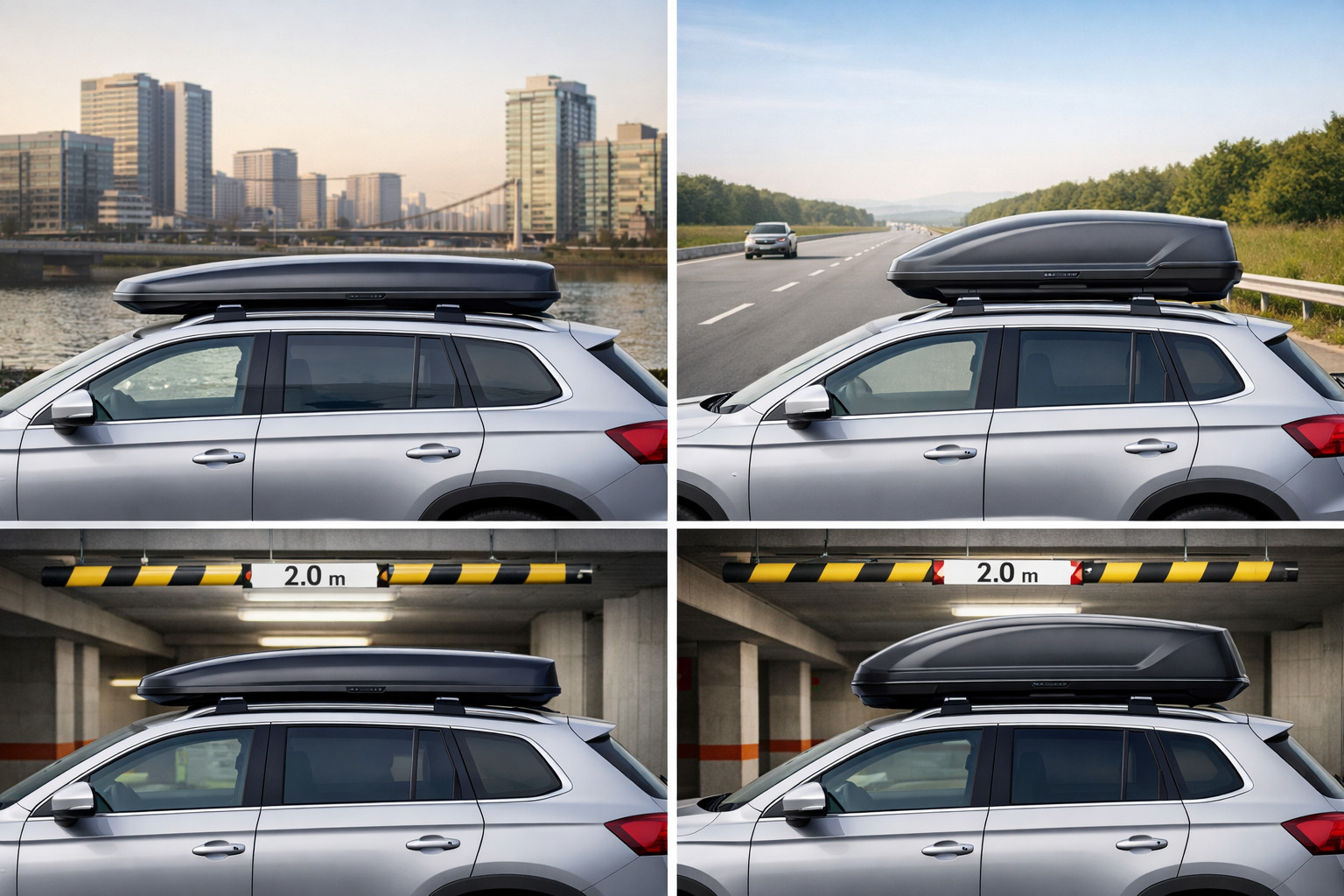
The choice between a low-profile and a high-profile roof box comes down not to design, but to two questions: where you drive every day and what you carry at peak times. If your car regularly enters an underground parking garage, a garage, or sits in a yard under tree branches, a low box is usually more practical. If the main task is to fit large suitcases, kids’ items, or camping gear, a high box gives noticeably more usable space.
An important nuance: the line between “low” and “high” isn’t standardized. So don’t look at the series name—look at the real height the box adds to the vehicle, compatibility with crossbars, ease of installation, and the shape of the cargo you actually put inside.
What the choice really comes down to
A low-profile roof box wins where height, noise, and everyday convenience are critical. In practice, these models may not be small at all: for example, Thule Motion 3 XL Low has a volume of 396,4 L and a height above the crossbars of 30,5 cm, while Yakima GrandTour Lo is 424,8 L and adds about 25,4 cm to the vehicle’s height. For skis, snowboards, soft bags, and travel odds and ends, this is often enough.
A high-profile roof box isn’t chosen for size alone, but when you need a volume buffer. Thule Motion 3 XXL has 590 L, and Yakima SkyBox NX XXL has 623 L. This format handles family trips, large suitcases, and bulky gear better, but it more often creates issues with parking garages, reacts more to wind, and takes up more space even when it isn’t fully loaded.
What criteria to compare by
- Actual height after installation. Measure the car together with the crossbars and the box. In the city, this can matter more than liters.
- Usable shape, not just liters. A low box works well with long items, but worse with tall suitcases. A high box is the opposite.
- Noise and aerodynamic drag. A low profile is usually quieter and “catches” less wind, but the result depends on the box shape, crossbar type, speed, and wind.
- Installation and access. If you often take the box off and put it back on, look for quick-mount clamps, dual-side opening, easy lid closing, and reliable lock operation.
- Hardware durability. A low or high profile by itself guarantees nothing. Real service life depends more on lid stiffness, mounts, locks, and how often the box is removed and stored.
- Price. A more expensive model isn’t just the brand—it’s faster mounting, better locks, cleaner mechanics, and fewer everyday hassles.
- Vehicle compatibility. Before buying, check the crossbar spacing and the clearance for the tailgate. A large box may physically not sit correctly even on a vehicle that’s wide enough.
Quick comparison of options (table)
| Option | Strengths | Weaknesses | Who it’s for |
|---|---|---|---|
| Low-profile roof box | Adds less to overall vehicle height, usually quieter, more convenient for the city, easier to live with day to day | Less volume, worse for large suitcases and bulky camping kits | Those who drive in the city a lot, have low parking garages, carry skis, boards, medium-size bags |
| High-profile roof box | More capacity reserve, better for family luggage, large suitcases and gear | More likely to conflict with parking garages, can be noisier, less convenient in daily use | Families, travelers, those who regularly go on vacations or carry lots of bulky items |
A detailed breakdown of each option
Low-profile roof box
This is the choice for those who don’t want to think about vehicle height every time. Using Motion 3 XL Low as an example: 396,4 L, length 215,4 cm, weight 24 kg, and 30,5 cm above the crossbars. GrandTour Lo feels even lower in everyday use: a long body of 231,1 cm, 424,8 L, and an increase in the vehicle’s overall height of about 25,4 cm. In the city, that’s a difference you can actually notice.
The strong point of the low format isn’t only parking clearance. It usually feels calmer on the highway, is less irritating in terms of noise, and changes driving habits less. And it’s not necessarily “for skis only.” If you pack soft bags, covers, and long items, 400+ liters is often enough.
The weak spot is vertical volume. A large hard-shell suitcase, a stroller, or tall storage boxes quickly eat up the advantage. One more nuance: a low box can be long, so checking tailgate clearance and crossbar spacing is mandatory.
High-profile roof box
The idea is simple: when you have a lot of stuff, a low profile stops being a lifesaver. Motion 3 XXL gives 590 L at a length of 231,9 cm and 40 cm above the crossbars. SkyBox NX XXL has 623 L, a length of 229,9 cm, and even more vertical headroom. This format works better with large suitcases, family trips, and camping gear.
On the road, a high box is convenient because you less often have to play compromise games while packing. There’s less chance you’ll need to move part of the load back into the cabin. In good models, this is complemented by dual-side opening, quick mounts, and solid lock mechanics.
The downsides are just as straightforward. First, height: underground garages, garage doors, and tree branches become a real test of attention. Second, aerodynamics: at speed and in crosswinds, a large box is felt more. Third, practicality: such a box is harder to store and less convenient to remove alone.
Which option is better for different scenarios
For a city car that parks under a roof every day, it’s almost always more logical to start with a low profile. If your main cargo is skis, snowboards, travel bags, or kids’ items without big bulk, there’s often no point in overpaying for a taller shell.
For highway driving, it depends on your trip format. When it’s two people and compact luggage, a low box is nicer to use. When it’s a family, large suitcases, camping, or seasonal items, the high option quickly pays off in packing comfort.
If you’re unsure, base your decision not on the average trip, but on the toughest one you have a few times a year. That’s what will show whether you need real volume or if a lower, quieter model is enough.
Usage scenario and what’s better to choose (table)
| Scenario | What to choose | Why |
|---|---|---|
| Daily city driving, underground parking, garage | Low-profile roof box | Adds less height, fewer chances to hit the ceiling or garage door |
| Weekend highway trips for two | Low-profile roof box | Usually quieter and sufficient in volume for compact luggage |
| Family vacation for 4–5 people | High-profile roof box | Works better with large suitcases and bulky items |
| Ski trips | Low or high depending on how much gear you have | For 4–6 pairs of skis a low box is often enough; for a bigger load, a high one is more convenient |
| Camping, tents, soft but bulky items | High-profile roof box | Vertical volume matters more than a lower profile |
| Rare trips 1–2 times a year | The one that clearly covers your real volume needs | No need to buy the biggest box “just in case” if it creates inconvenience most of the year |
Common mistakes when choosing
- Buying by liters without considering shape. 400 L in a low shell and 400 L in a high shell pack differently.
- Ignoring total vehicle height. The “low” label doesn’t mean the car will fit into every parking garage.
- Not checking crossbar compatibility. Their spacing and roof geometry matter no less than the box volume.
- Buying an oversized box “just in case.” You end up with extra noise, weight, storage hassle, and an almost empty box on the roof.
- Underestimating mounting and hardware. If the box is removed often, cheap mounts and inconvenient locks become annoying very quickly.
- Packing wet gear without covers and not watching the locks in winter. Moisture and ice won’t break the box instantly, but they create constant small problems.
When a more expensive solution makes sense
Paying extra is justified when the box isn’t used occasionally but regularly: frequent family trips, long routes, seasonal gear, constant removal and installation. In that mode, the value isn’t abstract “premium feel,” but proper locks, a stiffer lid, dual-side access, and quick mounts. A convenient place to start filtering is the roof box catalog.
A pricier low box makes sense if quietness and stress-free access to low parking garages are critical. A pricier high box makes sense if you need large volume without compromises in access and mechanics. But investing in such a setup is logical only together with good roof crossbars and a proven roof rack system, otherwise part of the advantages simply gets lost.
Conclusion
In short: for the city, daily driving, garages, and parking structures, a low-profile roof box is better. It adds less height, is usually quieter, and is less annoying in day-to-day life. If the main task is big family luggage, suitcases, camping, and long trips, a high box is more practical.
The smartest algorithm is simple: measure the real height of your car with crossbars, check crossbar spacing, and honestly assess the bulkiest trip you take in a year. After that, it becomes clear whether you need a lower profile or a true capacity reserve.
Pros and cons
A low roof box adds less to the car’s overall height, so it’s easier to use in the city, underground parking lots, and garages. This reduces the risk of hitting the ceiling or gates.
This format is usually quieter on the highway and less affected by wind. In everyday use, that feels noticeably more comfortable, especially on regular trips.
Even low models can still offer enough space for practical items: skis, snowboards, soft bags, and travel essentials. So it’s not necessarily a compromise in capacity.
A high roof box provides noticeably more usable space for large suitcases, family luggage, and camping gear. It is a better fit when there really is a lot to carry.
In a high box, it is easier to pack bulky cargo without difficult compromises, with less chance of moving part of the load into the cabin. This is more convenient for long trips and vacations.
A low roof box has less vertical volume, so tall hard-shell suitcases or a child stroller can quickly eat up its advantage. It is less suitable for very bulky items.
Even a low box can be long, so before buying you need to check the clearance to the tailgate and the distance between the crossbars separately. Otherwise, compatibility may only be on paper.
A high roof box more often creates problems with parking lots, garage doors, and branches. In the city, this can become a constant source of inconvenience.
The high format is felt more at speed and in crosswinds, and it is also less convenient to remove and store. In everyday use, it is more demanding to handle.