22.04.2026
772
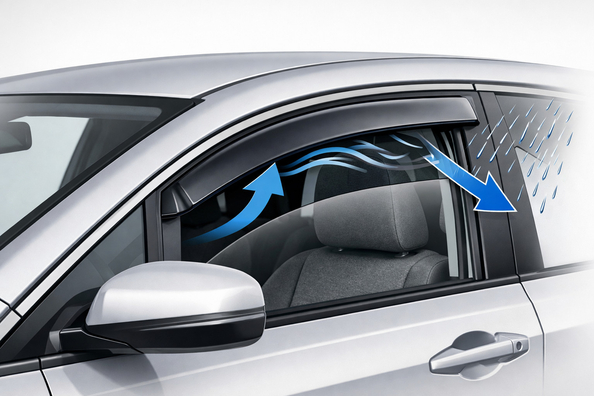
To ventilate the cabin in the rain without getting water on the door card, a wind deflector shouldn’t just “be on the window” — it has to sit precisely on the door frame and work with the glass in the right position. When water still gets inside, the issue is almost never the idea of a deflector itself, but the selection, the fitment, or how far the window is lowered.
The best results usually come from vehicle-specific deflectors made for a particular car: in-channel types that insert into the window run, or well-fitted stick-on (overlay) types. They really do let you crack the window in the rain, reduce fogging, and add fresh air to the cabin, but they won’t eliminate noise completely and won’t save you if the window is opened too far or if a strong side wind hits the edge.
Water gets into the cabin not because the deflector is “bad by itself”, but because airflow around the A-pillar, mirror, and the upper door frame differs from one vehicle to another. If the deflector shape doesn’t match the door geometry, it won’t direct droplets away — it will only partially cover the opening.
The second reason is how it’s used. A deflector is designed for a slightly cracked window, not a half-open one. When the glass is lowered too far — especially at speed or in sideways rain — protection drops sharply and water still gets into the cabin.
Start with the simplest check: look whether the deflector sits evenly along the entire length, without tension or twisting. If it’s a new set, it’s worth test-fitting it before final fixing: it should go into place without force and without noticeable edge lift.
Next, check the window. After installation, it should cycle up and down several times normally, without jerks or misalignment. If after installation the glass starts to bind, stop, or slowly squeeze into the top position, the issue is most often the fitment or the deflector profile itself.
Also check how far you open it. In the rain, crack the window just a little and see whether droplets appear along the lower edge. If everything is dry at minimal opening but gets wet when opened more, the deflector is working нормально — you’re simply exceeding its real working range.
DD Tuning expert comment: the most common mistake is buying a cheap universal set and expecting the same fit as a model-specific one. The second typical mistake is sticking an overlay deflector onto a frame that hasn’t been fully degreased, or installing it in the cold and then washing the car right away. If the edge lifts even slightly in the first few days, at speed it almost always turns into whistling and water in the opening.
| Symptom | Likely cause | What to do |
|---|---|---|
| Droplets get into the cabin even with a deflector | The window is lowered too far, or the deflector profile doesn’t block the airflow | Reduce the opening to the minimal working position; check fit accuracy |
| Whistling at speed | There’s a gap, an edge has lifted, or the set doesn’t match the door shape | Inspect the edge along the full length; if needed, reinstall or switch to a model-specific set |
| The window moves tightly after installation | The in-channel deflector sits incorrectly in the run, or the profile is too thick | Remove and check the fit again; if the problem remains, don’t strain the window regulator — replace the set |
| After a few days the edge starts to peel off | Installed on a dirty, wet, or waxed surface; wrong installation temperature | Remove, properly clean the frame, install on a dry surface under suitable conditions, and allow time to bond |
| In the rain it’s fine in the city, but worse on the highway | Stronger airflow and side wind exceed the deflector’s capabilities | Open the window less at speed and don’t expect complete silence or absolute dryness in all conditions |
First — a model-specific set for your exact vehicle. Accurate geometry creates the effect people install deflectors for: air comes in, but water doesn’t fly straight into the opening. As for type, the best results usually come from in-channel deflectors or well-fitted overlay models of decent quality.
Second — proper installation. For overlay types, a clean and dry surface without wax and the right installation temperature are critical. For in-channel types, it’s important that the profile sits in the run without twisting, and that after installation you give the window time to “settle” as required by the instructions.
Third — the correct usage. For ventilation in the rain, you shouldn’t open the window wide — only crack it slightly. In this scenario, a deflector really reduces water ingress, helps against fogging, and brings in air without a harsh draft.
Cheap universal sets work poorly when bought “to fit roughly”. They may look similar, but even a small difference in radius or length creates a gap — and then you get whistling, vibration, and water along the edge of the glass.
Trying to “save” a bad fit by pressing harder or re-sticking without proper surface prep almost never helps. If the frame is still dirty, damp, or waxed, the problem will come back.
Likewise, don’t expect a deflector to make an open window completely quiet on the highway. It can reduce turbulence a bit, but it won’t remove noise entirely. If the goal is to drive fast with the window noticeably open and without any whistling, that’s an unrealistic expectation.
Buying makes sense when the problem is actually the deflector: the wrong profile, weak contact, an edge lifting, whistling after installation, or the desire to switch from a universal option to a model-specific one. For selection, you can browse the general deflectors category, separately window deflectors, and if you’re choosing between types, it’s useful to compare model-specific and universal options.
Replacing the deflector itself is justified when it clearly doesn’t sit on the door frame or starts interfering with the window. But if the window moves tightly even without it, or the window run already has its own issue, a new accessory won’t fix that. In that case, address the underlying fault first, and only then choose a deflector.
| Solution | When it works | When it’s not worth spending money |
|---|---|---|
| Model-specific in-channel window deflector | When the profile matches your vehicle exactly and the window moves freely after installation | When the channel is narrow and the window is already sensitive to any extra resistance |
| Model-specific overlay (stick-on) deflector | When the frame is clean and dry, the deflector follows the contour precisely, and it’s given enough time to bond properly | When installed in the cold, on dirt, or right after waxing, and also if the car often goes through harsh brush car washes |
| Reinstalling an already purchased set | When the cause is only surface preparation or a minor misalignment during installation | When the set itself doesn’t match the geometry and the edge keeps lifting |
| Simply opening the window less | When the deflector is fine, but water appears only with too large an opening | When water gets into the cabin even at minimal opening due to poor fit |
| Cheap universal set | Only as a compromise on a simple frame and without high demands for quietness and fit | When you need consistent results in the rain, quietness at speed, and normal window operation |
From a customer’s experience: a driver was looking for a way to keep the window slightly cracked in the rain because the cabin fogged up quickly in the city. First, they tried a cheap set but got whistling and leaking along the edge. After switching to a model-specific deflector and getting used to opening the window just a few millimeters, the cabin ventilates normally and water no longer blows inside.
What really helps isn’t “any deflectors”, but precise model-specific solutions with proper fitment and correct installation. Their strong point is ventilation with a slightly cracked window in the rain, less fogging, and a calmer airflow. Their limitation is that they don’t like a wide window opening, strong side winds, and they don’t forgive sloppy installation.
So before spending money, it’s worth honestly checking three things: whether the set fits your vehicle, whether it’s installed correctly, and whether you’re lowering the window beyond its real working position. This material is based on real selection experience, practical work, and real-use scenarios — not on the promise that one accessory will solve everything in any weather.
| ✔ | Model-specific deflectors made for a particular car really work better than universal ones, because they fit the door frame more precisely and redirect water more effectively. |
| ✔ | They let you crack the window open a little in the rain without any obvious drops getting into the cabin, as long as the glass is opened within the working range. |
| ✔ | The deflector helps reduce cabin fogging and lets in fresh air without a strong direct draft. |
| ✔ | With proper installation, over-channel and in-channel models can work reliably and not interfere with normal window movement. |
| ✔ | In the city, with the window slightly open, they deliver a noticeably better result than simply driving without rain protection. |
| ✘ | The deflector does not help if the window is opened too low: in that mode, water still gets into the cabin. |
| ✘ | At speed or in side wind, its effectiveness drops noticeably, and it does not provide complete dryness or silence. |
| ✘ | Incorrect selection or a poor fit causes whistling, turbulence, and leakage along the edge. |
| ✘ | Cheap universal kits often fit worse and can even make window operation harder if the profile is inaccurate or too thick. |
Shipping to EU
Wholesale and retail
Own warehouse
Опис продукту
Подарунки не надаються при оформленні покупки у кредит під 0,01% або при покупці частинами.