 Author: Radomskyi Maksym Vasyliovych
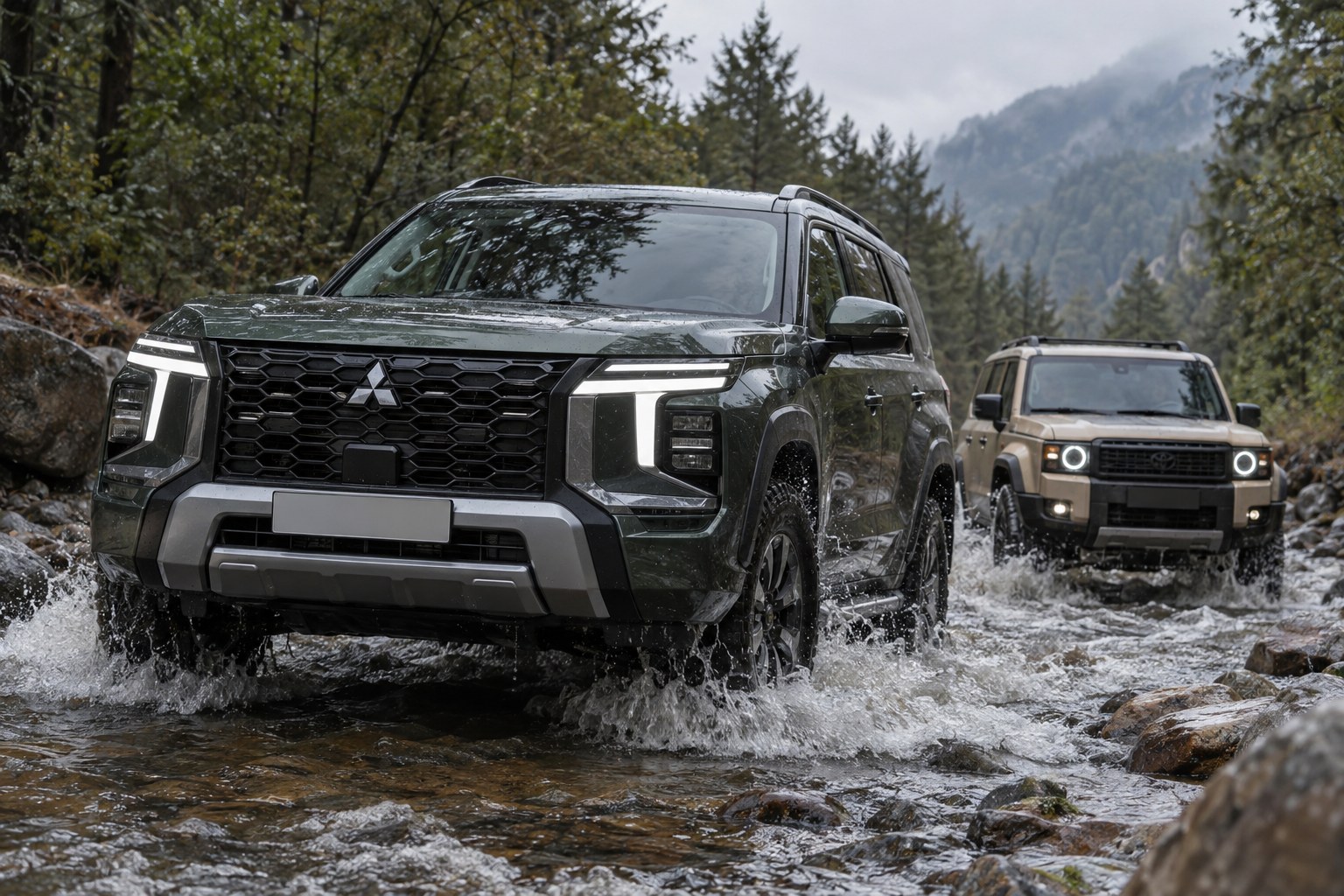
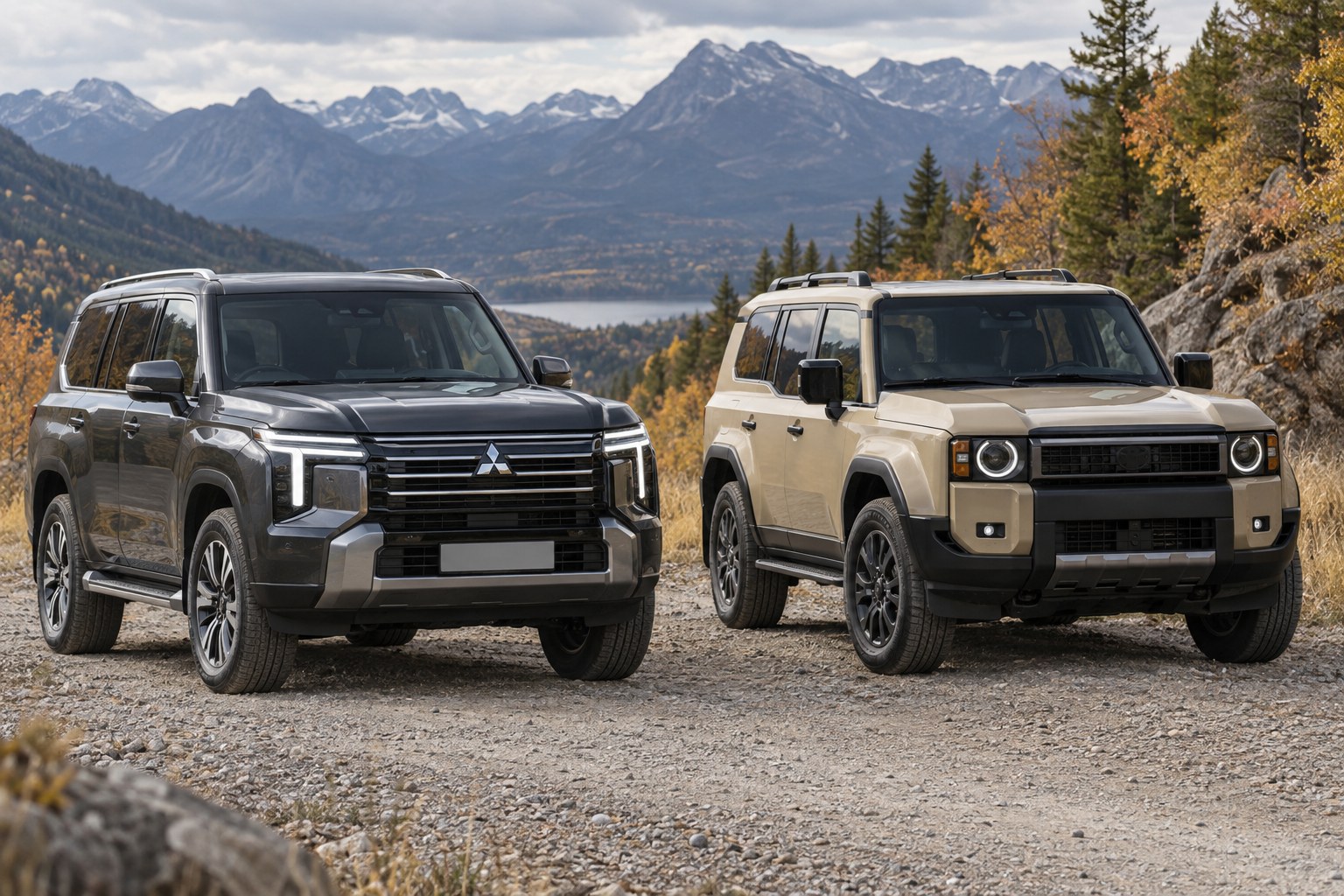
Mitsubishi has brought the Pajero back into the class of large body-on-frame SUVs, and in this class the most famous rival is already waiting for it — the Toyota Land Cruiser Prado 250. Both vehicles have a ladder frame, a solid rear axle, low range, a diesel of about 205 hp, an eight-speed automatic, and tow up to 3.5 t. But behind similar figures are two different four-wheel-drive philosophies, different geometry, and a different degree of being “proven.” We compare only what is confirmed by Mitsubishi and Toyota press releases; where data for the new Pajero has not yet been announced, we state that as well.
Contents
- In brief: what’s the difference
- Comparison table
- Frame and suspension
- Engines and transmissions
- Four-wheel drive: Super Select vs full-time 4WD
- Off-road and with a trailer
- Interior, screens, and safety
- Who it suits
- Bull bar and side steps: what’s already available
In brief: what’s the difference
- Dimensions are almost the same. Pajero — 4 920 mm long, Prado — 4 925 mm. The Prado is wider (1 980 vs 1 925 mm), while the Pajero has a 20 mm longer wheelbase.
- The drivetrains differ in concept. The Pajero has Super Select 4WD-II with a 2H rear-wheel-drive mode, while the Prado is full-time four-wheel drive only.
- Engines are close. Pajero: 2.4 L, 150 kW, 480 N·m. Prado in Europe: 2.8 L, 151 kW (205 hp), 500 N·m, and from 2025 there’s also a Hybrid 48V version.
- Geometry favors the Pajero at the rear. Departure angle 25.8° vs 17° for the European-spec Prado; ground clearance 230 mm vs 205–215 mm.
- The Prado is a proven model, introduced in August 2023. The Pajero was shown on September 2, 2026, and some data (weight, wading depth) has not yet been announced by the manufacturer.
Comparison table
For the Prado, the data shown is for the European version with the 2.8 L diesel (Toyota UK press release); for the Pajero, the data comes from Mitsubishi’s global press release and the specification for Australia, where it will be sold as a 2027 model.
| Parameter | Mitsubishi Pajero (2027) | Toyota Land Cruiser Prado 250 |
|---|---|---|
| Length / width / height | 4 920 / 1 925 / 1 910 mm | 4 925 / 1 980 / 1 925–1 935 mm |
| Wheelbase | 2 870 mm | 2 850 mm |
| Front / rear track | 1 630 / 1 630 mm | 1 664 / 1 668 mm |
| Body | ladder frame made of high-strength steel (from the Triton pickup) | ladder frame on the GA-F platform |
| Front / rear suspension | double wishbones / solid axle, 5-link | double wishbones / solid axle, 4-link |
| Engine | 2.4 L diesel, variable-geometry turbo | 2.8 L diesel (from 2025 — also Hybrid 48V) |
| Power / torque | 150 kW / 480 N·m (470 N·m in some versions) | 151 kW (205 hp) / 500 N·m |
| Transmission | 8-speed automatic | 8-speed Direct Shift |
| Four-wheel drive | Super Select 4WD-II: 2H, 4H, 4HLc, 4LLc | full-time, Torsen center differential, H4/L4 |
| Rear differential lock | yes (in all Australia-spec versions) | yes, electronic |
| Ground clearance | 230 mm (20" tires) | 205 mm (18") / 215 mm (20") |
| Approach / departure angles | 30.4° / 25.8° | 32° / 17° |
| Breakover angle | 22.6° | not specified in the European specification |
| Wading depth | not officially announced | 700 mm |
| Braked towing capacity | 3 500 kg | 3 500 kg |
| Fuel tank / AdBlue | 80 L / 17 L | 80 L / 17 L |
| Curb weight | not officially announced | 2 335–2 520 kg |
| Seats | 5 or 7 | 5 or 7 (in the UK — 7) |
Frame and suspension
Both SUVs are classic body-on-frame vehicles, and that is the main thing that sets them apart from crossovers like the Outlander or RAV4. The Pajero is built on the Triton pickup’s frame, but Mitsubishi developed the cabin, front suspension, and rear suspension specifically for this model. Up front are double wishbones; at the rear is a new solid axle with a five-link setup.
The Prado 250 sits on the GA-F platform shared with the Land Cruiser 300. Toyota says torsional rigidity of the frame has increased by 50% compared with the previous Prado, and frame-plus-body rigidity has increased by 30%. The suspension layout is similar: double wishbones up front, a solid rear axle on four links. An important Prado detail is the Stabilizer Disconnect Mechanism (SDM): it adds another 10% of wheel travel in slow off-road driving and automatically locks when speed increases.
Both vehicles received electric power steering. For the Land Cruiser this is the first time ever; for the Pajero it replaces hydraulic power steering.
Engines and transmissions
On paper the powertrains are very close. The Pajero gets a new 2.4-liter diesel with a variable-geometry turbo: 150 kW and 480 N·m (470 N·m in some versions). The European Prado has a 2.8-liter diesel rated at 151 kW (205 hp) and 500 N·m available from 1 600 to 2 800 rpm. Both engines are paired with an eight-speed automatic.
The difference is in choice. At launch, the Pajero has one engine. In Europe, from 2025 the Prado is also available as a Hybrid 48V: the starter-generator adds up to 12 kW and 65 N·m when pulling away and makes the start-stop system smoother. In other markets Toyota offers the 2.4 L i-FORCE MAX gasoline hybrid (326 hp total), but it is not available in Europe.
Four-wheel drive: Super Select vs full-time 4WD
This is a fundamental difference between the two vehicles. Pajero gets Super Select 4WD-II with four modes: 2H (rear-wheel drive only, an economical highway mode), 4H (four-wheel drive that can also be used on dry asphalt), 4HLc (four-wheel drive with a locked center differential), and 4LLc (low range with lock). On top of that works the S-AWC electronic system and seven drive modes: Normal, Eco, Gravel, Snow, Mud, Sand, and Rock.
Prado has full-time four-wheel drive with no 2H mode: the center differential is a Torsen limited-slip unit, there are H4 and L4 ranges, and an electronic rear differential lock. Toyota switched the lock actuation from an electric motor to a solenoid — engagement in about 0.15 s, 85% faster than before. Added to this are Multi-Terrain Select (Mud, Sand, Rock, Dirt, Deep Snow, Auto), Crawl Control with five speeds, and downhill assist control.
In practice, the Pajero gives the driver more manual control and the option to save fuel in rear-wheel drive, while the Prado bets on the idea that four-wheel drive is always on and the driver does not need to switch anything until real off-roading begins.
Off-road and with a trailer
By official geometry the Pajero looks bolder at the rear: a 25.8° departure angle versus 17° for the European Prado, and 230 mm ground clearance versus 205–215 mm. Up front the Prado is slightly better: 32° versus 30.4°. The Pajero’s breakover angle is 22.6°; Toyota does not list it for the European Prado. Keep in mind that the departure angle depends heavily on the towbar and rear bumper of a specific version, so you need to compare the same trim levels.
For the Prado, Toyota specifies a wading depth of 700 mm; for the Pajero, Mitsubishi has not officially announced this figure. Both tow up to 3 500 kg with a braked trailer, both have 80 L of fuel and 17 L of AdBlue. Australia-spec Pajero versions also get a system that monitors trailer sway and brakes individual wheels.
Interior, screens, and safety
The Pajero is a three-row seven-seat SUV (in the base version for Australia there is also a five-seat option). The second row slides by 150 mm. The horizontal dashboard is a direct nod to the first Pajero. The central screen is 14.3 inches (12.3 inches in simpler versions), with a Dynamic Sound Yamaha Ultimate audio system with 12 speakers. There are eight airbags, including Mitsubishi’s first center airbag between the front seats.
The Prado is produced in five- and seven-seat configurations. The instrument cluster and multimedia screen are both 12.3 inches. European versions include the full third-generation Toyota Safety Sense suite, a surround-view system with Multi-Terrain Monitor, a driver monitoring camera, and an emergency stop system if the driver stops responding.
The driver-assist packages on both vehicles are comparable: automatic braking with pedestrian and cyclist detection, adaptive cruise control, lane keeping, and front cross-traffic alert. What changed in the Prado 250 versus its predecessor, we covered in the Prado 250 review, and all data on the new Pajero is collected in a separate article about the Pajero.
Who it suits
- Pajero — for those who do a lot of highway driving and want rear-wheel drive for economy, switching to four-wheel drive only when needed. Plus a better departure angle and higher ground clearance for dirt roads and trips outdoors.
- Prado 250 — for those for whom predictability is the main thing: full-time four-wheel drive, the proven Land Cruiser platform, SDM for tough off-roading, a known wading depth, and a choice between diesel and a 48V hybrid.
- If you’re still unsure — it is worth waiting for the first independent Pajero tests and the European specification: weight, wading depth, and trims for Europe have not yet been announced.
Bull bar and side steps: what’s already available
Accessories for the Prado 250 are already available: the catalog has Prado 250 tuning and accessories, including side steps for the Prado 250 and expedition gear — roof boxes, a side ladder, a fold-down step. For the new Pajero, there are no model-specific accessories yet: manufacturers usually prepare them a few months after sales start.
There is the same nuance with bull bars on both vehicles: up front there are radar and surround-view cameras, so the protection must be designed for the specific model so it does not block the sensors. The general selection is in the bull bars and side steps section.
We deliver via Nova Poshta across Ukraine; orders from 15 000 ₴ — free with our own transport.
Pros and cons
Pajero: 2H rear-wheel drive mode for fuel savings on the highway
Pajero: departure angle of 25.8° versus 17° on the European Prado
Pajero: ground clearance of 230 mm versus 205–215 mm
Pajero: 14.3-inch central display and eight airbags, including a center airbag
Pajero: 20 mm longer wheelbase with the same overall length
Pajero: at launch, only one engine, with no hybrid version
Pajero: weight and wading depth have not been officially announced
Pajero: new model with no operating experience, Prado has been on the market since 2023
Pajero: European specification and launch timing for Europe have not been announced
Pajero: model accessories are not yet available