 Author: Radomskyi Maksym Vasyliovych
This upgrade plan is for a Toyota RAV4 2013–2018 owner who regularly loads the trunk and doesn’t want to polish the top edge of the rear bumper every few months. The scenario is simple: bags, suitcases, a stroller, tools, sometimes a dog or dirty items after a trip. The goal isn’t to “cover” the car in accessories, but to protect the areas that truly take a beating every day.
For this generation of RAV4, the main thing is not to mix things up. A cargo tray or trunk mat works against water, dirt, and items sliding around. Rear bumper protection works against scratches during loading. And if you have a Hybrid, fold the seatbacks often, or carry animals, then you need more than just a tray—you need fuller coverage for the floor and seatbacks.
What this upgrade needs to handle
This upgrade has three practical tasks. First, to keep water, sand, snow, and small debris from spreading throughout the trunk. Second, to preserve the top surface of the rear bumper—the area most often hit by bags, boxes, strollers, and animals’ paws. Third, to make the trunk easier to maintain, so it can be quickly tidied up without deep cleaning.
If you only carry supermarket groceries, a basic set is enough. If you often fold the rear row, transport bicycle wheels, building materials, dogs, or wet items, a simple tray no longer covers all the risks: the seatbacks and the bumper during loading remain exposed.
What to upgrade first
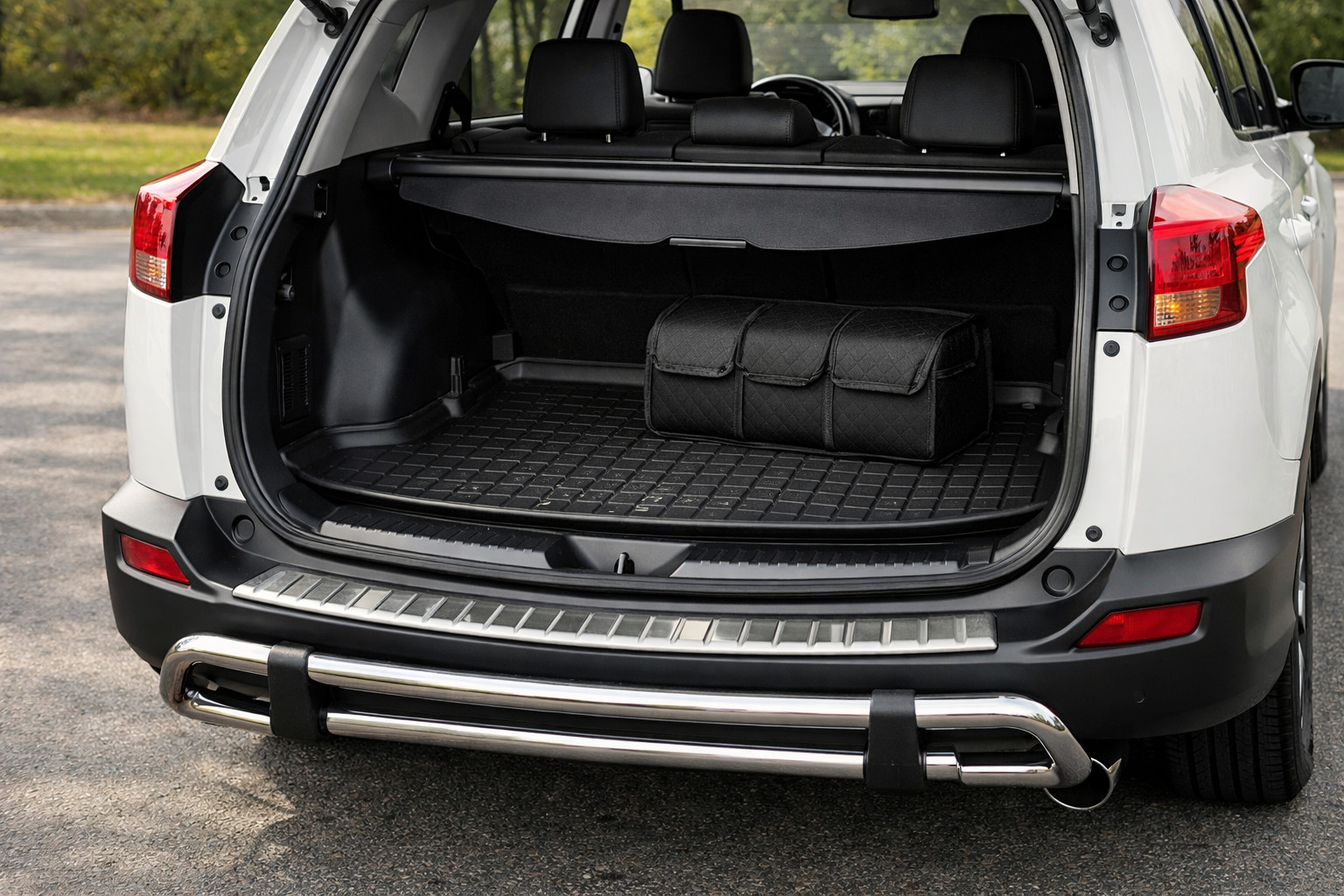
First priority for the RAV4 2013–2018 is a trunk mat or cargo tray molded to the shape of the cargo area. It takes on daily dirt, drips, shoe marks, and prevents small items from sliding. In real-world selection, it’s a purchase that delivers immediate results in almost any scenario.
Second priority is protection for the upper edge of the rear bumper. If you place bags carelessly, often drag cargo over the edge, or carry a dog, scratches appear there faster than you’d think. For some 2016–2018 versions it makes sense to look at an edge scuff plate; for heavy loading, solutions that cover the bumper at the moment of contact work better than ones that only stick on top.
Before buying, it’s important to check your trunk configuration. Within 2013–2018 there are differences between standard versions and Hybrid, so the floor shape and accessory fit can vary. When a mat is bought “by eye,” this is where gaps or misalignment most often show up.
Upgrade, why it’s needed, who benefits (table)
| Upgrade | Why it’s needed | Who really benefits |
|---|---|---|
| Cargo tray or mat with a raised edge | Holds water, dirt, sand; keeps small items from sliding on the floor | Almost all owners who use the trunk weekly |
| Scuff plate for the upper edge of the rear bumper | Takes the scratches from bags, boxes, and hard cargo | Those who often load over the edge and want to preserve the paint |
| Fold-down bumper protector flap | Covers the bumper during loading, when cargo actually rubs against the edge | Those who carry a stroller, crates, a dog, suitcases, gear |
| Rear seatback protection | Prevents the seatbacks from getting dirty and scratched with the second row folded | Those who often expand the cargo area and carry long or dirty items |
| Cargo cover | Hides items from view, partially protects them from the sun | Those who leave items in the car and value privacy |
| Cargo net | Secures small purchases, bottles, car chemicals so they don’t roll around | Those who often carry small items separately from the main load |
The key difference is this: a simple tray protects the floor, but not the seatbacks and not the bumper itself at the moment of loading. So for a basic city use case it’s enough, but for active trunk use it’s only the first step.
DD Tuning expert comment: The most common mistake with the RAV4 2013–2018 is buying a universal trunk mat because it’s cheaper, then covering gaps with a towel or trimming the edges. The second typical mistake is buying a cargo cover hoping it will protect the trim or the bumper. If your use case involves dirt and loading, you should start not with privacy, but with floor coverage and edge protection.
What makes sense to add as a second stage
In the second stage, it makes sense to fine-tune what depends not on the car itself, but on how you use it. If you fold the seatbacks at least a few times a month, carry a dog, or transport sports gear, it’s worth looking at a full liner with seatback protection. It’s more expensive than a standard tray, but it removes the issue of exposed areas that quickly wear and get dirty.
If your trunk use is mostly urban, a more logical second step is a net for small items. It won’t “save” the interior, but it stops bottles, bags, and canisters from constantly rolling around. It’s a small thing that becomes noticeable in daily use.
The cargo cover is also better treated as a second-stage item. It’s useful if you leave bags, electronics, or tools in the car and don’t want the trunk contents on display. But it doesn’t replace a mat or bumper protection.
What’s more about comfort or looks
In this topic, “comfort” solutions include a cargo cover, neat decorative trim pieces, and some textile liner options. They may look nice, but in a dirty or work-oriented scenario they offer less benefit than a practical tray or bumper flap.
Textile in the trunk makes sense when you carry dry items and want a tidier look. But if the car sees wet bags, shoes, tools, or animals, textile is harder to maintain. The same goes for decorative trim: it can freshen up the appearance, but it doesn’t always protect from cargo contact as much as buyers expect.
What people often buy for nothing
The most common wasted purchase is a universal trunk mat. On the shelf it looks like savings, but in a real RAV4 it leaves corners uncovered, can slide around, and doesn’t account for the shape of the cargo floor. If you have a Hybrid, the risk of a mistake is even higher.
The second typical unnecessary purchase is an expensive decorative bumper scuff plate in a scenario where the main problem isn’t scratches, but constant dirt inside the trunk. In other words, people treat the symptom first, not the cause. The bumper paint does suffer, but if there’s no proper coverage inside, the mess and moisture won’t go away.
Another miss is mixing up the names. A tray, mat, liner, trunk mat can mean different coverage levels. One option covers only the floor up to the seatbacks, another also covers the seatbacks, and a third adds a fold-down edge over the bumper. That’s why people often overpay for packaging appeal rather than for real coverage of the needed area.
And finally: adhesive bumper protectors don’t like careless installation. If the surface isn’t prepared or you apply it at the wrong temperature, the result fails faster than the accessory can justify itself.
What to install first, what to postpone, what’s optional (table)
| Scenario | What to install first | What you can postpone | What isn’t required |
|---|---|---|---|
| Daily shopping, bags, kids’ items | Trunk mat or cargo tray, bumper edge protection | Net for small items | Cargo cover, decorative trim |
| Seatbacks folded often, long cargo | Model-specific liner or mat verified for your floor, bumper protection | Seatback protection as a separate element if it isn’t included in the liner | Chromed decorative solutions |
| Dog, dirty gear, wet items | Full trunk coverage, preferably with seatback protection, bumper flap or other bumper protection | Net, cargo cover | Textile trunk liner |
| Rare trunk use | Only a basic trunk mat | Bumper protection | Full custom liner, cargo cover, net |
A ready upgrade plan for this scenario
- Check your RAV4 version: year, standard or Hybrid, trunk floor shape, and how often the second row is folded.
- Install a model-specific trunk mat or cargo tray. This is the base—without it, other purchases don’t fully make sense.
- Right after that, protect the upper edge of the rear bumper. If loading is frequent and rough, don’t focus only on a scuff plate—consider a solution that covers the edge at the moment of contact with the cargo.
- If you carry a dog, stroller, tools, or fold the seatbacks, move to the second stage: a fuller liner and seatback protection.
- For small items, add a net so the trunk doesn’t turn into a box of things rolling around.
- Buy the cargo cover last, if you truly need privacy and sun protection for items—not protection for the trim.
When it makes sense to choose more expensive solutions
More expensive solutions make sense not when you simply want a “better accessory,” but when the basic option no longer fits your use case. If you need a simple, quick solution for everyday cargo, you can start with an EVA trunk mat. It’s logical when the main goal is to protect the floor without extra add-ons.
If you specifically want maximum dirt and water containment and easy cleaning, it’s worth separately checking rubber trunk mats. And if your main issue is marks on the threshold from suitcases, crates, or a dog’s paws, it’s more practical to look at rear bumper protectors and build from the exact loading intensity.
Paying extra is justified in three cases: when the car is truly working, not just occasionally carrying groceries; when you need a precise fit without gaps; when you often fold the seats and want to cover not only the floor, but also the seatbacks and the bumper edge. In all other cases, a basic two-item kit gives better value than a long list of “just in case” accessories.
From a customer’s experience: Most often in this scenario, a person comes in asking for bumper protection because they already see scratches on the edge. After clarifying how the car is used, it turns out the source of the problem is broader: bags, kids’ items, or gear are constantly riding in the trunk, and the floor is left without proper coverage. The best combo is a trunk mat plus bumper protection, and only then are secondary accessories added based on the specific owner’s habits.
Conclusion
For the Toyota RAV4 2013–2018 in the “trunk plus rear bumper protection” scenario, the logic is simple: first cover the trunk floor, then the bumper edge, then the seatbacks and additional small items for your usage pattern. The cargo cover, decorative trim, and other nice options only make sense after the basics are solved.
This order works better than random purchases because it’s based not on catalog images, but on what actually gets dirty, rubs, and wears on the RAV4. The material is based on real selection experience, practice, and real use cases—where the main thing is not to overpay for looks and not to miss compatibility.
How it works
- Check your trunk configuration First, determine the car’s year, whether it is a standard version or Hybrid, and how often you fold down the rear row. This is important because the trunk shape and accessory fit in the RAV4 2013–2018 can differ.
- Install a model-specific trunk mat or tray This is the basic step: a mat or tray absorbs water, dirt, and sand, and keeps small items from sliding around on the floor. For everyday trunk use, this is the most practical first purchase.
- Cover the top edge of the rear bumper If you often load bags, suitcases, a stroller, or other cargo over the edge, this is the area that gets scratched the fastest. Choose a solution that truly protects the bumper at the moment it comes into contact with cargo, not just a decorative trim.
- Add seat-back protection if the trunk is used heavily When you often fold the second row, carry a dog, tools, or long items, a tray alone is no longer enough. A more complete liner with seat-back protection will help cover the surfaces that get dirty and worn quickly.
- Choose small accessories for your use case For small shopping bags and bottles, a cargo net is appropriate, and a cover is needed only when privacy or partial protection of items from the sun is important. These items do not replace a mat and bumper protection; they only complement them.
Pros and cons
A trunk mat or liner immediately covers the cargo floor from water, sand, snow, and small debris. For everyday use, it is the most practical basic upgrade and also makes cleaning easier.
Protection for the upper edge of the rear bumper really reduces the risk of scratches when loading bags, boxes, a stroller, or cargo over the edge. This is especially useful if the trunk is often used actively and not very carefully.
For frequent folding of the seats or transporting a dog and dirty items, a full liner with seatback protection covers more issues than a regular mat. It protects not only the floor, but also the areas that get dirty and worn quickly.
A cargo net helps secure small purchases, bottles, or car care products so they do not roll around the trunk. It is a small but noticeable thing in daily use.
In the 2013–2018 RAV4, there are differences between the regular versions and the Hybrid, so a universal mat often fits with gaps or misalignment. If the configuration is not checked in advance, there is a risk of buying an accessory that does not fit your floor.
A simple tray or mat protects the floor, but does not solve the problem of the seatbacks and does not take the load contact with the bumper. For active trunk use, this means that without additional elements, some areas remain vulnerable.
A trunk cover is useful for privacy, but it does not help with dirt or scratches on the bumper edge. If installed first, it will not cover the main practical trunk problems.
Adhesive bumper pads can quickly lose their purpose if installed without proper surface preparation or in the wrong temperature. In that case, the accessory may start to deteriorate before it pays for itself.