07.08.2026
159
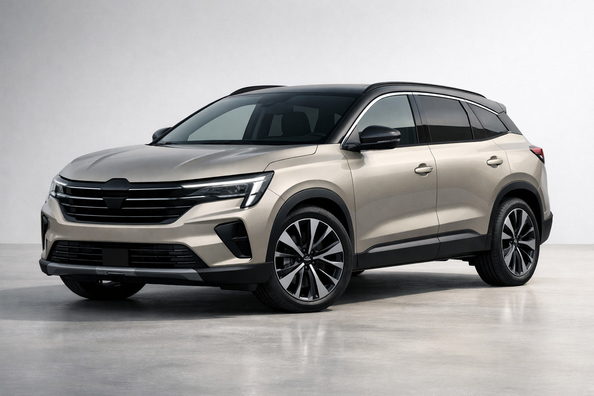
Renault Symbioz is a family crossover for those who find the Captur a bit too small, while the Austral is still too big or more expensive than necessary. The idea is simple: compact exterior dimensions, a proper trunk, a hybrid powertrain, and a focus on everyday convenience rather than off-road ambitions.
For the buyer, it’s important to understand that Symbioz isn’t trying to be a separate “big SUV.” It’s more of a practical urban and suburban car for a family of 3–4 people who value efficiency, easy parking, and a flexible interior. If you need all-wheel drive, strong towing pull, or truly harsh use on bad roads, this isn’t that format.
Symbioz enters a very crowded family crossover segment. Its position is clear: more space and practicality than the Captur, but smaller and less status-oriented than the Austral. For Renault, it’s an attempt to cover the “one car for everything” demand without stepping up into a bigger and heavier class.
The model’s strong point is balance. It doesn’t feel bulky in the city, yet it already delivers noticeably more usefulness for family trips, kids’ stuff, shopping, and weekend luggage. It won’t suit those who expect a crossover to have the character of a true off-roader or want a wider choice of powertrain versions.
The production Renault Symbioz debuted in 2024, and at this point we’re talking about the first generation of the model. This is an important nuance: the history is short, so it’s still too early to look for “time-tested” pre-facelift and facelift versions.
The name Symbioz had previously appeared at Renault on a concept, but the production car is a different story. Essentially, the current model is built around a brand-familiar logic: take a compact platform, add more cabin and cargo space, and make the car as convenient as possible for everyday use.
At launch, the production Symbioz came with the confirmed E-Tech 145 full-hybrid system. The base is a 1.6-liter gasoline engine paired with electric motors; total system output is 145 hp. This isn’t about sporty acceleration, but about quiet urban driving, smooth initial pickup, and lower fuel use in stop-and-go traffic.
The gearbox is a multi-mode automatic transmission, with front-wheel drive. For the buyer, that means a simple thing: Symbioz feels better in the city and in mixed driving than on constant high-speed highway runs with a full load. If Renault later expands the lineup for specific markets, it’s worth checking the exact version.
| Technical parameter | What to know |
|---|---|
| Years of production | from 2024 |
| Generation | 1st generation |
| Powertrain | 1.6-liter gasoline full hybrid |
| Total power | 145 hp |
| Transmission | multi-mode automatic |
| Drive | front-wheel drive |
| Length | about 4410 mm |
| Wheelbase | about 2640 mm |
| Ground clearance | about 169 mm, depending on version |
| Trunk volume | approximately 492–624 L depending on rear bench position |
Dimension-wise, Symbioz hits a very practical sweet spot: it’s already noticeably roomier than typical urban crossovers, but it still doesn’t create problems in courtyards and parking lots. A length of about 4.41 m provides a solid space reserve for the second row and the trunk, and the wheelbase of roughly 2.64 m supports seating comfort.
Ground clearance is enough for curbs, winter ruts, and rough courtyards, but it’s not something to overestimate. The suspension is tuned for asphalt and everyday driving, not for serious off-road use. You can feel that in the body geometry and the car’s overall philosophy: maximum everyday usefulness, minimum off-road posturing.
Inside, the main focus isn’t flashy details, but smart space organization. The sliding rear bench lets you choose between more passenger room and a larger trunk, and the seating position is typically crossover-like: higher, more convenient for the city, and easier for daily in-and-out.
In terms of equipment, Symbioz aims toward Renault’s higher models, but the exact set depends on the trim. Depending on the version, you may get modern infotainment, driver assistance systems, cameras, parking sensors, adaptive cruise, and extended active safety features. For a family car, that matters more than decorative elements: less fatigue on the road and an easier life in dense traffic.
In day-to-day life, Symbioz is strongest where the car constantly brakes, pulls away, and runs short or medium routes. That’s where the hybrid setup makes the most sense: calm responses, a more efficient urban cycle, and a light feel in traffic jams. For a family, it also means a quieter city driving mode and fewer annoying little things in daily use.
The compromises are obvious too. Front-wheel drive and ground clearance don’t make it a car for muddy country tracks after heavy rain, and 145 hp is an adequate but not exciting level of pull. If your scenario is city, suburbs, child seats, shopping, suitcases, and occasional highway trips, Symbioz fits well. If you need powertrain versatility or heavy-duty use, it’s better to look at a different class.
From an owner’s point of view, Symbioz is interesting because almost all of its advantages are felt every day, not only in a brochure. But the downsides are practical too: not about emotions, but about scenarios where the model’s capabilities start to fall short.
| Pros | Cons |
|---|---|
| The hybrid system is well suited for the city and mixed driving | At launch, the choice of powertrain versions is limited |
| A very well-judged format for a family without moving up a class | No all-wheel drive |
| Practical trunk and sliding rear bench | Performance is adequate, but without a reserve for an aggressive driving style |
| Modern comfort and safety package | New model: some accessories don’t appear right away |
| Compact exterior dimensions for everyday parking | Not designed for rough roads and serious off-road use |
If you look at it from the owner’s perspective, the main plus is the lack of excess. The car isn’t too big, isn’t too complicated in terms of how you use it, and is genuinely useful in everyday family life. The main minus is narrow specialization: it’s a crossover for normal asphalt life, not an all-purpose vehicle for every possible case.
For Symbioz, tuning makes sense primarily as protection and practical add-ons. The first things typically needed are floor mats for the cabin and trunk, trunk sill protection, mud flaps, trunk organization, and roof crossbars. These items truly reduce wear and add convenience, whereas random décor on a new model often provides less benefit than it seems.
Since the model is fresh, the range for it usually expands gradually. So the practical approach is simple: first look for specific items for Symbioz, and if they aren’t yet grouped into separate categories, check brand pages and related materials to see which accessories are actually appropriate for a family crossover.
Renault Symbioz is a smart option for a family that needs a modern crossover without extra weight, extra size, and extra daily running costs. Its strength lies in practicality, hybrid logic, and a well-judged format between a city car and a family car. Its limits are just as honest: no all-wheel drive, no sporty ambitions, and no claim to serious off-road capability.
If you assess the model realistically, Symbioz suits those who want a comfortable family car for every day, not an all-purpose vehicle “for all roles at once.” The material is based on real selection experience, practice, and real usage scenarios, so the main takeaway is simple: in its format, Symbioz looks stronger than many competitors precisely when it’s bought for the right tasks.
| ✔ | The E-Tech 145 hybrid system is well suited to city driving and mixed trips: in traffic jams and on short routes, it should be more economical and quieter than a conventional petrol version. |
| ✔ | The car’s format is a good fit for a family of 3–4 people: it is compact on the outside, but offers a decent boot and more space than the Captur. |
| ✔ | The sliding rear bench adds practicality, as it lets you quickly choose between more room for passengers and a larger cargo area. |
| ✔ | The dimensions and ground clearance are sufficient for everyday city use: the Symbioz does not look bulky, is easy to park, and is well suited to curbs and rough courtyards. |
| ✔ | Depending on the trim, useful modern systems are available — multimedia, cameras, parking sensors, adaptive cruise control and safety assistants, which make everyday use easier. |
| ✘ | At launch, the model has a limited choice of powertrain versions, so buyers cannot yet choose from many technical options. |
| ✘ | There is no all-wheel drive, so the Symbioz is not suitable for those who need better off-road ability or confidence on difficult surfaces. |
| ✘ | 145 hp is enough for relaxed driving, but without a reserve for an active style or confident overtaking when fully loaded. |
| ✘ | The model is not designed for rough roads or serious off-road use, so it is not the best choice for country tracks or heavy-duty operation. |
Shipping to EU
Wholesale and retail
Own warehouse
Опис продукту
Подарунки не надаються при оформленні покупки у кредит під 0,01% або при покупці частинами.