 Author: Radomskyi Maksym Vasyliovych
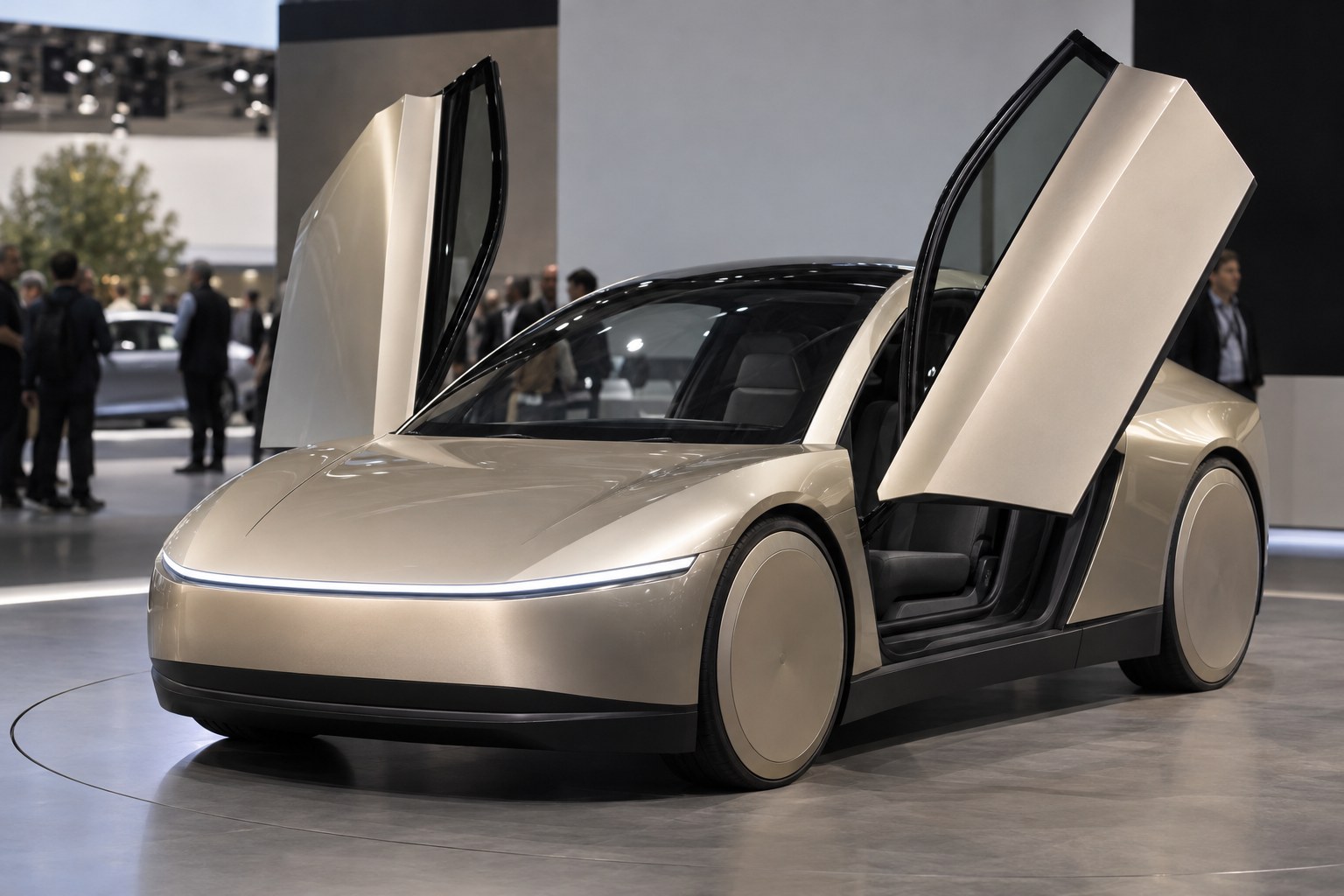
Tesla will bring the Cybercab robotaxi to the Paris Motor Show (Mondial de l'Auto), which runs October 12–18, 2026 at Paris Expo Porte de Versailles. It is a two-seat electric vehicle without a steering wheel or pedals, mass-produced in Texas since April 2026, and since September 4 it has been carrying paying passengers in Austin. Tesla has not announced sales in Europe or operation of the service in the EU: there is no approval for such vehicles here yet, and the vote on European approval even for regular FSD (Supervised) has been postponed until at least December.
What Tesla will show at the Paris Motor Show
The organizer of the exhibition reported Cybercab's participation. Mondial director Serge Gachot said in a Bloomberg interview on October 6 that visitors will be able to test-drive six other Tesla vehicles with the Full Self-Driving system, but they will not be able to ride in the Cybercab itself: it has no steering wheel or pedals, and there is no permit for driverless driving in France either.
According to Drive Tesla Canada, Tesla is taking stand C25 in hall 7.1. Next to the Cybercab will be the Model 3 and Model Y, the humanoid robot Optimus, Tesla Energy storage units, and a Supercharger charging station. The same outlet writes that Tesla is bringing to Paris not a mock-up but a vehicle from the operating U.S. robotaxi fleet.
Strictly speaking, the Cybercab has already been seen in Europe: in November–December 2024 the concept was displayed in Tesla showrooms in Berlin, Paris, and London. But back then it was an exhibition prototype, while at Mondial 2026 the model will be shown for the first time at a major European motor show as a production car. We wrote about other premieres of the show in the article “Paris Motor Show 2026: dates and main premieres”.
What is known about the production Cybercab
Tesla unveiled the Cybercab on October 10, 2024 at the We, Robot presentation at Warner Bros. Studio in Burbank (California). The first production unit was assembled at the Giga Texas plant near Austin in February 2026, and full-scale production started in April. This is Tesla's first model built using the unboxed method: the body is assembled from large modules that already contain internal equipment, rather than moving a single body through the entire line. Tesla promised this would make the assembly line twice as short.
On September 3, 2026 Tesla held a closed presentation in Austin, and on September 4 the Cybercab began carrying paying passengers as part of the Robotaxi service, which since June 2025 had been operating with the Model Y. The fleet is still small: according to Texas registries, by early September about 45 Cybercab vehicles were cleared for commercial перевозки.
The specifications are known from documents Tesla submitted to the U.S. Environmental Protection Agency (EPA):
| Parameter | Tesla Cybercab |
|---|---|
| Seats | 2 |
| Drivetrain | front-wheel drive, one electric motor 163 kW (219 hp) |
| Battery | 47.6 kWh |
| Range (preliminary EPA estimate) | about 472 km (293 miles) |
| Energy consumption | about 10.3 kWh per 100 km (165 Wh per mile) |
| Curb weight | 1,412 kg |
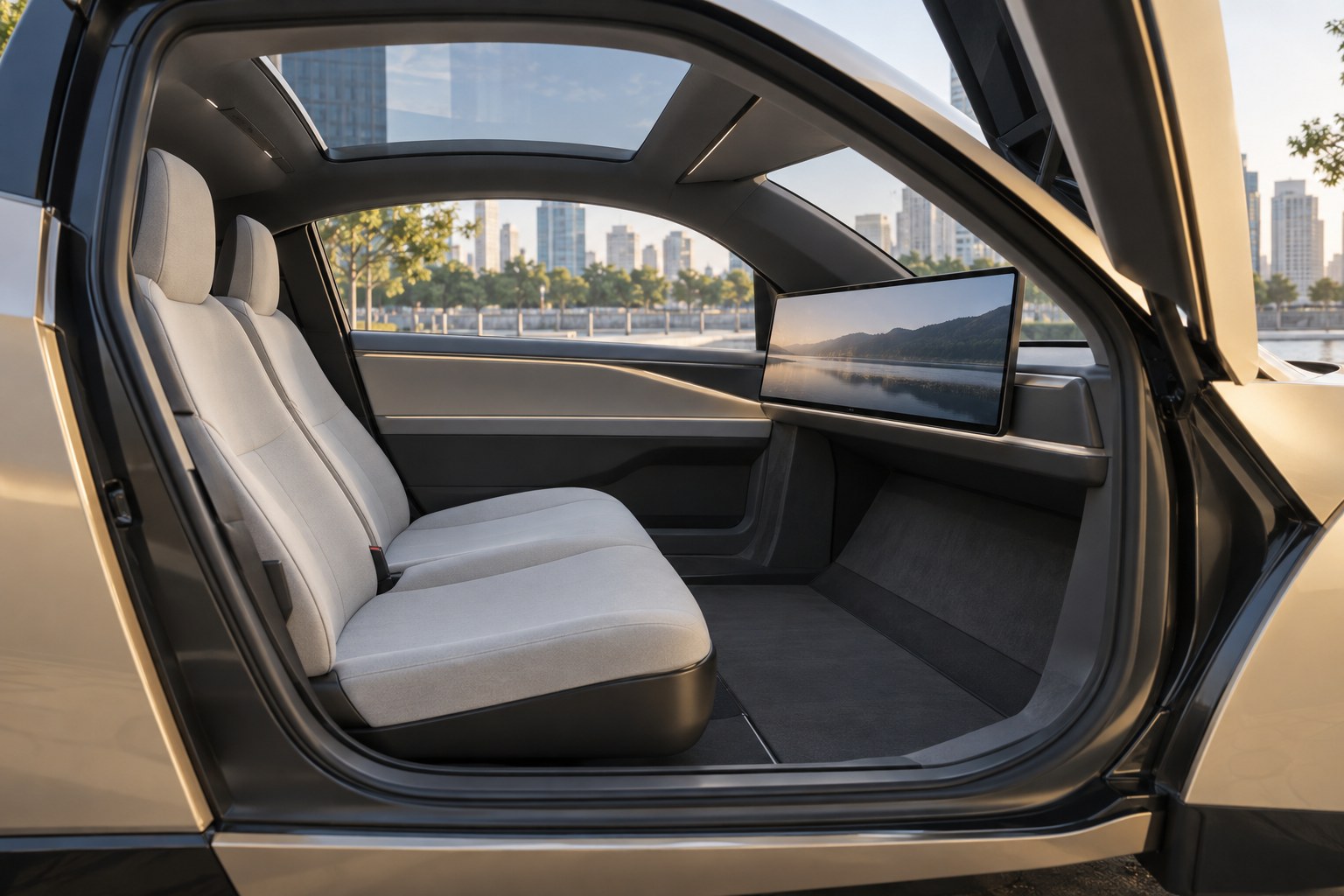
| Controls | no steering wheel, pedals, or side mirrors |
| Sensors | cameras only, without lidar and radar |
| Doors | two, open upward |
| Charging | a hidden NACS connector for DC fast charging; wireless charging is stated as a future feature for fleets |
The Cybercab is not sold to private buyers: it is a vehicle for the robotaxi service. According to the press, Tesla is considering selling such cars to third-party taxi fleet operators. The vehicle also has issues at home: in September 2026 the U.S. traffic safety regulator NHTSA began checking how Tesla self-certified the Cybercab for compliance with federal safety standards written for driver-operated vehicles.
Will Cybercab be allowed in the European Union
Here it is necessary to distinguish between two different stories. The first is the FSD (Supervised) system, i.e., the “autopilot” on regular Teslas that the driver monitors. On April 10, 2026 the Dutch regulator RDW issued it a temporary permit under Article 39 of EU Regulation 2018/858 (for new technologies not yet described by the rules). As of the end of September, it had been recognized by seven countries: the Netherlands, Belgium, Czechia, Denmark, Lithuania, Estonia, and Slovenia—together about 12% of the EU population. France, Germany, Italy, and Spain have not joined yet.
For the permit to apply across the entire EU, a qualified majority is needed in the профильный committee TCMV: at least 15 out of 27 countries, with no less than 65% of the population. At the meeting on October 6 the issue was only discussed, without a vote, so the earliest possible vote date is December 2026. According to electrive, Sweden and other Nordic countries have questions about driver attention monitoring and the system's behavior on winter roads, while France has questions about compliance with city speed limits.
The second story is the Cybercab itself, and it is much more complex. There is no driver in it at all, so approval for FSD (Supervised) is not enough for it. Fully automated vehicles in the EU are admitted under a separate Regulation 2022/1426, and it currently allows only small series: no more than 1,500 registrations of one type of vehicle per year across the entire Union. In addition, in Europe an automaker cannot certify a car on its own, as in the U.S.—testing is conducted by an independent technical service, and approval is issued by a national authority. Tesla has announced neither a European city for the Cybercab launch, nor timelines, nor which path it will take to obtain approval.
When Cybercab could appear in Europe and what it means for Ukraine
There is no official date. Some outlets mention 2027 as a possible start for Tesla robotaxis in Europe, but the company itself has not confirmed such plans. A realistic sequence looks like this: first the EU has to decide the fate of FSD (Supervised) for regular cars, then Tesla will have to go through a separate procedure for a vehicle without a steering wheel, and even then the small-series limit will constrain the fleet size. So Paris is a technology demonstration, not the start of sales.
In Ukraine, Tesla does not officially sell cars, so the Cybercab is unlikely to appear here in the coming years. But the Model 3 and Model Y that will stand next to it on the booth are familiar on our roads. What changed in the Model Y after the 2025 update, we covered in the article “Tesla Model Y Juniper 2026: what changed”, and another unusual project of the brand—in the review Tesla Cybertruck. Floor mats, wind deflectors, and other accessories for the Model Y are collected in the Tesla Model Y tuning section.
We deliver via Nova Poshta across Ukraine.