17.09.2026
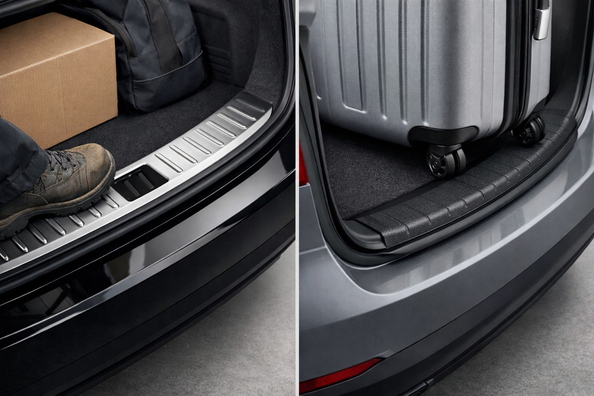

If you need to protect the edge of the trunk opening from scratches during loading, you should look not at the accessory name but at which area it actually covers. For suitcases, boxes, and everyday shopping, a rigid scuff plate on the top surface of the rear bumper is most often more practical; a narrow edge strip makes sense when items really hit the outer edge itself.
Confusion comes from catalogs: a rear bumper protector and a bumper edge protector are often listed in the same product group. In practice, the difference is made by coverage width, model-specific accuracy, the mounting method, and whether you only need to protect the paint on the edge or also want to shield the trunk from dirt, a dog, or bulky cargo.
The choice is simple: where exactly do your scratches appear. If cargo slides across the top of the bumper, a narrow edge strip won’t solve the problem fully. If the main marks are right on the break line of the edge, a wide protector may be unnecessary extra coverage.
So it’s more correct to think in terms of tasks, not names. There’s protection for the visible edge, there’s protection for the whole loading zone, and there’s a combined option where the bumper is covered separately and the trunk floor and seatbacks are covered separately.
Another important point: in this topic, you shouldn’t buy “universal” instead of compatible. For trunk protection, it’s critical that the accessory follows the radii of your exact bumper; otherwise the weak spot will be either along the edge or at the joints.
| Option | Strengths | Weaknesses | Who it’s for |
|---|---|---|---|
| Wide protector for the top surface of the rear bumper | Covers the main contact zone during loading, doesn’t require daily unfolding, usually easy to clean | Doesn’t protect the trunk floor and seatbacks, sensitive to installation quality | For those who often carry suitcases, boxes, bags, a stroller |
| Narrow bumper edge protector | Neat look, protects the edge itself, often less visually noticeable | May not cover the top surface; sometimes too small for real cargo abrasion | For those whose scratches appear right on the edge break, not higher up |
| Trunk mat with bumper flap | Maximum coverage, works better with dirt, moisture, a dog, and equipment | More expensive, needs unfolding; a separate flap without a mat doesn’t cover the floor and seatbacks | For families, crossover owners, and those who often carry dirty or bulky cargo |
DD Tuning expert comment: most often people buy a protector by its name, not by a photo of the coverage area, and end up protecting the wrong place where the body actually gets scratched. The second common mistake is sticking the part on in the cold or actively loading the trunk right after installation. If you need a quiet and long-lasting result, not only the material matters but also the exact shape and correct installation.
This is the simplest way to protect the exact area where bags, boxes, and suitcases are most often dragged. On the market there are rigid low-profile options about 3 mm thick that are applied without drilling. If the shape is precise, such a protector doesn’t interfere with closing the trunk, tolerates regular washing, and requires no actions from the driver before loading.
There’s one weak point here: installation. Adhesive mounting likes a clean surface, warmth, and time to fully cure—sometimes up to three days. If you stick it onto a cold bumper or start rubbing heavy items over it right away, service life drops sharply.
This option is often chosen for its neat appearance: it covers the edge itself and doesn’t take up much area. This is especially noticeable with stainless or decorative-protective strips, when the owner wants not only to protect the paint but also not to overload the car’s exterior.
But this is where the risk of buying the wrong thing is highest. If cargo rubs on the upper horizontal part of the bumper, a narrow edge strip will be insufficient. Service life is decent only with accurate geometry; on a complex radius, a poor fit starts lifting sooner, and the benefit is less than expected.
This is no longer just edge protection, but a system for those who really use the trunk. The flap folds outward when the tailgate is open and takes the contact from a dog, dirty gear, stroller wheels, or crates. If it comes with a full mat, then the floor is protected too and, depending on the kit, the seatbacks as well.
The downsides are practical too. A separate flap on its own doesn’t replace a mat, and a full set is noticeably more expensive than a standard protector. Also, not everyone likes unfolding and folding protection every day, and after wet or dirty use it dries longer than a rigid protector.
| Parameter | Rigid protector | Edge protector | Mat with flap |
|---|---|---|---|
| Installation | Easy, but demanding about temperature and cleanliness | Also easy, especially if it’s an adhesive solution | More complex due to larger area and kit elements |
| Noise | Minimal with proper fit | Minimal if the part fits tightly | May be higher due to the movable flap |
| Service life | High with correct installation | Depends on geometric accuracy | Depends on folding frequency and moisture |
| Practicality | High for everyday use | High if the problem is local | Highest for dirt, pets, and bulky cargo |
| Price | Mid-range | Mid-range or lower | Higher due to coverage area and kit |
For city use and daily routine, a rigid protector for the top surface of the bumper usually wins. It covers the main risk zone, doesn’t add hassle, and doesn’t require a separate ritual before each trunk opening.
A bumper edge protector is justified when you clearly see the damage pattern: the marks run right on the edge break, and the top surface is almost intact. Then a narrow strip can look cleaner and do exactly what’s needed.
If the trunk is used in “dog, sled, fishing, stroller, tools, or small business” mode, a separate protector solves only half the task. In this scenario, either a full mat with a flap makes sense, or a combination of a bumper protector and a trunk mat.
| Scenario | Best choice | Why |
|---|---|---|
| Daily bags, suitcases, boxes | Rigid protector for the top surface of the bumper | This zone most often rubs during normal loading |
| Scratches only on the very edge | Bumper edge protector | You don’t overpay for extra area if the issue is local |
| A dog jumps into the trunk | Trunk mat with bumper flap | You need protection not only for the edge, but also for the floor from fur, paws, and dirt |
| Dirty gear, stroller, equipment | Trunk mat with flap or a combination of a mat and a rigid protector | The bumper edge isn’t the only contact zone here |
| You want the least noticeable protection | A precisely fitted narrow edge protector | Less visual impact, but only if the geometry truly matches your car |
A pricier solution is justified in two cases. First—when the car is loaded often and you want to keep the painted bumper free of marks from boxes and suitcases: then it makes sense to look at rear bumper protectors with a precise, model-specific fit. Second—when you need to cover not only the edge but the trunk itself: then it’s logical to combine bumper protection with rubber trunk mats.
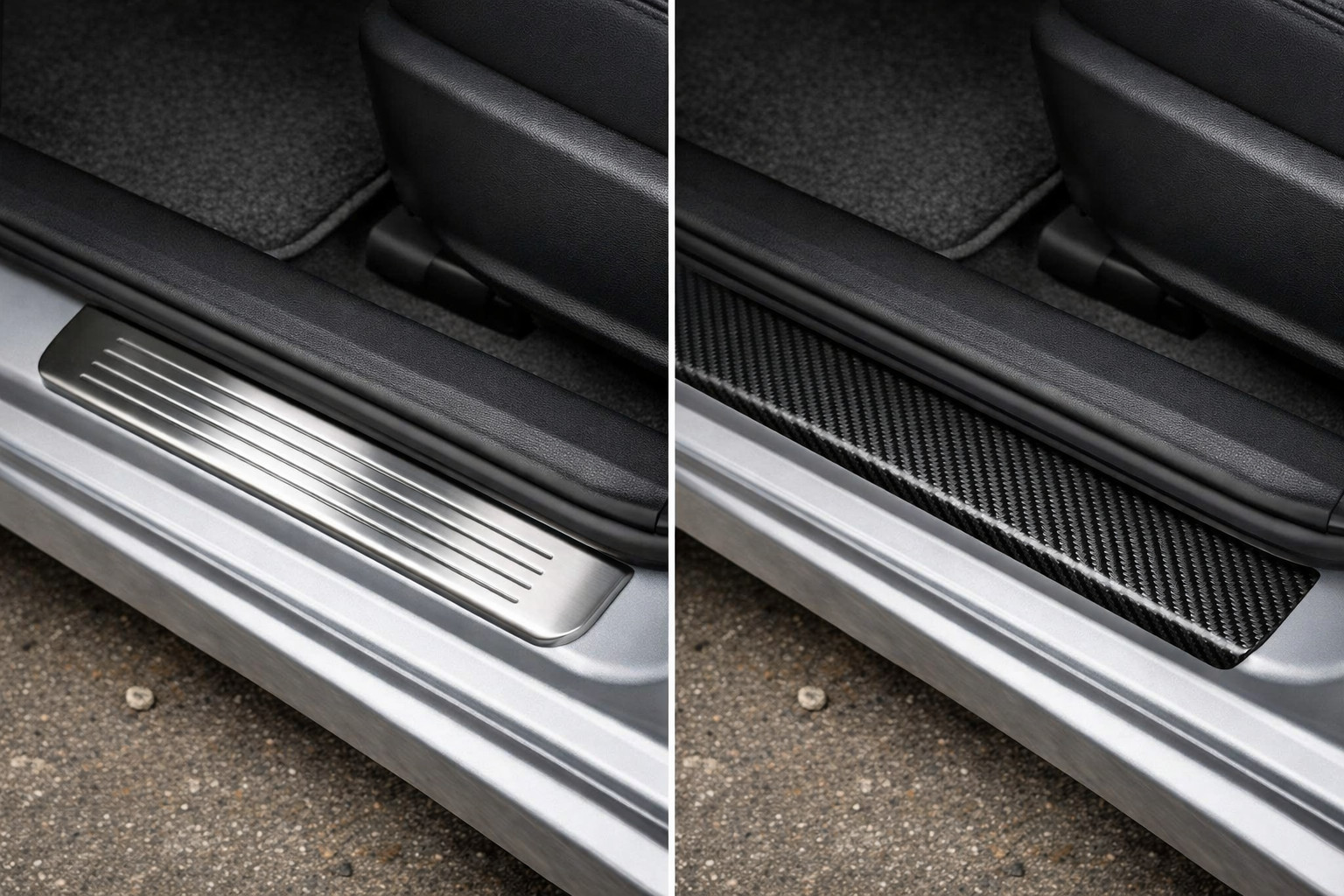
Separately, a more expensive option makes sense if scratches appear not only on the bumper but also on the lower edge of the trunk opening. In that case, people also look at a stainless trunk edge trim, but this is an add-on to protection, not a replacement.
| What people choose in the higher segment | What you pay extra for | When it’s justified |
|---|---|---|
| Model-specific rigid protector | Precise fit, neat appearance, easy installation | When daily protection matters without extra steps |
| Full mat with flap | Maximum coverage of the trunk, seatbacks, and edge | When transporting dirty or bulky cargo, pets, equipment |
| Combined set | Covers several zones at once | When one part no longer solves the problem completely |
From a customer’s experience: a crossover owner first looked for a narrow metal strip because he thought only the bumper edge was getting damaged. After clarifying the use case, it turned out a stroller and bags go into the trunk every day, and on weekends they also carry a dog. As a result, he chose a rigid bumper protector together with a trunk mat and was happy that there’s no need to unfold anything before each load, and dirt doesn’t travel further into the cabin.
In short, for most drivers it’s more practical not to look for magic in the name, but to choose protection that covers the real contact area. In most everyday scenarios, a rigid protector for the top surface of the rear bumper wins; an edge protector is needed when the damage is localized right on the edge; a full mat with a flap is justified for dogs, dirty equipment, and regular heavy loading.
The key to a good choice is one: check not only the name, but also the photos, coverage area, compatibility with your model, and installation conditions. Then trunk protection won’t be just “something,” but exactly what actually works in your scenario.
| ✔ | The rigid trim on the upper surface of the rear bumper covers exactly the area that gets scratched most often when loading suitcases, boxes, and bags. It does not need to be unfolded every time before using the trunk. |
| ✔ | The bumper edge trim takes up very little space and looks neat, so it works well when you only need to protect the edge itself without noticeably affecting the car’s appearance. |
| ✔ | A trunk mat with a flap provides the most coverage: it protects not only the edge but also the trunk floor, and in the set — the seat backs as well. This is useful for dogs, dirty gear, and bulky cargo. |
| ✔ | Properly fitted rigid model-specific trims have a longer service life and usually withstand regular washing well. For everyday city use, this is a practical solution. |
| ✔ | Most options are installed with adhesive tape without drilling, so installation can be done without affecting the body. This makes fitting easier compared with more complex solutions. |
| ✘ | Adhesive mounting depends heavily on installation conditions: the surface must be clean, the plastic warm, and time is needed for full bonding. If applied in cold weather or the trunk is loaded right away, the part may peel off sooner. |
| ✘ | A narrow edge trim does not solve the problem if the cargo rubs against the upper horizontal surface of the bumper. In that case, the protection may be too limited. |
| ✘ | A trunk mat with a flap is more expensive than a regular trim and requires more steps to use: it has to be spread out and folded back. After wet or dirty use, it also takes longer to dry. |
| ✘ | A separate flap without a full mat does not cover the trunk floor or the seat backs. In other words, it is not universal protection, but only a solution for part of the loading area. |
Shipping to EU
Wholesale and retail
Own warehouse
Опис продукту
Подарунки не надаються при оформленні покупки у кредит під 0,01% або при покупці частинами.