11.04.2026
472
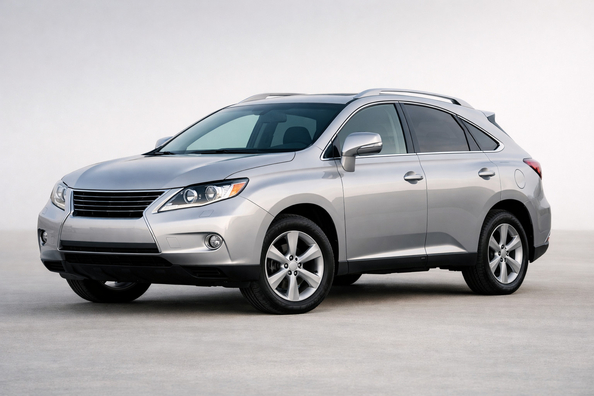

Lexus RX 2009-2015 is a crossover for those who put quietness, ride smoothness, and calm day-to-day use first. There’s no sporty character or serious off-road ambition here, but you do get a comfortable driving position, a large trunk, and a very straightforward family premium-car format.
An important nuance: the 2009 model year still belongs to the second generation, while 2010-2015 are already the third. So engine, transmission, and dimension figures shouldn’t be mixed without a disclaimer: within this period the RX changed noticeably in technical terms, even though its role in the market stayed the same.
In its day, the RX was one of the strongest choices for a buyer who wanted not a “driver’s” crossover, but a calm, quiet, and genuinely premium-feeling daily car. It suits those who drive a lot in the city, regularly go on the highway, and don’t want to put up with a harsh suspension or a noisy cabin.
Who the RX fits best: families with one or two kids, drivers who value comfort over excitement, and anyone who wants a premium crossover without edgy, nervous handling. Who it won’t suit: those looking for sharp steering, minimal fuel consumption from the gasoline version, or space on the level of a large seven-seater.
Within this topic, we’re essentially talking about two different RXs. The 2009 version is still the second generation: slightly more compact, with a 5-speed automatic transmission and an older architecture. From 2010, the third generation begins, where the body became larger, the interior more modern, and the model shifted even further toward everyday comfort.
For the third generation, two main lines remained: the gasoline RX 350 and the hybrid RX 450h. Later, the RX 350 F SPORT appeared, but even there the focus isn’t on pure sportiness, but rather a more aggressive look and firmer tuning.
The choice logic here is simple. The RX 350 is chosen for the smooth pull of a naturally aspirated V6 and predictable behavior, the RX 450h for the same comfort but with noticeably lower official fuel consumption. At the same time, RX 350 power depends on year and market, so you need to look at the specific car, not an averaged number from listings.
| Version | Powertrain | Output | Transmission or layout | Practical character |
|---|---|---|---|---|
| RX 350 2009 | 3.5 L V6 | 270 hp, 341 N·m | 5-speed automatic | A calm, torquey option, but with an older transmission |
| RX 350 2010 | 3.5 L V6 | 275 hp, 347 N·m | 6-speed automatic | A noticeably more modern step after the generation change |
| RX 350 2012-2015 | 3.5 L V6 | 270 hp, 336 N·m | 6-speed automatic, in F SPORT 2013-2015 — 8-speed | The most common gasoline RX for everyday use |
| RX 450h 2010-2015 | 3.5 L V6 Atkinson cycle plus electric motors | 295 hp combined | Hybrid layout; in AWD the rear axle is driven by a separate electric motor | The most interesting for the city if efficiency matters without losing comfort |
In real life the RX 350 doesn’t feel slow, but it also doesn’t encourage aggressive driving. For 2009, the official combined consumption was 10.9 L/100 km, and for later RX 350s you should expect an even bigger appetite, especially in city driving. The RX 450h looks more convincing precisely in everyday use: depending on the version and measurement method, official figures sit roughly in the 7.4-8.5 L/100 km range.
The third generation became noticeably more grown-up in proportions. For later cars, length is 4770 mm, width — 1885 mm, wheelbase — 2740 mm, height — 1695 mm without roof rails or 1720 mm with roof rails. On the RX 350 2009, width is 1845 mm and wheelbase is 2715 mm, meaning it’s a slightly more compact crossover.
| Parameter | RX 350 2009 | RX 350 2015 | RX 450h 2015 |
|---|---|---|---|
| Width | 1845 mm | 1885 mm | 1885 mm |
| Wheelbase | 2715 mm | 2740 mm | 2740 mm |
| Ground clearance | 180 mm | 185 mm | 175 mm |
| Turning radius | 11.4 m | 11.8 m | 11.4 m |
| Trunk behind the second row | 1080 L | 1132 L | 1132 L |
| Trunk with the second row folded | 2400 L | 2273 L | 2273 L |
In terms of suspension and tuning, the RX is clearly focused on comfort. In the RX 350, the AWD system works via electronically controlled torque distribution between the axles from 100:0 to 50:50. Ground clearance of 175-185 mm is enough for city curbs, snow, and rough asphalt, but this is not a vehicle for serious off-roading or regular driving in deep ruts.
The RX interior ages well not because of its décor, but thanks to solid basic ergonomics. The seating position is comfortable, there’s not much noise, and there’s enough space both up front and in the second row. In the later RX 350, front legroom is 1096 mm and rear is 934 mm; in the RX 450h there’s a bit more for rear passengers — 942 mm.
For everyday life, something else matters: the rear seats have a 60/40 backrest, slide and recline, the trunk is convenient, and by 2015 there was already a rear-view camera and a 12-speaker audio system. In terms of feel, the RX wins not by a single option, but by the overall level of quietness and ride softness that owners typically mention first.
In the city, the RX is convenient thanks to the high seating position, good visibility, and a turning radius that’s small for the class. On the highway, its strong point is calm stability and quietness, not driver-focused эмоции. If you need a vehicle that doesn’t wear you out day to day, the RX works exactly like that.
Before buying a used car, service history and campaign records matter more than decorative options. For early RX 350s, you should check issues related to the oil hose or the oil cooler for the variable valve timing system; for RX 450h 2010-2012, check the history of work on the brake booster and pump. If towing matters, later versions allow up to 1587 kg, and the fuel tank in the RX 350 is larger than in the RX 450h.
From an owner’s perspective, the RX is valuable because it does almost everything a bit right: it isn’t noisy, it isn’t harsh, it doesn’t require getting used to, and it works well for family life. But for the same reason, its weaknesses are also very practical: fuel consumption in the RX 350, unemotional steering, and a few known service нюances in the early years.
| Pros | Cons |
|---|---|
| Quiet cabin and soft suspension, so the car doesn’t tire you out in the city or on the highway | The RX 350 uses noticeably more fuel than you’d want from a daily crossover |
| Large, practical trunk suitable for family trips and everyday tasks | Handling is tuned for comfort, not an active driving style |
| Strong reputation for reliability and high owner trust | On early model years, you need to carefully check the service campaign history |
| The RX 450h delivers noticeably better efficiency without losing the comfort feel | For a large family, the cabin and second row may not feel as spacious anymore |
| AWD and maneuverability make the model convenient in winter and in dense city traffic | F SPORT doesn’t turn the RX into a sporty crossover, and the ride may become firmer |
For the RX, practical rather than decorative tuning makes sense. This model is valued for comfort, so accessories are better chosen for everyday tasks: keeping the interior clean, protecting the lower body, and reducing signs of daily wear. On the accessories page for Lexus RX 2009-2015, it makes sense to start with exactly these kinds of items.
Lexus RX 2009-2015 is one of the best options for those who don’t need a sharp-edged, but a truly comfortable premium crossover for everyday use. The RX 350 is worth choosing if you want a familiar naturally aspirated V6 and simple ownership logic, and the RX 450h if city efficiency and an even calmer character are the priority.
The key is to clearly separate 2009 from 2010-2015, not mix their specifications, and carefully check the service history of the specific vehicle. This material is based on real selection experience, hands-on practice, and real usage scenarios, so the conclusion is simple: the RX is genuinely good when it’s chosen for comfort, quietness, and everyday convenience.
| ✔ | A quiet cabin and soft suspension make the RX comfortable for daily city and highway driving. The car doesn’t tire you out with noise or stiffness, even on long trips. |
| ✔ | A large trunk and a comfortable second row work well for family trips and everyday errands. The rear seat backrests are 60/40, and they also slide and recline. |
| ✔ | The RX 450h offers noticeably better fuel economy without sacrificing comfort. This is especially noticeable in city driving, where the hybrid makes the most sense. |
| ✔ | The high seating position, good visibility, and a turning radius that’s small for the class make maneuvering in dense city traffic easier. All-wheel drive also adds confidence in winter. |
| ✔ | The cabin is well thought out in terms of ergonomics and noise levels. Even in used cars, this is an important advantage, because the interior ages mainly functionally rather than just visually. |
| ✘ | The RX 350 uses noticeably more fuel than you’d want from a daily crossover. In the city, its appetite is especially noticeable. |
| ✘ | The handling is tuned for comfort rather than an active driving style. Those who want sharp steering and more excitement may find the RX too calm. |
| ✘ | The early production years have known service-related quirks, so the service history should be checked carefully before buying. This applies to both early RX 350 and RX 450h 2010-2012. |
| ✘ | For a large family, the cabin and second row may no longer feel as spacious as you’d want from a crossover of this class. The RX is more focused on comfort for four to five people, rather than maximum space. |
Shipping to EU
Wholesale and retail
Own warehouse
Опис продукту
Подарунки не надаються при оформленні покупки у кредит під 0,01% або при покупці частинами.