02.04.2026
270
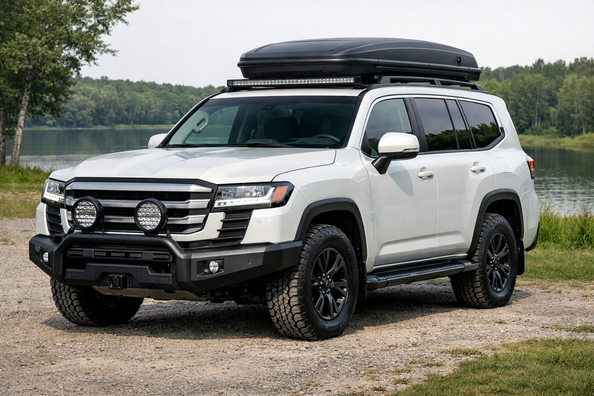

The Toyota Land Cruiser 300 comes from the factory with a healthy reserve in pulling power, luggage capacity, and capability, so for a practical upgrade scenario without heavy off-road overloading, there’s no need to start with a winch, a steel bumper, or a suspension lift. It’s more sensible to first address what genuinely improves daily driving, trips with gear, and light runs on dirt.
In this scenario, the key is not to ruin the LC300’s strengths with unnecessary steel. The best sequence is: tires and pressure, cabin and cargo protection, towing equipment, and only then the items you actually need for your specific type of trips—not “just in case.”
The point of this refinement is simple: make the LC300 more comfortable for everyday use, long-distance travel, towing, and light off-road driving, without turning it into a heavy expedition build. For this model, that’s especially logical because the base is already very strong: a 3.3-liter V6 twin-turbo, 10-speed automatic transmission, four-wheel drive, a 110 L fuel tank, and towing up to 3500 kg.
It’s important not to mix up use cases. If your vehicle does asphalt, highways, country house trips, dirt roads, a trailer, and occasional sand, you don’t need “combat” tuning—you need a well-chosen set of useful items. Any extra weight quickly eats into payload, and on the LC300 it already depends on the version and isn’t unlimited.
The first stage should solve basic everyday and road tasks. The best starting point is the right tires for your driving pattern and proper pressure control, because they have the biggest impact on noise, grip, comfort, and fuel consumption. Next should come the items that protect the cabin and cargo area from mud, sand, and wet gear.
The third must-have block is a towing kit and related components, if a trailer isn’t an occasional thing for you but a regular task. Toyota’s official approach here is pragmatic: towing equipment first, everything else after. For the LC300, that makes sense because the vehicle already has a strong towing reserve from the factory.
| Upgrade | Why it’s needed | Who really benefits |
|---|---|---|
| Tires for your use case | Better road contact, less noise, more predictable behavior on dirt and asphalt | Those who drive daily, on highways, in mixed conditions, or occasionally go onto dirt roads |
| Tire pressure monitoring/control | Helps adapt the vehicle to load, sand, or asphalt | Those who change driving conditions and want stability without extra tuning |
| Rubber floor mats and cabin protection | Makes cleanup easier after mud, water, sand, and gear | Families, travelers, anyone who carries kids, pets, or outdoor equipment |
| Cargo organizer and cargo area protection | Keeps cargo in order and reduces wear in the luggage compartment | Those who often carry items, tools, or wet gear |
| Towing kit and trailer wiring | Safe, OEM-style towing | Those who regularly tow a trailer, boat, or camper |
The second stage is no longer basic hygiene—it’s reinforcement for specific routes. If you often travel far or take a lot of gear, then roof solutions, a cargo barrier, additional cargo-area protection, and, if needed, rear bumper protection become logical. But a roof platform only makes sense when the cargo truly doesn’t fit inside or you need to free up cabin space.
For sand, dust, and rough dirt roads, you can consider underbody protection, recovery points, and other items—but these are no longer universal must-haves. If the vehicle doesn’t see those conditions regularly, these positions tend to weigh down the budget and add mass more than they deliver noticeable benefits.
Some accessories don’t make the LC300 more practical—they only change how it feels. This includes items that improve ease of entry, appearance, or minor day-to-day ergonomics, but don’t solve a real transportation task. If the budget is limited, these purchases should go last.
The same goes for heavy-duty exterior armor: it can be useful in serious off-road conditions, but for an urban or mixed-use scenario it often just adds weight, loads the front axle, and can even complicate the operation of factory cameras and visibility systems. In other words, it’s not an “upgrade by default,” but a decision for very specific use.
A common mistake is buying accessories for the vehicle’s image rather than your actual route. Most often, people overpay for a suspension lift, aggressive tires, a steel bumper, a winch, light bars, and heavy roof constructions, even though the vehicle is driven mostly on asphalt or for light trips outside the city. In that mode, it’s not help—it’s extra weight, noise, and fuel consumption.
The second mistake is choosing what looks good in a catalog or on someone else’s vehicle, but doesn’t fit your exact trim. On the LC300, some accessories depend on the version, and certain solutions need to be checked separately for GX, GXL, VX, Sahara, or another specification. The third mistake is installing “combat” items before the basics: without proper tires and smart loading, even expensive armor doesn’t deliver a practical advantage.
| What to install first | What can be postponed | What isn’t mandatory |
|---|---|---|
| Tires, pressure, rubber mats, cargo protection, organizer, towing kit | Roof platform, cargo barrier, rear bumper protection, additional gear modules | Winch, steel bumper, light bar, snorkel, suspension lift without real need |
| If you often tow a trailer — wiring and the tow ball for your towing format | Expensive aftermarket without verified compatibility | Anything that adds weight just for appearance |
| For sand or dust — underbody protection and recovery points | Expedition armor for rare trips | A setup that eats into payload without daily benefit |
Below is a practical order if the LC300 is used for daily driving, family trips, highways, a trailer, and occasional dirt:
This order delivers the best balance between usefulness, weight, and cost. It doesn’t create unnecessary load on the vehicle and doesn’t make you pay for features that sit idle.
More expensive solutions make sense when they solve a recurring task, not an occasional fantasy. For example, if the LC300 regularly tows a heavy trailer, runs long routes with cargo, or drives where sand and dirt are the norm rather than the exception, then you can consider more specialized solutions. In that case, it’s important to look not only at price but also at compatibility with your specific vehicle version.
To select OEM or compatible solutions, it makes sense to start with accessories for the LC300, and if you specifically need towing or touring components, cross-check them against the official catalog and your trim level. If your use case is closer to trailer travel, focus first on the right towing equipment, not exterior décor.
Put simply: if road driving is 90% of your mileage, don’t buy a setup as if the vehicle goes rock crawling every weekend. But if you’ve already hit real limits in cargo space, weight, or towing, then more expensive solutions are justified—only in targeted areas.
For the Toyota Land Cruiser 300 in a practical upgrade scenario without heavy off-road overloading, the smartest approach is to go from function to aesthetics. Start with tires, pressure, cabin and cargo protection, and a towing kit if you tow a trailer. The second stage is cargo solutions and targeted protection for real routes. Anything heavy, expensive, and flashy that doesn’t have daily use is best postponed.
Quick verdict: the LC300 doesn’t need a “rebuild”—it needs precise fine-tuning for your style of use. If you start the upgrade correctly, the vehicle will remain comfortable, strong-pulling, and practical; if you start with external show, you’ll simply lose payload and money.
| ✔ | Tires matched to the actual driving conditions and pressure monitoring immediately improve grip, noise, and comfort without unnecessary changes to the vehicle’s setup. This is especially useful for mixed use: city, highway, and occasional gravel roads. |
| ✔ | Rubber mats, cabin protection, and cargo-area protection make cleanup easier after mud, water, sand, and wet gear. For family trips and hauling items, this delivers a noticeable practical benefit. |
| ✔ | A towing kit and trailer wiring cover regular towing without improvised solutions. For the LC300, this is a logical upgrade if a trailer or boat is not a one-time thing. |
| ✔ | An organizer or cargo divider helps keep the load in place and reduces wear on the cargo area over time. This is useful if tools, belongings, or wet gear are often carried in the vehicle. |
| ✔ | A step-by-step approach makes it possible not to overload the vehicle with unnecessary hardware and not to spend money on what is not used every day. The vehicle stays closer to its factory behavior, but becomes more practical for everyday use. |
| ✘ | A силовий bumper, winch, snorkel, and suspension lift are mostly unnecessary for this scenario. They add weight, noise, and fuel consumption if the vehicle mainly drives on asphalt and light gravel roads. |
| ✘ | A roof platform and other large cargo solutions make sense only when the standard space is no longer enough. If there is little cargo, this is just extra load and expense. |
| ✘ | Many useful solutions depend on the specific LC300 trim, so not everything can be bought without checking compatibility. This makes selection more difficult and increases the risk of a wrong purchase. |
| ✘ | If heavy or “off-road” accessories are installed first, useful payload can be used up quickly. For a vehicle that already has payload limits, this is a noticeable downside in everyday use. |
Shipping to EU
Wholesale and retail
Own warehouse
Опис продукту
Подарунки не надаються при оформленні покупки у кредит під 0,01% або при покупці частинами.