01.07.2026
566
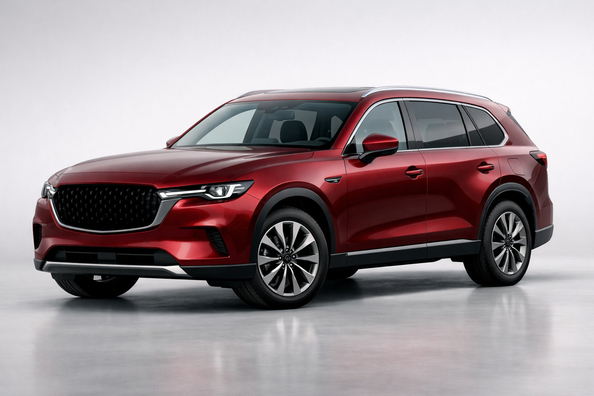

Mazda CX-90 is a large three-row family crossover that focuses less on maximum space and more on driving feel, pulling power, and cabin quality. It’s the brand’s flagship with a longitudinal layout, standard all-wheel drive, and a range of powertrains that are notably more interesting than the typical “naturally aspirated engine plus CVT” setup in this class.
The model’s weak spot is obvious too: the third row and cargo area aren’t class-leading, so the CX-90 is a better fit for people who more often travel with five or six rather than regularly carrying seven adults with luggage. In this review, the key focus is practical benchmarks, without unnecessary noise.
CX-90 is the largest crossover in Mazda’s lineup. In the market it’s usually placed alongside the Kia Telluride, Hyundai Palisade, Honda Pilot, and Toyota Grand Highlander, but it has a different character: Mazda is stronger in handling, chassis feel, and cabin presentation, yet it doesn’t beat competitors on sheer space.
That’s why the model is worth considering if you want a family vehicle with a more “driver-focused” nature and a solid reserve of torque. But if your main criterion is maximum third-row room, a wide cargo opening, and minimal compromises in interior flexibility, the CX-90 won’t be the most practical choice.
The CX-90 debuted in 2023 as a 2024 model and currently exists in its first generation. This isn’t an evolution of an old layout, but Mazda’s new large platform with a longitudinal engine and a rear-drive bias.
Within the current generation there are gasoline versions with a 3.3L turbo inline-six and a plug-in hybrid based on a 2.5-liter engine. Early batches, especially some hybrid vehicles, received mixed feedback due to electronics and service campaigns, so when buying used, checking the specific VIN is important.
Based on confirmed public specifications for the CX-90, the main options are: a 3.3L gasoline inline-six with mild hybrid assistance and a 2.5L plug-in hybrid. All versions have an 8-speed automatic transmission and standard all-wheel drive.
| Version | Powertrain | Power and torque | What matters in real life |
|---|---|---|---|
| 3.3 Turbo | 3.3L turbo inline-six, 48V mild hybrid | 280 hp, 450 N·m | The base gasoline version with strong pull for family trips and highway driving |
| 3.3 Turbo S | 3.3L turbo inline-six, 48V mild hybrid | 340 hp and 500 N·m on higher-octane gasoline, or 319 hp on regular | The better choice if you want performance, passing power, and towing without feeling strained |
| CX-90 PHEV | 2.5L gasoline engine plus 68 kW electric motor, 17.8 kWh battery | 323 hp or 319 hp depending on fuel, 500 N·m | Interesting in the city and on short routes; official electric range is about 43.5 km |
Gasoline versions are officially around 9.4 L/100 km in the combined cycle, though figures may vary slightly by model year. In real driving, a large gasoline CX-90 showed about 9.2 L/100 km on a mixed route, while the plug-in hybrid was around 9.0–9.6 L/100 km depending on mode and trip length.
The CX-90’s strength is its architecture: a longitudinal engine, standard all-wheel drive, a long 3120 mm wheelbase, and a chassis tuned not to feel soft but to provide noticeable body control. For a large family crossover, you feel this in high-speed stability and more precise steering responses.
| Parameter | Value |
|---|---|
| Length | 5100 mm |
| Width | 1994 mm |
| Height | 1740–1745 mm depending on roof rails |
| Wheelbase | 3120 mm |
| Ground clearance | 203–206 mm depending on wheels |
| Trunk | 422/1133/2101 L or 450/1134/2129 L depending on third-row configuration |
| Towing | up to 2268 kg for gasoline versions, up to 1588 kg for the PHEV |
| Curb weight | approximately 2198–2378 kg depending on version |
On paper the trunk is decent, but not outstanding for the class. If you need the third row often, the gap versus more utility-focused competitors becomes noticeable quickly—both in volume and in seating space.
The interior is one of the reasons the CX-90 makes the shortlist at all. Materials, seating position, overall build feel, and the number of physical buttons are closer to more expensive models than to the mainstream average. Configurations are available with 7 or 8 seats, but the current PHEV is seven-seat.
There’s a nuance, though: not everyone likes the infotainment logic with the rotary controller, and the third row is more suited to children or short adult trips. On the plus side, the CX-90 looks strong on safety: the set of electronic assistants is extensive, and independent ratings are high.
In daily use, the CX-90 fits best for families who value highway quietness, stability, and pleasant low-end pull. In the city, the PHEV makes sense when you can charge regularly: officially, on 240 V the battery charges from 20 to 80% in about 1 hour 30 minutes; on 120 V it takes much longer.
Practical notes are worth knowing in advance too: on rough roads the ride may feel firmer than expected, some drivers note brake-pedal sensitivity, and for early vehicles software updates and completed service campaigns are especially important. In other words, it’s not a “problem” model by definition, but checking the maintenance history is a must.
From an owner’s perspective, the CX-90 appeals not with dry numbers but with overall balance: the vehicle is large, yet not characterless. At the same time, interior practicality and the third row keep it from being a universal solution for every big family.
| Pros | Cons | What it means in real life |
|---|---|---|
| Lively handling and stability | On poor pavement it can feel firmer than you expect | Great on the highway; in the city on broken streets it won’t suit everyone |
| Strong engines, especially the 3.3 Turbo S | The PHEV and early vehicles have a more mixed reputation | Gasoline versions look like the simpler choice for worry-free ownership |
| High-quality interior and good sound insulation | Infotainment interface isn’t the most convenient in the class | Nice for long trips, but you’ll need time to get used to the control logic |
| Standard all-wheel drive and decent towing | Third row and trunk aren’t class-leading | Excellent for five people; for seven with luggage there are compromises |
For the CX-90, the most sensible additions aren’t decorative parts but protection for the cabin and cargo area. In a large family vehicle, dirt, wet shoes, kids’ items, and frequent entries quickly show how useful rubber floor mats and properly selected mats for Mazda CX-90 can be.
If you need a set for a specific use case, it’s better to immediately check all accessories for CX-90 and filter out what you don’t need. For this model, I’d address cabin floor coverage, the cargo compartment, and easy everyday cleaning first—not exterior styling.
Mazda CX-90 is a strong choice for those who need a large family crossover with good performance, a mature chassis, and a cabin that feels more upscale than is typical for the class. But it’s not the space champion: if the third row and trunk are critical for you every day, you should compare very carefully.
The safest bet for a mixed family-and-highway scenario is the gasoline versions, while the PHEV makes sense where there’s regular charging and a clear understanding of its specifics. The material is based on real selection experience, hands-on practice, and real-world usage scenarios, so the main takeaway is simple: you should choose the CX-90 not for body size alone, but for the combination of handling, torque, and a sense of quality.
| ✔ | Responsive handling and highway stability. Thanks to the longitudinal layout, long wheelbase and tuned chassis, the CX-90 drives in a composed way and gives more precise steering responses than many large family crossovers. |
| ✔ | Strong powertrains, especially the 3.3 Turbo S. The gasoline versions pull well in the city and during overtakes, and the higher trim is also suitable for towing without feeling overworked. |
| ✔ | A high-quality cabin with good sound insulation. The article separately highlights the materials, seating position and overall sense of build quality, which are closer to more expensive vehicles than to the mid-range class. |
| ✔ | Standard all-wheel drive and decent towing capability. This makes the CX-90 a convenient option for family trips, highway driving and trailer hauling in gasoline versions. |
| ✔ | There is a practical hybrid version for the city. The PHEV makes sense where regular charging is available, and can be convenient for short daily routes. |
| ✘ | The third row and the trunk are not class-leading. If you often carry seven adults with luggage, the CX-90 quickly proves less practical than some competitors. |
| ✘ | On poor surfaces, the suspension can feel a bit stiff. In the city on broken roads, this may not suit those who expect a softer ride from a large crossover. |
| ✘ | The multimedia interface is not the most user-friendly in the class. It takes time to get used to the control logic with the rotary controller, and it does not suit everyone in everyday use. |
| ✘ | Early cars and some PHEVs have a more controversial reputation. For a used car, it is important to check the VIN, service history, and whether updates and campaigns have been completed. |
Shipping to EU
Wholesale and retail
Own warehouse
Опис продукту
Подарунки не надаються при оформленні покупки у кредит під 0,01% або при покупці частинами.