26.06.2026
558
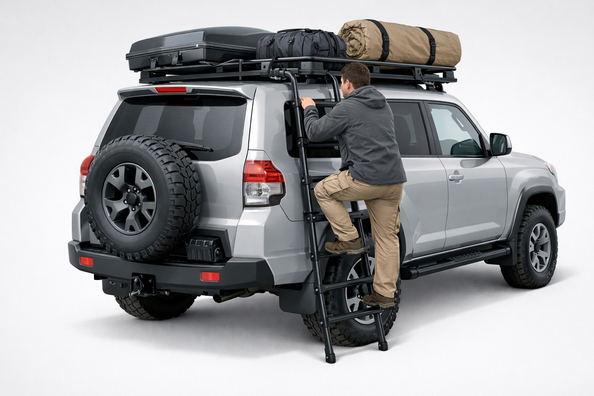
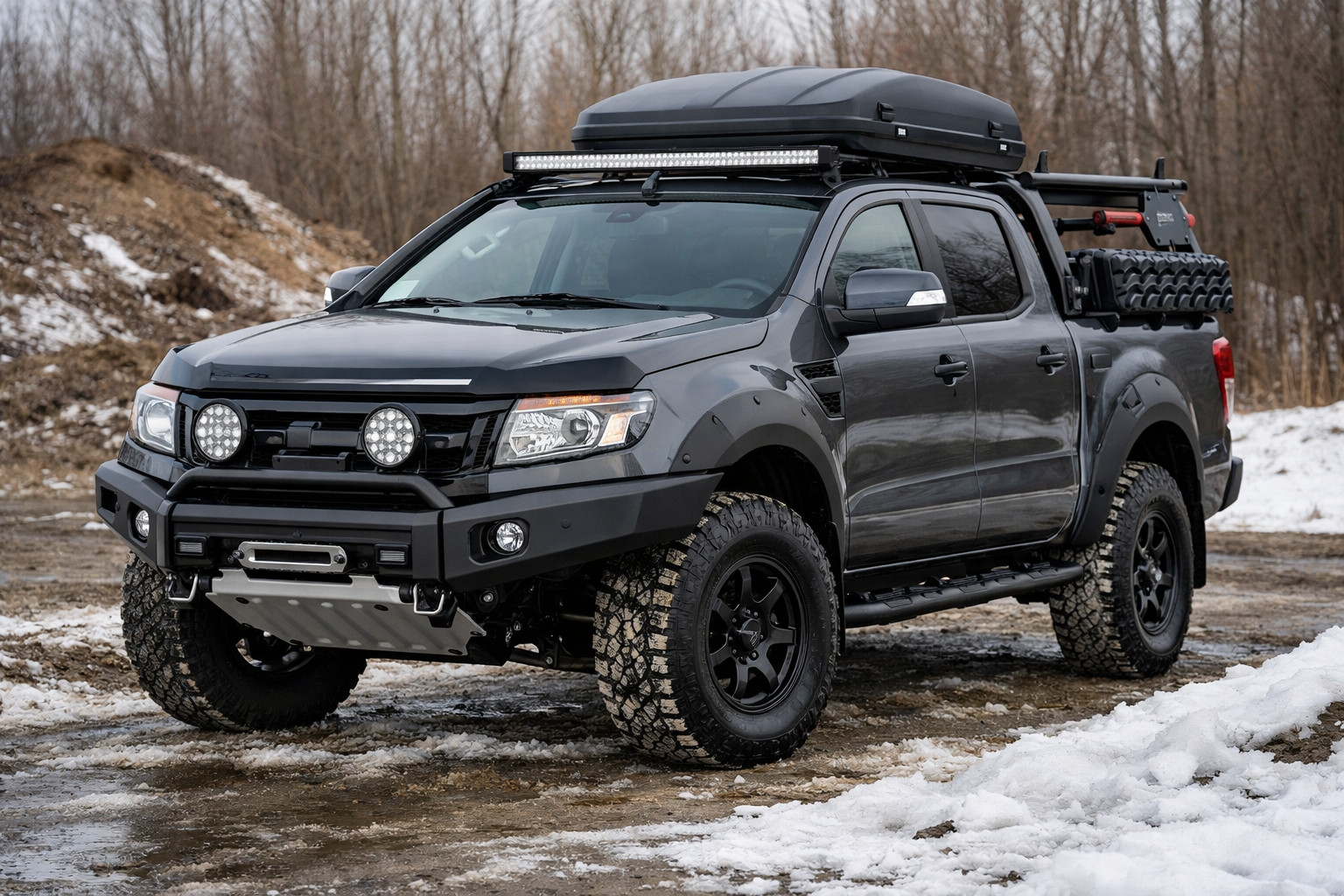
A ladder for an SUV is needed not when the vehicle just looks tall, but when roof access becomes a regular task or you can’t properly use your gear without it. If you wash the roof or adjust the load once a season, a fixed ladder is often unnecessary. But if there’s a roof box, basket, expedition gear, or a rooftop tent up there, it’s no longer about convenience—it’s about safe access.
The usual mistake is the same: people judge only the vehicle’s height and ignore how often they climb up, how they climb down, slippery weather, and the strength of the roof system. As a result, some waste money on a heavy accessory, while others scratch the bodywork, slip off the wheel, or load the door and hinges where it should never be done.
An SUV already has a high roof access point from the factory, and after a suspension lift, larger tires, rails, or a basket, the difference becomes even more noticeable. From the ground you can reach the edge, but not the middle of the roof, the box latches, or the far side of the cargo. That’s exactly when improvising with the bumper or wheel stops being a workable approach.
A separate story is a rooftop tent. For it, a ladder is part of the working system, not just help for climbing up. Also, in these setups you need to look not only at height but also at loads: static load on the system is usually much higher than dynamic—often about three times higher.
If during this check it turns out the roof itself isn’t the issue but the first step up is, sometimes the problem is solved not with a ladder but with a lower access point.
DD Tuning expert comment: the most common mistake is buying a ladder when the real problem is weak crossbars or a first step that’s too high. On lifted vehicles, proper lower access points often bring more benefit than a massive rear construction. If a rooftop tent is planned, first check rack compatibility and only then decide on the climbing solution.
| Symptom | Likely cause | What to do |
|---|---|---|
| You can’t reach the middle of the roof or the far latch of the roof box | The roof is too high; extra height added by the rack or tires | Consider a fixed ladder or a lower access point if climbing up is frequent |
| You scratch the body when climbing down or slip off the wheel | No stable support; the temporary access method is poor | Stop using the wheel as a permanent solution; switch to a ladder or another safe climb |
| The rooftop tent deploys awkwardly or the ladder sits at the wrong angle | Unsuccessful mounting height, incorrect crossbar spacing, or an incompatible system | Check the tent manual, height, angle, and rack parameters |
| Crossbars noticeably flex under load | A weak rack that doesn’t match the real equipment | Replace the roof system first instead of buying a ladder |
| The problem occurs only in winter or on trips | Access is needed rarely, but in difficult conditions | Consider a removable telescopic ladder or a compact step instead of a fixed one |
| You want to mount a ladder to doors or hinges as a DIY solution | Incorrect assessment of body joint strength | Use only engineered mounts for your specific vehicle or abandon that approach |
A fixed rear or side ladder works where the roof is used constantly: expedition cargo, a roof box, snow in winter, daily access to gear. Its main advantage isn’t that you climb up faster, but that you climb down more safely.
A removable telescopic ladder or folding step makes sense when access is needed only occasionally. They don’t weigh the vehicle down all the time and don’t create size/clearance issues, but they’re suitable only for level ground and a calm, unrushed routine.
A rigid roof rack system is mandatory if there will be a tent on the roof. In that case, a ladder doesn’t compensate for weak crossbars. First a durable base, then the right access.
A lower first step on a lifted vehicle can also change everything. If the main issue starts at the rocker/threshold level, reducing the first-step height genuinely makes access both into the cabin and onto the roof easier.
Constantly climbing via the wheel, spare, or bumper is only acceptable as a temporary compromise. For occasional access it can be tolerable, but with frequent use the risk of slipping increases, especially in mud, rain, or freezing weather.
DIY supports that hook onto doors, hinges, or a body edge without engineered mounting are a bad idea. Only solutions where the load is distributed through factory points and the joint is designed for it are safe.
Buying a ladder when the crossbars are already operating at their limit is also pointless. You’ll solve only the climbing issue, not the load-bearing capacity of the system. For a tent, that’s critical.
A cheap step instead of a ladder won’t save you on uneven parking or when you regularly need to open a heavy roof box. It’s convenient as a backup option, but not as the main tool for a tall SUV.
If roof access is needed weekly or a rooftop tent is installed, it makes sense to look specifically at SUV ladders. This is a case where the accessory solves a real functional task, not a decorative one.
When the issue isn’t the climb itself but a weak or poorly chosen roof base, first check roof racks and crossbars. For a tent or heavy gear, this matters more than any ladder.
On lifted vehicles or cars with a high sill, it often makes sense to start with side steps. They don’t replace a tent ladder, but they work well where what’s missing is simply a convenient first step.
| Solution | When it works | When it’s not worth spending money |
|---|---|---|
| Fixed rear or side ladder | Frequent roof access, tall body, roof box, basket, tent | If you climb onto the roof a few times a year |
| Removable telescopic ladder | Occasional trips, mobility needed, less extra weight | If you open the roof box daily or often park on uneven ground |
| Folding step or stool | Washing, one-time loading, modest vehicle height | For a rooftop tent, slippery weather, or heavy equipment |
| Replacing crossbars or the roof rack | When there’s a tent, heavy cargo, or the current system bends | If the only problem is lack of convenient access and the base itself is fine |
| Side steps as a lower access point | Lifted vehicle, high sill, frequent daily vehicle use | If you need to reach the center of the roof or use a tent |
From a customer’s experience: the owner of a lifted SUV with a roof box first managed with the rear wheel and bumper. In summer it still worked, but in winter the descent became dangerous, and reaching the far roof-box latch still required stretching across the roof. In the end, a fixed ladder justified itself not by faster climbing, but by stable access in daily use.
An SUV ladder is truly needed in three cases: the roof is high, access is needed regularly, or a rooftop tent is installed. If you use the roof only occasionally, it’s often more cost-effective to go with a simpler, lighter solution than to constantly carry extra structure on the vehicle.
The key is not to confuse an access problem with a weak roof rack or a first step that’s too high. This material is based on real selection experience, practical work, and real usage scenarios—where what matters isn’t the accessory’s looks, but safe climbing, controlled descent, and compatibility of the entire roof system.
| ✔ | A fixed ladder is truly useful when access to the roof is needed often: for a box, basket, expedition gear, or a roof tent. In such scenarios, it offers not just convenience, but a safer climb and especially descent. |
| ✔ | The article clearly separates cases where a ladder is unnecessary from situations where, without one, work is already unsafe or inconvenient. This helps avoid buying a heavy accessory without a real need. |
| ✔ | There is a practical emphasis that the problem is often not the roof itself, but a weak rack, an unsuitable first-step height, or an unstable support point. This suggests where to start checking before buying a ladder. |
| ✔ | For a roof tent, specific compatibility parameters of the system are given, including the crossbar spacing, ladder angle, and permissible load. This makes it possible to assess not only the ladder itself, but the entire structure as a whole. |
| ✔ | It is also shown separately that for occasional access, a removable telescopic ladder or a folding step is better suited. This allows you to choose a lighter solution if the roof is used infrequently. |
| ✘ | If you only need to get onto the roof a few times a year, a fixed ladder may be an unnecessary expense. In such cases, it is easier to manage with a removable or temporary solution. |
| ✘ | A fixed structure does not solve the problem of weak crossbars or an unsuitable base on the roof. If the rack or mounting system cannot handle the load, the ladder itself will not fix the situation. |
| ✘ | For infrequent use, a ladder is not always the most convenient due to the extra weight and size on the car. The author directly points out that this can be an unnecessary burden when access is needed only occasionally. |
| ✘ | In difficult conditions — slippery weather, winter, uneven parking — even a suitable step or an improvised way of access can be dangerous. In other words, safety depends heavily not only on the accessory, but also on the place and conditions of use. |
Shipping to EU
Wholesale and retail
Own warehouse
Опис продукту
Подарунки не надаються при оформленні покупки у кредит під 0,01% або при покупці частинами.