 Author: Radomskyi Maksym Vasyliovych
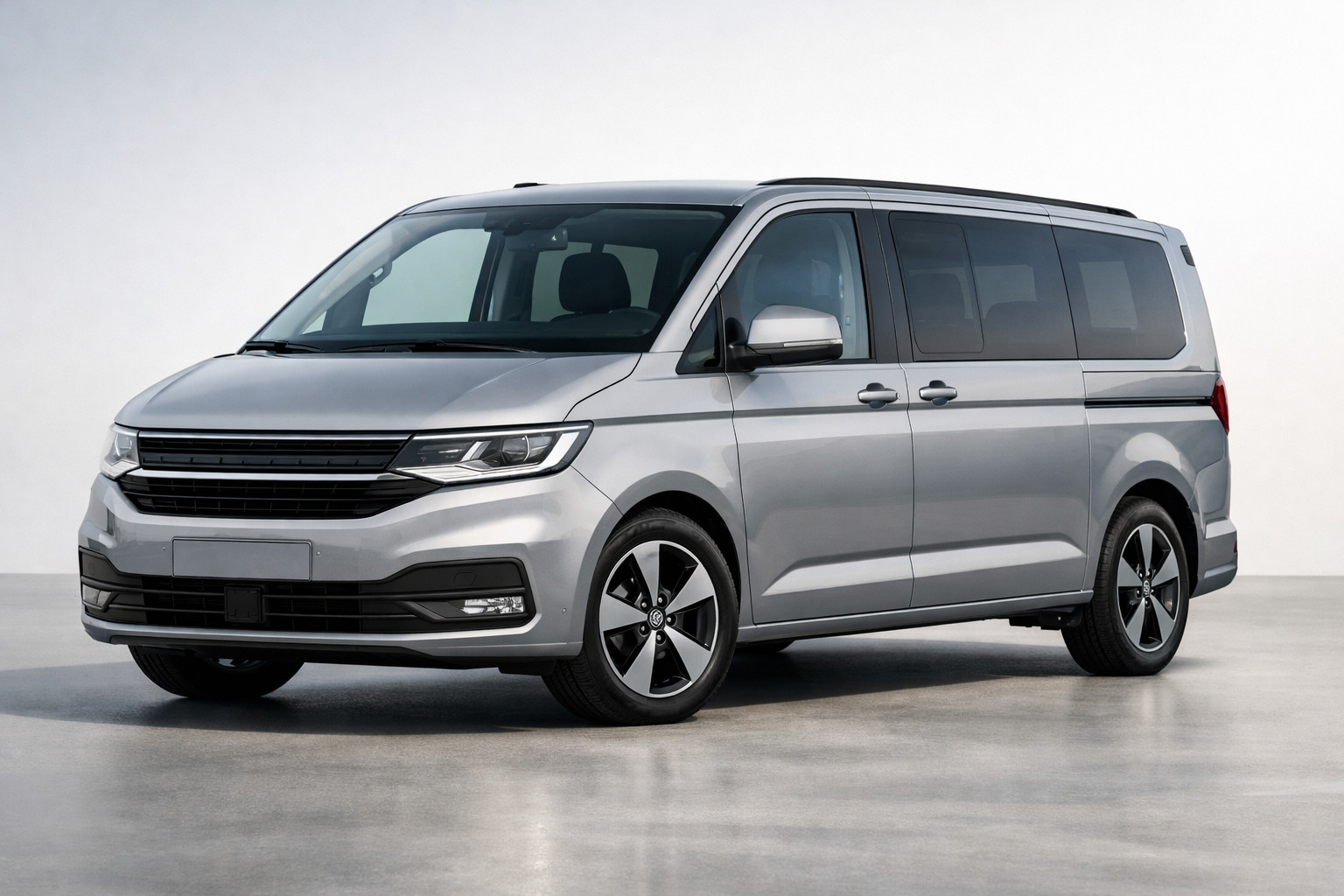
The Volkswagen Transporter T7 in the 2025 version matters not because of a new index, but because the model’s logic itself has changed. This is no longer a refined T6.1, but a new commercial van with a broader range of body styles, more modern electronics, and a different technical base. For business, the key here isn’t design, but three practical things: how much it carries, how it drives under load, and how convenient it is day to day.
It’s important not to confuse it with the Multivan T7. The Multivan moved toward a family and shuttle minivan, while the Transporter T7 remains a working platform for panel van, Kombi, and passenger versions. That’s why it should be judged as a transport tool, not as a passenger car with a big cabin.
The model and its place in the market
The Transporter T7 enters the mid-size commercial van segment, where buyers typically compare not the badge on the hood, but usable volume, pulling power, durability, and running costs. Its direct competitors are other mid-size vans and passenger shuttles for urban deliveries, service teams, transfers, and small business.
The model’s strength is its wide range of use cases. The same T7 can be seen as a city van, a corporate shuttle, or a mixed-use vehicle where weekdays are for tools and weekends are for people and gear.
Generations and model history
The Transporter line runs from the T1 of 1950 through the T2, T3, T4, T5, T6 and T6.1 to the T7, which debuted as a fully new generation for the commercial branch. For the buyer this matters for one reason: the T7 is not just a facelift of its predecessor, but a new architecture, a different set of body types, and new electronics.
A separate detail that’s often missed: under the T7 name there are now fundamentally different products. The passenger Multivan and the work-focused Transporter have diverged in different technical directions, so the ownership experience differs as well.
Engines and transmissions
The core of the 2025 range is 2.0-liter TDI diesels with 110, 150, and 170 hp. These will be the most interesting for those who track consumption, mileage, and pulling power under load. The base versions are better suited for city use and light runs, the 150 hp looks like the most sensible compromise, and the 170 hp makes sense for highway work, towing, and a consistently full load.
Also, for certain markets and versions, a 2.5-liter petrol plug-in hybrid with 232 hp and EV versions are announced. As for gearboxes and drivetrains, everything depends on the powertrain: the lower-output diesels traditionally lean toward a manual, the higher versions toward an automatic, and all-wheel drive isn’t available for every combination.
Body, dimensions, and chassis
The T7 became more practical exactly where it shows up in real work: a longer cargo compartment, more usable width, a choice of wheelbases and body styles for different tasks. For a van, this matters more than pretty numbers in a brochure, because this is where you find out whether a pallet fits, whether a rack will go in, or whether you’ll need a longer wheelbase.
| Parameter | Reference for Volkswagen Transporter T7 |
|---|---|
| Generation production years | from 2024, model year 2025 |
| Diesel engines | 2.0 TDI: 110, 150, 170 hp |
| Hybrid | 2.5 L, 232 hp, availability depends on market and body style |
| EV versions | announced, power outputs depend on country and version |
| Gearboxes | manual or automatic depending on engine |
| Drivetrain | front-wheel drive, for some versions all-wheel drive is possible |
| Wheelbase | around 3100 or 3500 mm |
| Body length | around 5050 or 5450 mm |
| Width | around 2032 mm without mirrors |
| Height | depends on version and roof; in standard versions roughly up to 2 m |
| Ground clearance | varies by version, tires, and load; it’s best to confirm it for a specific vehicle |
| Trunk or cargo compartment volume | for the panel van, a reference is about 5.8–9.0 m³; in passenger versions it depends on the number of rows and seat configuration |
In terms of chassis setup, the T7 is geared not for off-road, but for stable work in the city, on the highway, and on warehouse access roads. If you need a van for ruts and construction sites, you should look not only at the drivetrain, but also at tires, underbody protection, and the real sill height.
Interior, comfort, and safety
Inside, the T7 feels noticeably more modern than older generations. The front area is more digital, more convenient in the details, and closer to passenger-car control logic. But in a working van, what matters isn’t screens, but seating position, the number of storage spaces, ease of cleaning, proper seat geometry, and access to the second row or the cargo area.
Safety is better than before too: more assistants, cameras, sensors, and electronic helpers. At the same time, the set of systems depends heavily on the trim level, so when choosing a used or stock vehicle you need to look not at the model name, but at the specific equipment.
Everyday use
In daily work, the T7 is strong where a van spends most of its life: pulling through traffic, maneuvering in courtyards, being loaded several times a day, and doing long shifts on the highway. If the vehicle often runs empty, the new generation feels more civilized than its predecessors. If it constantly carries weight, what matters more than multimedia is the right engine and wheelbase.
For passenger and mixed versions, the key question is how much luggage space remains with the seat rows installed. For a panel van, the load opening height, floor length, and rear bumper edge protection matter more, because they affect daily working speed and body condition.
Strengths and weaknesses
| Strengths | Weaknesses |
|---|---|
| Wide choice of body styles and usage scenarios | It’s easy to choose the wrong configuration if you don’t define the task in advance |
| 2.0-liter diesels cover most working needs | 110 hp may be too little for constant full load |
| More modern interior and better ergonomics | More electronics, which means more dependence on trim level and service |
| Practical dimensions for city and highway with the right wheelbase | The long wheelbase in the city already requires habit and extra care when parking |
| Suitable for both business and a mixed family-work routine | Not the option you pick at random as “just a cheap van” |
Who it suits: those who clearly understand their route, cargo weight, and operating mode. Who it won’t suit: those looking for the simplest vehicle with no electronics, or who choose a short, low-output version for a job that really needs a long wheelbase and a reserve of pulling power.
Tuning and accessories
For the T7, the most sensible upgrades aren’t decorative items, but protection and everyday practicality. In this model, solutions that preserve the interior, protect the body edge, and make daily loading easier pay back quickly.
What to check out for this model
- Model overview — if you want to double-check which wheelbase and body type you need for your exact scenario.
- Rubber floor mats — useful for a van that carries people, tools, or dirty cargo every day.
- Rear bumper protector — protects the body edge when boxes, cases, or equipment constantly pass through the rear opening.
If the vehicle handles long items or often goes on business trips, it also makes sense to look at roof cargo solutions. But it’s best to start with the accessories that reduce daily wear and tear and simplify cleaning.
Conclusion
The Volkswagen Transporter T7 in 2025 is no longer just a familiar van with a new face, but a different kind of tool for work and travel. It’s best suited to businesses and private owners who choose a vehicle for a specific scenario: city, highway, passengers, tools, mixed use, or towing. This material is based on real selection experience, practice, and real-world use cases, so the main advice is simple: first define the body and the load, and only then the engine, gearbox, drivetrain, and the set of accessories.
Pros and cons
A wide choice of body styles and wheelbases makes it possible to tailor the Transporter T7 to different tasks — from city deliveries to passenger transport. For business, this is practical, because you don’t have to pay extra for space you don’t need.
The 2.0-liter diesel lineup covers most working scenarios: 110 hp for lighter runs, 150 hp as a compromise, and 170 hp for highway driving, towing, and full loads. This makes it possible to choose an engine for the actual load, not by guesswork.
The cabin has become more modern and more ergonomic than in older generations. This is noticeable in daily work, when the van is often used not only for transport, but also as the driver’s workplace.
The improved set of assistants, cameras, and sensors increases safety in the city and during maneuvering. For a commercial vehicle, this is important because it often drives in tight yards, warehouses, and dense traffic.
The T7 is well suited to mixed use, when the vehicle works both as a van and as a passenger bus. This makes the model convenient for small business, service teams, and corporate trips.
It is easy to make a mistake with the configuration if you do not determine your needs in advance. With such a wide choice of body styles, bases, and powertrains, the wrong selection can lead either to extra costs or to a lack of practicality.
The base 110 hp diesel may be too weak for constant operation with a full load. In this mode, the vehicle already calls for a more careful engine choice, especially if there are highway runs or a trailer.
More electronics means a higher dependence on the specific trim and service. If the vehicle is used or bought from stock, you need to check the equipment very carefully, not just the model name.
The long wheelbase in the city takes some getting used to and requires attention when parking. For daily trips in tight courtyards or on busy streets, this can be inconvenient.